

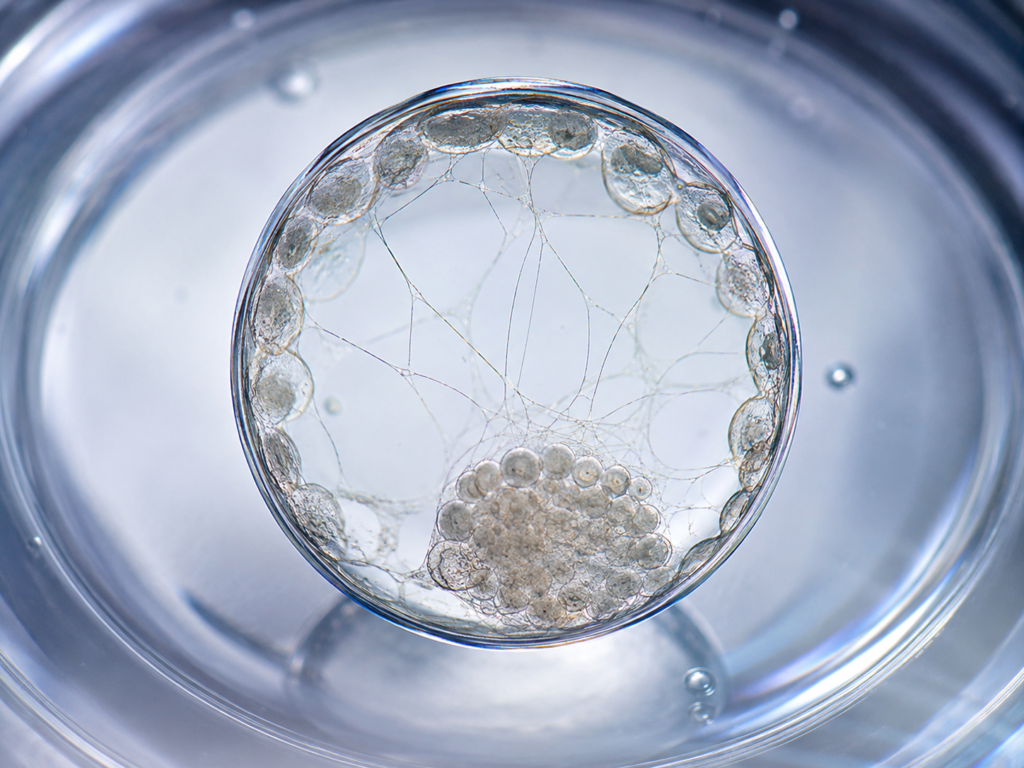
- Presence of Cytoplasmic Strings Correlates with 51.8% Live Birth Rate vs. 36.3% in Absent Cohorts: Meta-analysis of 6 non-randomized studies encompassing 2,766 embryo transfers yields an Odds Ratio (OR) of 1.88
- Clinical Pregnancy Odds Doubled (OR 2.20, 61.6% vs. 42.1%): Significant correlation with top-tier Gardner morphological grading (OR 2.40) and faster morphokinetic development
- Certainty of Evidence Remains “Very Low”: Statistical significance attenuated after controlling for maternal age, baseline morphology, and chromosomal ploidy; serves as a prospective morphokinetic biomarker rather than an independent diagnostic metric
Prioritizing which embryo to transfer remains a central challenge in assisted reproductive technology (ART). Morphological grading systems (such as the Gardner scale) assess outward architecture, yet embryos with identical visual grades often exhibit divergent implantation and live birth outcomes.
A systematic review and meta-analysis published in Human Reproduction Update (August 26, 2026) suggests that a transient, thread-like intra-embryonic structure—termed cytoplasmic strings—may provide novel insight into blastocyst developmental competence.
What Are Cytoplasmic Strings?
As a human embryo develops into a Day 5–6 blastocyst, it segregates into two distinct cell lineages: the Inner Cell Mass (ICM), which gives rise to the fetus, and the outer Trophectoderm (TE), which forms the placenta, surrounding a fluid-filled cavity known as the blastocoel.
Cytoplasmic strings are ultra-fine, bridge-like cellular projections traversing the blastocoel cavity to physically connect the ICM and the TE.
Historically, these structures were occasionally dismissed as incidental artifacts, debris, or morphological irregularities arising during blastocoelic cavitation. However, with the widespread implementation of high-resolution time-lapse incubation systems (TLI), embryologists observed that cytoplasmic strings are dynamic, transient structures that appear and resolve at specific developmental windows, occurring more frequently in robust, rapidly developing embryos.
The meta-analysis evaluated data from published human embryo studies encompassing 7,583 blastocysts (4,417 with confirmed cytoplasmic strings and 3,166 without).
Meta-Analysis Findings: Live Birth and Implantation Potential
When pooling reproductive outcomes across clinical studies:
- Live Birth Rate (6 studies, $n = 2,766$ transfers):
- With Cytoplasmic Strings: Projected live birth rate of 51.8%
- Without Cytoplasmic Strings: Projected live birth rate of 36.3%
- Odds Ratio (OR): 1.88 (95% CI: 1.35–2.61, $P < 0.05$)
- Clinical Pregnancy Rate (5 studies, $n = 1,963$ transfers):
- With Cytoplasmic Strings: 61.6% vs. 42.1% without strings
- Odds Ratio (OR): 2.20 (95% CI: 1.29–3.75)
- Morphological Correlation: Blastocysts displaying cytoplasmic strings had 2.40-fold higher odds of receiving a top-tier Gardner morphological score (OR 2.40, 95% CI: 1.63–3.53).
- String Dynamics & Quantity: Embryos displaying $\ge 5$ distinct strings exhibited superior morphological quality compared to those with 1–4 strings. Furthermore, early appearance followed by timely resolution correlated with faster cleavage kinetics and accelerated blastulation.
Biological Hypotheses: Intercellular Communication and Structural Anchoring
While the precise physiological role of cytoplasmic strings remains under active investigation, researchers have proposed two primary biological functions:
- Active Intercellular Signaling Conduits (Cytonemes): Animal and embryological models demonstrate that specialized filopodia-like structures can facilitate paracrine signaling and vesicular transport across fluid cavities. In human blastocysts, micro-vesicular protrusions have been observed migrating along cytoplasmic strings from the trophectoderm toward the inner cell mass, suggesting an active pathway for biochemical cross-talk during lineage specification.
- Mechanical Positioning and Cavitation Stabilization: As the blastocoel expands under hydrostatic pressure, cytoplasmic strings may provide structural tension, guiding the ICM to its physiological niche within the embryonic pole and coordinating expansion dynamics between the ICM and TE.
Methodological Confounders and Evidence Grading
Despite promising raw odds ratios, the authors emphasized significant methodological boundaries:
- “Very Low” GRADE Certainty: All six live birth studies were observational, non-randomized cohorts subject to heterogeneity in patient selection and laboratory culture environments.
- Loss of Significance in Multivariable Models: When pooling studies that strictly adjusted for critical confounders—such as maternal age, baseline morphological grade, day of transfer, and insemination method (IVF vs. ICSI)—the association between cytoplasmic strings and clinical pregnancy was no longer statistically significant (adjusted OR 0.71).
- Chromosomal Ploidy Interactions: In subsets restricted to PGT-A confirmed euploid blastocysts, the presence of strings did not reliably differentiate live birth rates.
Consequently, it remains unresolved whether cytoplasmic strings directly enhance embryo competence, or if they simply represent an epiphenomenon—a structural byproduct of inherently vigorous, high-quality blastocysts that divide and cavitate efficiently.
Clinical Translation: Integrating Dynamic Markers with AI
Static Gardner grading captures only a single snapshot in time. In contrast, cytoplasmic strings are transient, sub-micron structures that emerge, stretch, and detach within hours, making manual visual logging across hundreds of time-lapse focal planes labor-intensive and prone to inter-observer variability.
The practical value of this finding lies in automated computer vision and deep learning models.
By training artificial intelligence algorithms to detect the emergence, count, and persistence kinetics of intra-blastocoelic strings alongside standard morphokinetic milestones ($t_5$, $t_8$, $t_\text{SB}$, $t_\text{B}$), clinics may further refine non-invasive embryo prioritization algorithms for patients who do not undergo PGT-A.
Cytoplasmic strings provide a compelling biological window into the active, mechanical micro-architecture of the human blastocyst, illustrating how embryo selection is moving from surface morphology toward dynamic cellular behavior.
Medical Source & Study Information
- Journal: Human Reproduction Update (Official Journal of the European Society of Human Reproduction and Embryology, ESHRE), Published August 26, 2026.
- Study Title: Cytoplasmic strings in human in-vitro embryos are a promising indicator for enhanced live-birth outcomes: a systematic review and meta-analysis
- Authors: Victoria F. Dodhia, Ka Ying Bonnie Ng, Tom P. Fleming, Ying Cheong
- Institutions: University of Southampton and Southampton University NHS Foundation Trust, UK
- DOI: 10.1093/humupd/dmag026
※ This article was synthesized based on the systematic review and meta-analysis published in Human Reproduction Update (August 2026) alongside literature in embryological morphokinetics and time-lapse microscopy. It does not replace individualized clinical diagnosis or medical care, and specific treatment decisions should always be made in consultation with a qualified clinical embryologist or reproductive specialist.
※ The images associated with this article were generated using generative AI (ChatGPT, OpenAI) as illustrative visual references and do not depict real individuals.