
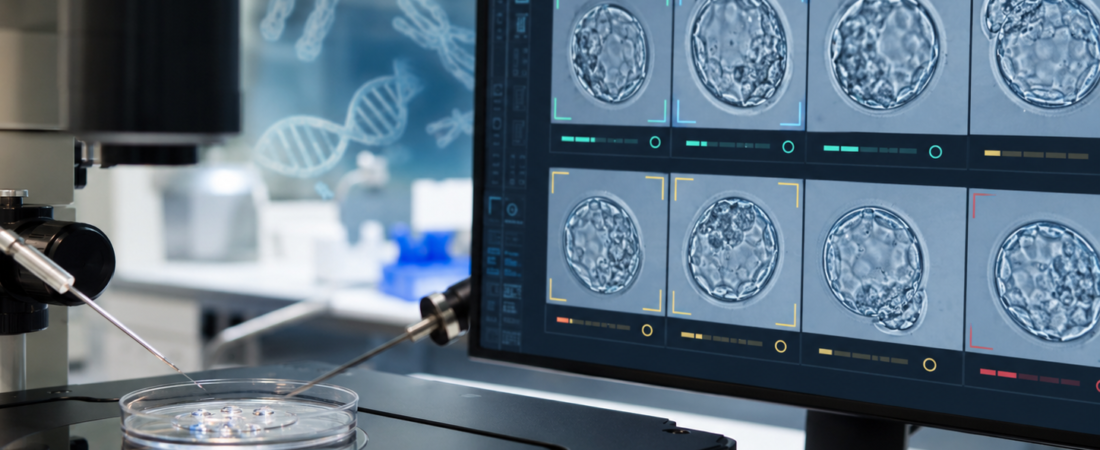
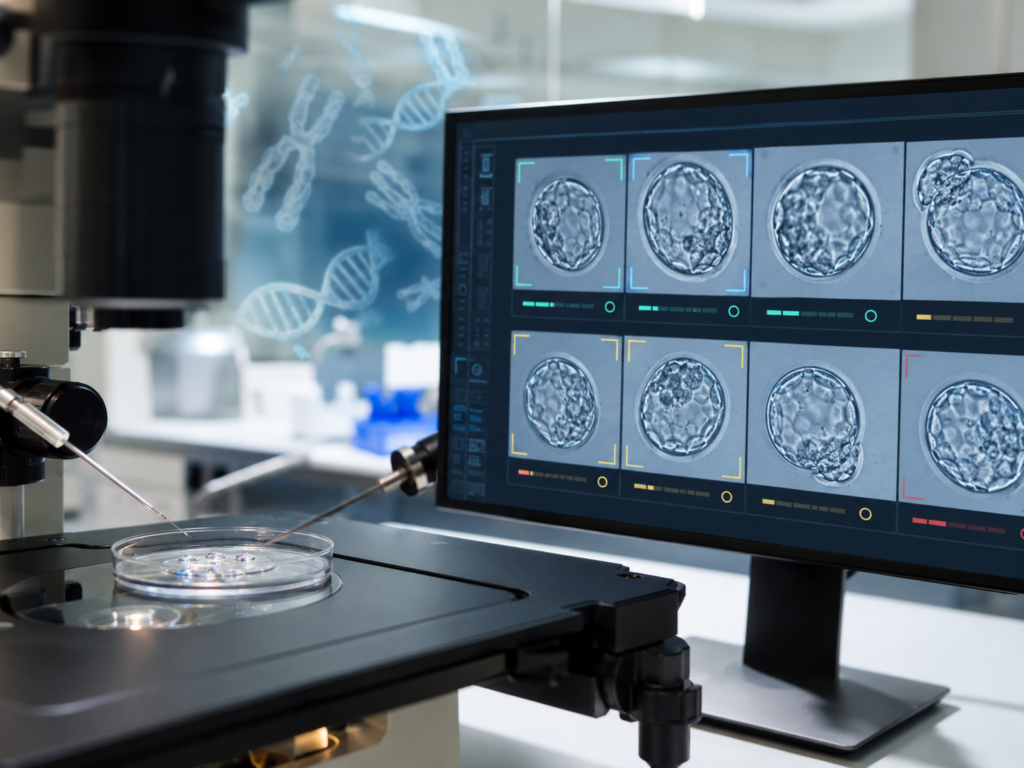
- Latest AI Model Prioritizes Euploid Embryos as First Choice in 68% of Cases… Outperforming traditional Gardner morphological grading at 58%
- Analysis of 786 PGT-A Cycles: Still images and developmental morphokinetics alone cannot definitively diagnose chromosomal euploidy vs. aneuploidy
- Embryo Prioritization Tool Confirmed, But Firm Boundary Drawn Against Replacing PGT-A
Artificial intelligence (AI) has demonstrated a slight advantage over traditional embryologist visual grading when ranking embryos for transfer in In Vitro Fertilization (IVF). However, no matter how sophisticated image and morphokinetic analyses become, AI has not reached the threshold of determining whether an embryo possesses normal chromosomes.
A study published online on August 3, 2026, in the international journal Fertility and Sterility demonstrated both the clinical potential and the biological limits of AI-based embryo selection.
Analyzing 786 IVF cycles that underwent Preimplantation Genetic Testing for Aneuploidy (PGT-A), researchers found that the latest AI algorithm selected a chromosomally normal (euploid) blastocyst as its top transfer priority in 68% of cohorts—higher than conventional morphological assessment. Conversely, this also means that even when a euploid embryo was present in the cohort, the AI failed to prioritize it as the first choice roughly one out of every three times.
Ranking Performance: AI (68%) vs. Human Grading (58%)
Researchers investigated 786 PGT-A cycles cultured in time-lapse incubators between 2013 and 2020.
To evaluate ranking accuracy, the core analysis focused on 279 cycles that produced three or more blastocysts and contained a mixture of both euploid and aneuploid embryos. Rather than testing whether the AI could provide a binary “yes/no” ploidy diagnosis on isolated embryos, the trial tested each method’s ability to rank-order sibling embryos from the same patient to identify the optimal embryo for initial transfer.
The comparative performance across evaluation methods was:
- Latest Version AI Model: 68% first-choice euploid selection rate
- Combined Morphology + Morphokinetics: 64%
- Earlier AI Version: 62%
- Traditional Gardner Morphological Grading (Human): 58%
- Random Embryo Selection: 44%
Trained on large datasets of embryo images and time-series developmental kinetics, the modern AI algorithm increased the likelihood of placing a euploid embryo at the top of the transfer queue compared to manual human observation.
However, the authors underscored that the 68% figure must be interpreted within its biological context.
Prioritization vs. Genetic Diagnosis
A common misconception regarding AI in reproductive medicine is that algorithms can determine whole-chromosome ploidy directly from photographic or time-lapse video data. These findings directly refute that assumption.
Even though the AI model ranked first overall, it still frequently selected an aneuploid embryo ahead of a euploid sibling. The research team concluded that no embryo ranking system based purely on morphology or developmental kinetics could completely prevent an aneuploid embryo from being prioritized over a euploid one.
Prioritizing an embryo based on visual markers is fundamentally distinct from diagnosing chromosomal status:
- PGT-A: An invasive diagnostic procedure where a small biopsy of trophectoderm cells is taken directly from the blastocyst to count chromosomes.
- AI Evaluation: A non-invasive screening tool that evaluates outward morphology and division kinetics.
A high AI viability score does not make an embryo a “PGT-A normal” embryo.
Morphological Quality Does Not Guarantee Chromosomal Normalcy
Embryology laboratories have historically relied on the principle that symmetrical, well-developed embryos hold superior developmental potential. While morphology and cleavage speed correlate with general embryo viability, chromosomal aneuploidy does not consistently reflect in outward appearance:
- High-grade, fully expanded blastocysts can be severely aneuploid.
- Lower-grade or slower-developing blastocysts can be fully euploid.
Even the most advanced AI models cannot bridge this biological gap. The study’s title affirmed this reality: AI-based embryo ranking can match or improve traditional assessments but cannot predict an aneuploid chromosomal constitution.
Clinical Role: An Adjunct Prioritizer Rather Than a Diagnostic Replacement
These findings do not render AI tools obsolete. Rather, they define AI’s appropriate clinical role as an objective adjunct that supports embryologist workflow and standardizes grading consistency:
- Non-PGT-A Cycles: When patients choose not to undergo genetic biopsy and have multiple blastocysts available, AI can provide a standardized, objective baseline to assist in choosing the order of transfer.
- Laboratory Standardization: AI helps reduce inter- and intra-observer variability across clinical embryologists.
The American Society for Reproductive Medicine (ASRM), in its 2026 Committee Opinion on AI in the IVF laboratory, acknowledged AI’s promise in embryo selection while noting that current literature remains predominantly retrospective, requiring cautious clinical translation.
Study Limitations
- Study Design: This was a retrospective, single-center cohort study.
- Cohort Focus: The core comparative dataset was restricted to 279 cycles that met the specific criteria of having ≥3 blastocysts and mixed ploidy status.
- Endpoints: The trial measured rank-ordering accuracy (which embryo was chosen first), rather than demonstrating improved cumulative live birth rates in prospective, randomized clinical trials.
Conclusion
Current AI algorithms can rank-order embryos with greater statistical consistency than manual grading, but they cannot verify whether the top-ranked embryo has 46 intact chromosomes.
AI’s visual assessment of embryos has surpassed the human eye in pattern recognition, but resolving the underlying chromosomal architecture within the cell remains beyond the scope of image analysis alone.
Medical Source & Study Information
- Authors: Danilo Cimadomo et al.
- Study Title: AI-based embryo ranking can match or improve traditional assessments but cannot predict an aneuploid chromosomal constitution
- Journal: Fertility and Sterility (Official Journal of the American Society for Reproductive Medicine, ASRM), Published online August 3, 2026.
- DOI: 10.1016/j.fertnstert.2026.07.025
※ This article was synthesized based on the study by Danilo Cimadomo et al. published in Fertility and Sterility (August 3, 2026) and clinical guidance from the American Society for Reproductive Medicine (ASRM). It does not replace individualized medical advice, clinical diagnosis, or treatment, and specific medical decisions should always be made in consultation with a qualified reproductive specialist.
※ The images associated with this article were generated using generative AI (ChatGPT, OpenAI) as illustrative visual references and do not depict real individuals.