

CFAP58 male infertility can involve severe sperm tail abnormalities and very poor motility. A study of three unrelated men found that, despite disruption of the tail’s internal structure, intracytoplasmic sperm injection (ICSI) achieved fertilization and pregnancy. The findings suggest that an inability to swim is not necessarily the same as losing the ability to fertilize an egg.

Researchers identified CFAP58 defects in three men, examined damage to the tail’s 9+2 axoneme, and assessed fertilization using ICSI. The small study does not establish a treatment success rate for all affected men.
Sperm that cannot move effectively have difficulty reaching an egg. But does a sperm cell with a severely damaged tail and very little movement necessarily also lack fertilization capacity?
A new study suggests that fertilization and pregnancy may remain possible with ICSI when a genetic defect affecting sperm tail formation causes severe motility problems.
Researchers from the First Affiliated Hospital of Anhui Medical University and other centers in China reported their findings in the Journal of Assisted Reproduction and Genetics on September 26, 2026. The study involved three unrelated men with infertility.
Short, bent or coiled sperm tails: what is MMAF?
The condition investigated was multiple morphological abnormalities of the flagella, or MMAF.
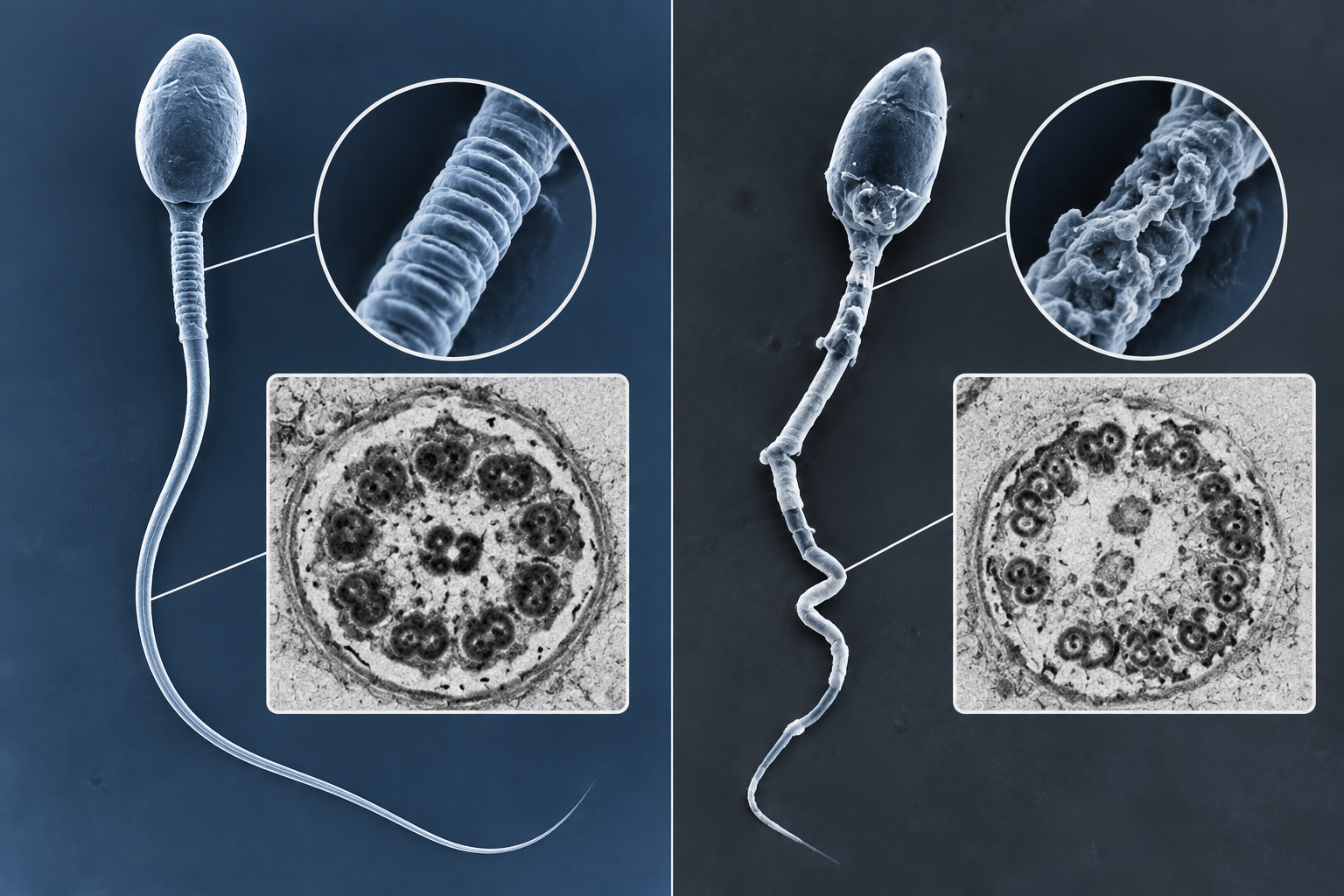
In simple terms, this is a rare form of male infertility in which sperm tails do not form normally. A normal sperm cell uses its long, regularly organized tail to propel itself forward. In MMAF, several abnormalities can occur together: tails may be unusually short, absent, bent or coiled.
Because the tail is not properly formed, the presence of sperm does not ensure that those sperm can move forward effectively.
Whole-exome sequencing identified three previously unreported loss-of-function variants in CFAP58. This gene is involved in assembling the sperm tail and maintaining the structure needed for movement.
Microscopy revealed disruption inside the sperm tail
The researchers looked beyond the external appearance of the sperm.
They used computer-assisted sperm analysis, protein analysis and immunofluorescence, together with transmission electron microscopy to examine internal tail structure.
A normal sperm tail contains a precisely organized framework known as the 9+2 axoneme. Two central microtubules are surrounded by nine pairs of microtubules. Forces generated within this microscopic framework allow the tail to move in a coordinated way.
In CFAP58-deficient sperm, this architecture was disrupted. The central pair was missing in some cross-sections, and accessory structures were disorganized. Sperm motility was severely impaired.
The researchers proposed that CFAP58 contributes to the structural connection between radial spokes and doublet microtubules within the tail. Its absence may damage that interface and destabilize the axoneme.
A useful comparison is a miniature motor made from many finely assembled parts. Without CFAP58, the connections between those parts can be compromised, undermining the stability of the whole tail.
Fertilization and pregnancy were achieved with ICSI
The next finding was particularly interesting.
Although the sperm had serious structural problems that prevented effective swimming toward an egg, ICSI achieved fertilization. The researchers reported successful pregnancy as well as fertilization using CFAP58-deficient sperm.
In ICSI, an embryologist selects a single sperm under the microscope and uses a very fine glass needle to inject it directly into the egg’s cytoplasm.
In natural fertilization, a sperm must reach the egg and pass through the structures surrounding it. ICSI bypasses much of that journey.
Thus, even when the tail cannot move properly, a possibility of fertilization may remain if the sperm’s genetic material and the functions required within the egg are sufficiently preserved.
Immotility does not always mean an inability to fertilize
This distinction is the central point of the study.
Motility is an important measure of male reproductive potential. However, an inability to move and an inability to contribute to fertilization and embryo development after entering an egg are not identical problems.
When a structural tail defect is the principal reason for impaired movement, as in MMAF, ICSI may provide a way to bypass that barrier.
Variants in several sperm-tail genes other than CFAP58 have also been linked to MMAF. Reports of pregnancy and live birth after ICSI have accumulated for some affected patients. Those broader reports should not be confused with outcomes specifically established in this three-man CFAP58 study.
What a three-man study can and cannot establish
The findings do not mean that every person with MMAF will achieve pregnancy through ICSI. This was a rare-disease study involving only three unrelated men.
The particular CFAP58 variant, the condition of the sperm, the female partner’s age and egg characteristics, and other factors may all affect treatment outcomes. The report of fertilization and pregnancy does not by itself establish a live-birth rate or long-term outcomes for children.
Nevertheless, the study illustrates why an evaluation of severe sperm immotility should go beyond the observation that the sperm are not moving. Identifying the genetic and structural cause can clarify the biological problem.
If the main obstacle is a defect in the tail itself, natural fertilization may be severely impaired while ICSI still offers a possibility of bypassing part of that obstacle.
Study source and methods
This article is based on CFAP58-deficient human sperm show radial spoke-doublet microtubule interface abnormalities and successful fertilization by ICSI, published online on September 26, 2026, in the Journal of Assisted Reproduction and Genetics. The authors were affiliated with the First Affiliated Hospital of Anhui Medical University, Hefei Maternal and Child Health Hospital and related institutions.
The investigation combined whole-exome sequencing in three unrelated men with sperm motility assessment, western blotting, immunofluorescence, transmission electron microscopy and assessment of fertilization through ICSI. It was not a randomized comparison of treatments.
DOI: 10.1007/s10815-026-04036-4; PMID: 42799967.
Related reading
- Testicular Sperm for MMAF: Higher ICSI Fertilization, Uncertain Pregnancy Benefit
- Globozoospermia After Failed ICSI: What Assisted Oocyte Activation Found
Images were created with generative AI (ChatGPT, OpenAI) for educational illustration and are not clinical photographs of the study participants.
Copyright © 2026 Fertility Information TokTok | THE FERTILITY NOTES. All rights reserved. Unauthorized republication, reproduction, redistribution, scraping, AI training, or other data use of any content, including articles, photographs and images, is strictly prohibited. Violations may result in legal liability.