
A Single Drop of Blood Begins to Alter the History of Reproduction US Research Team First to Recreate Pre-Sperm Human Cells from Blood… A Giant Leap Toward ‘Azoospermia Treatment’
“Will a day ever come when a man with zero sperm can still have a child of his own?”
Science has begun offering a realistic answer to this question, which reproductive medicine has long struggled to solve. Until now, the only viable options for azoospermic men to have biological children were undergoing surgery to extract microscopic traces of sperm from the testicles or opting for donor sperm. However, the paradigm is poised to shift: the era of generating sperm from blood rather than testicles is rapidly approaching.
A research team led by Professor Kotaro Sasaki at the Perelman School of Medicine at the University of Pennsylvania successfully replicated the process of human sperm formation in the laboratory using adult blood cells.
The findings were published in the premier stem cell international journal Cell Stem Cell. This study transcends a mere milestone in stem cell technology; it has brought the prospect of men with no sperm being able to have children carrying their own genetics into the realm of reality for the very first time, earning acclaim as a research breakthrough that rewrites the paradigm of reproductive medicine.
From Blood Cells to Induced Pluripotent Stem Cells (iPSCs)
The starting point of this research was surprisingly ordinary.
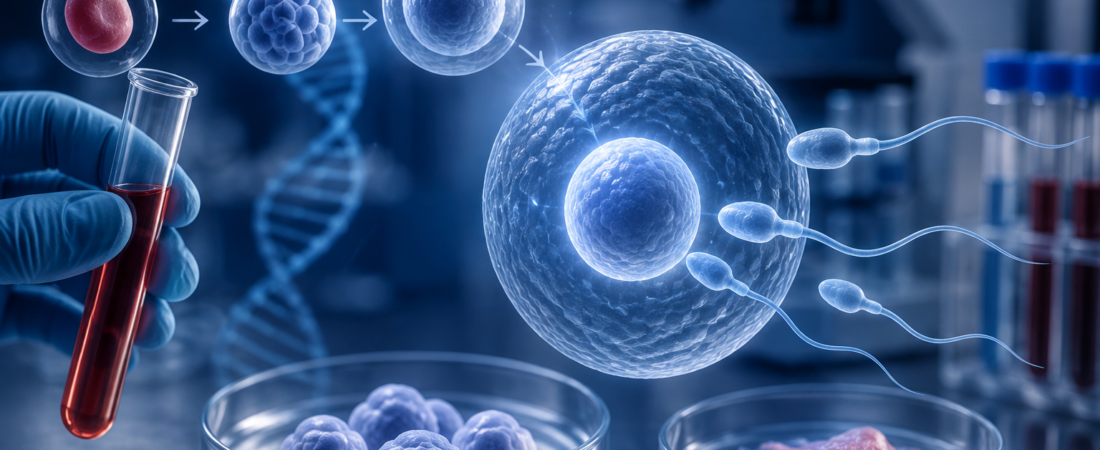
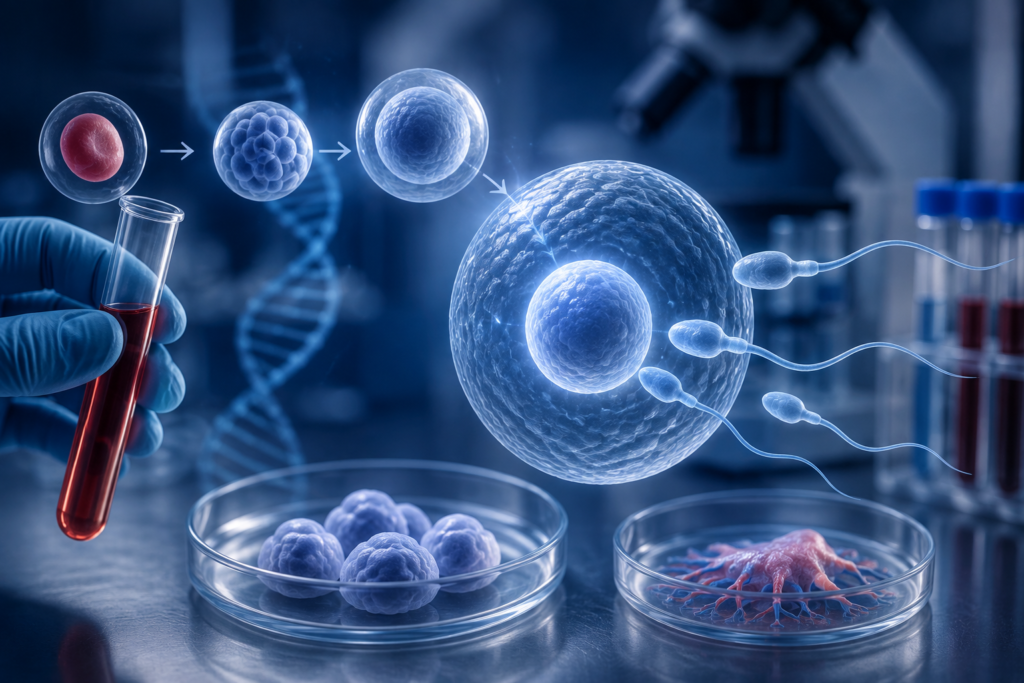
The researchers harvested immune cells from human blood and introduced specific reprogramming genes. By reversing the cellular clock of cells that had already completed their functions as blood cells, they transformed them into induced pluripotent stem cells (iPSCs) with an initial state similar to a fertilized egg.
iPSCs are “master cells” capable of differentiating into almost any cell type in the human body, ranging from skin, liver, and heart cells to eggs and sperm.
The research team went a step further. They guided these iPSCs through primordial germ cells into immature germ cells and co-cultured them with mouse testicular somatic cells. What set this study apart from previous research was that rather than stopping inside a petri dish, the cells were transplanted near the kidneys of immunodeficient mice to grow in a living physiological environment.
In response, the cells spontaneously aggregated to form tubule-like tissue resembling a real human testis, where human germ cells began growing through a process closely mirroring natural development.
Reaching the Spermatid Stage
After about six months, the cells reached the spermatocyte stage—initiating meiosis—and further progressed to the spermatid stage, just before tail formation. This marked the first time human stem cells have been utilized to replicate the process of sperm development to this extent.
Genetic analysis also revealed that the lab-grown cells exhibited gene expression patterns remarkably similar to germ cells in human testes. This meant they were not merely cells mimicking sperm, but that biological programs nearly identical to actual spermiogenesis were activated.
This research is drawing global attention because male fertility is deteriorating at an accelerated pace.
Synthesizing international studies published over recent decades, the average sperm count in men worldwide has plummeted by more than half since the 1970s.
This decline has accelerated recently, driven by a complex interplay of endocrine disruptors, obesity, smoking, microplastics, and aging. Experts view declining sperm counts not merely as an individual issue, but as a public health crisis threatening humanity’s overall reproductive health.
Overcoming Azoospermia and Future Horizons
Among male infertility conditions, azoospermia remains the most challenging to treat. When testicles produce zero sperm or only minute amounts, patients wishing to attempt IVF lack usable sperm altogether.
Consequently, some patients undergo testicular biopsies to search for sperm, often failing to find any. Ultimately, many face the choice of using donor sperm or giving up on having children.
If Professor Sasaki’s research team perfects this technology, the very concept of treatment could transform. An era may open where a patient’s own blood cells are used to generate fresh sperm for fertilization.
It represents a transition from “medicine that searches for sperm” to “medicine that creates sperm.” Beyond infertility treatment, this technology is anticipated to offer new options for patients who have lost reproductive capacity due to chemotherapy or men with congenital germ cell abnormalities.
However, a final hurdle remains. The cells produced in this study have not yet reached fully mature sperm capable of fertilization, stalling just before the tail-forming stage.
The researchers attribute this to human cells growing inside mouse tissue without receiving sufficient hormonal and growth signals native to the human testis. Moving forward, the team plans to pursue research utilizing macaque monkeys—which are genetically closest to humans—to complete the final maturation stages.
Naturally, technologies that artificially generate germ cells also carry challenges concerning bioethics and safety verification. Considerable time will likely be required before clinical application becomes a reality.
Even so, this research stands as a monumental milestone that has redirected the trajectory of reproductive medicine. Once upon a time, IVF was dismissed as an “impossible technology,” yet today tens of millions of children are born worldwide through assisted reproductive techniques.
Though generating sperm from blood cells remains a laboratory achievement, it has unlocked the first door toward an era where “one can have their own child even without sperm,” securing its place in the history of reproductive medicine.
※ This article was synthesized based on a research paper by Professor Kotaro Sasaki’s team at the University of Pennsylvania Perelman School of Medicine published in the international journal Cell Stem Cell, alongside related reproductive medicine literature. It does not replace a specific individual’s diagnosis or treatment, and actual medical judgment must be made through consultation with a specialist.
※ Images: Created using generative AI (ChatGPT, OpenAI); depicts fictional individuals, not real people.