
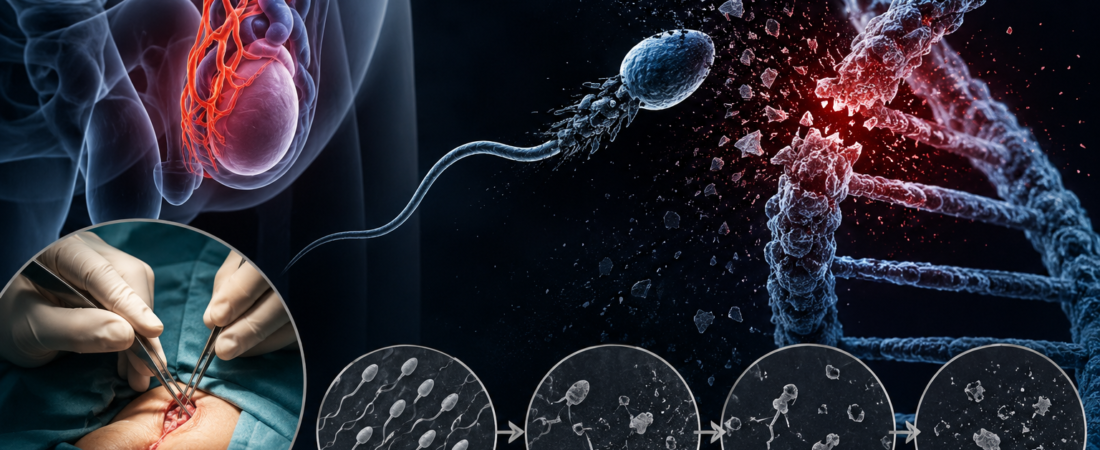
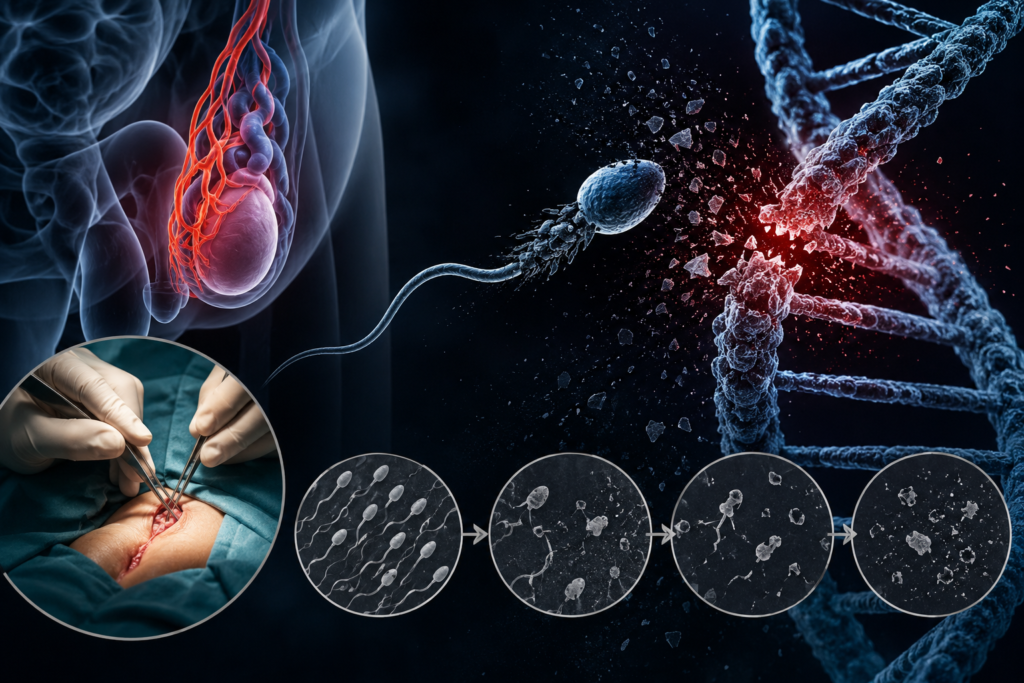
The medical perception of varicocele—a condition involving enlarged veins within the scrotum—is undergoing a rapid evolution. Once dismissed as a minor vascular anomaly or merely a cause of low sperm count, modern reproductive medicine now identifies varicocele as a significant threat to the very genetic blueprint of sperm.
The Paradigm Shift: From Quantity to DNA Integrity In the realm of male infertility, the term “Sperm DNA Fragmentation (SDF)” has become the new critical benchmark. Recent research confirms that patients with varicoceles suffer from more than just numerical deficiencies; they exhibit heightened rates of DNA damage within the sperm itself.
This damage carries consequences that extend far beyond the laboratory. High levels of DNA fragmentation are directly linked to:
- Failed Fertilization: Reduced success rates in IVF/ICSI.
- Embryonic Arrest: Embryos failing to reach developmental milestones.
- Recurrent Pregnancy Loss: Higher rates of miscarriage.
Reproductive medicine is no longer asking, “Is there sperm?” but rather, “Is the sperm genetically sound?”
The Mechanisms of Damage: Oxidative Stress and Heat Current research indicates that the severity of a varicocele does not always correlate linearly with the severity of infertility. Some patients with mild varicosities show high DNA damage, while others with pronounced varicoceles remain relatively unaffected.
Experts now emphasize the “micro-environment” within the testis. The mechanism is clear: varicocele causes venous reflux, which raises the scrotal temperature. Because human sperm production requires an environment slightly cooler than core body temperature, this thermal elevation—coupled with increased Reactive Oxygen Species (ROS)—creates a state of oxidative stress. This environment leaves sperm vulnerable to genetic structural breakage.
Redefining Clinical Strategy Treatment protocols are shifting in response to these findings:
- Advanced Diagnostics: Clinics are moving beyond basic semen analysis, increasingly incorporating DNA fragmentation tests (DFI) for couples facing recurrent implantation failure, unexplained infertility, or miscarriage.
- Surgical Precision: Recent studies (2025) confirm that microscopic varicocelectomy significantly improves not only sperm concentration and motility but also markedly reduces the DNA Fragmentation Index.
- The AI Frontier: Innovation is accelerating as researchers integrate AI-based image analysis to predict DNA damage levels, moving male infertility diagnostics from simple microscopy into the era of molecular biology and AI-driven precision.
A Word of Caution: Avoiding Overtreatment Despite these advancements, experts warn against the reflex to operate on every detected varicocele. Varicocele is a common condition in healthy men, and it does not always lead to infertility. Clinical evidence suggests that surgical intervention is most effective when a “clinically significant varicocele” coincides with abnormal semen parameters or genetic markers. Relying solely on ultrasound findings without considering the full clinical picture can lead to overtreatment.
Conclusion: A Sign of Systemic Dysfunction The recent body of research sends a clear message: varicocele is not merely a superficial “vascular expansion.” It is a systemic warning signal that the environment within the testis is compromised—and this compromise is powerful enough to destabilize the paternal genetic information passed on to the embryo. As the center of male infertility care shifts from counting cells to evaluating the health of their DNA, we are entering an era of more precise, molecularly informed treatment.
Sources: Recent international research on male infertility and reproductive medicine; studies on Sperm DNA Fragmentation (SDF) and varicocelectomy outcomes.
Disclaimer: This content is provided for informational purposes, based on recent advancements in reproductive medicine. Medical judgments and treatment decisions must always be made in consultation with professional medical personnel. Image: AI-generated (ChatGPT, OpenAI) / Visual reference for illustrative purposes only.