

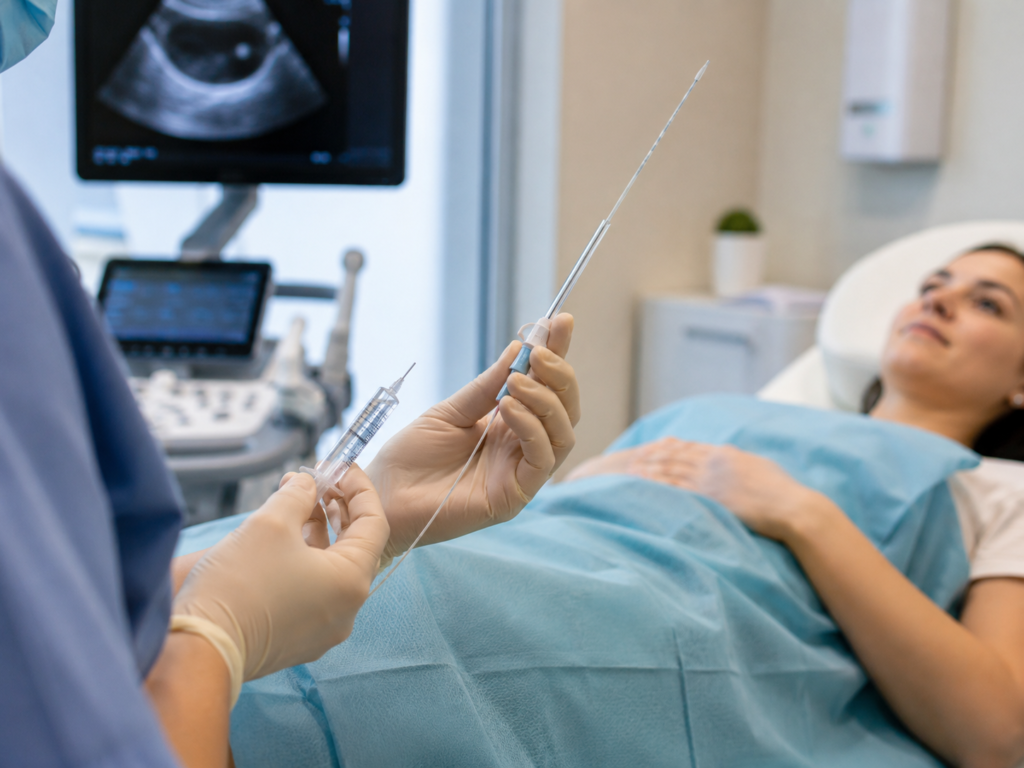
- Randomized Controlled Trial in 100 Women Undergoing Frozen Embryo Transfer: Clinical pregnancy achieved in 29 patients in the atosiban group vs. 19 in the control group
- Implantation Rate (33.3% vs. 23.8%) Shows No Statistically Significant Difference… Live birth outcomes remain unconfirmed
- Prior 1,100-Patient Large-Scale RCT Failed to Demonstrate Statistically Significant Live Birth Improvement… Insufficient evidence to justify routine administration for all patients
Can temporarily dampening uterine contractility immediately prior to embryo transfer enhance implantation rates in In Vitro Fertilization (IVF)?
Results from a randomized controlled trial (RCT) indicate that administering atosiban—a uterine contraction inhibitor—30 minutes before a Frozen Embryo Transfer (FET) increased the clinical pregnancy rate to 58%, compared to 38% in the untreated control group. While this 20 percentage point jump suggests a substantial benefit from a single pre-transfer injection, a closer evaluation of the broader evidence indicates that generalizing this result to standard clinical practice is premature.
The study was published as a conference abstract in the July 2026 supplement of the international journal Human Reproduction.
Conducted at a fertility center in New Delhi, India, between February and September 2025, the trial randomized 100 women undergoing FET into two equal arms:
- Atosiban Arm (n=50): Received an intravenous injection of 6.75 mg atosiban 30 minutes prior to embryo transfer.
- Control Arm (n=50): Underwent embryo transfer following standard clinical protocols without tocolytic administration.
The 20 Percentage Point Gap in Clinical Pregnancy
The primary outcome showed a marked divergence:
- Clinical Pregnancy Rate: 58% (29/50) in the atosiban group vs. 38% (19/50) in the control group (P<0.05).
Atosiban is a selective oxytocin receptor antagonist that suppresses uterine smooth muscle contractions by blocking the action of oxytocin.
During embryo transfer, the passage of the catheter through the cervix and into the endometrial cavity can stimulate mechanical irritation and trigger subclinical uterine peristalsis. Reproductive biologists have long hypothesized that excessive or high-frequency uterine contractions during or immediately after transfer may mechanically displace the embryo, hindering stable apposition and implantation.
The rationale behind this intervention is not altering embryo quality or endometrial thickness, but rather creating a “quiescent uterine environment” at the exact moment the embryo is deposited.
Key Secondary Endpoints and Study Limitations
Despite the headline pregnancy rate, several secondary metrics and design constraints require careful interpretation:
- Strict Patient Eligibility: Participants were aged 23–35, with a BMI <30 kg/m2, normal uterine anatomy, and an endometrial thickness ≥7 mm.
- Double Blastocyst Transfer: Every participant received two Grade-A blastocysts. Whether comparable findings occur in older patients, low-prognosis cohorts, recurrent implantation failure (RIF) cases, or elective single embryo transfers (eSET) remains unknown.
- Non-Significant Implantation Rates: While per-embryo implantation trended higher with atosiban (33.3% vs. 23.8%), the difference was not statistically significant (P=0.12).
- Miscarriage & Biochemical Rates: Early miscarriage rates (17.2% vs. 21.1%) and biochemical pregnancy rates (20% vs. 14%) showed no statistically significant differences.
- Absence of Live Birth Data: The published data is restricted to clinical pregnancy confirmed via ultrasound; final live birth rates (LBR) and multiple gestation rates were not reported in the preliminary abstract.
The 1,100-Patient RCT and Cochrane Evidence
The necessity for clinical caution is reinforced by much larger, blinded clinical trials that failed to demonstrate a conclusive live birth benefit:
- The 2025 Multicenter Double-Blind RCT (n=1,100): Published in Human Reproduction, this trial evaluated 1,100 women with one prior implantation failure undergoing single frozen blastocyst transfers, comparing atosiban 37.5 mg IV (n=549) against placebo (n=551).
- Live Birth Rate: 49.5% with atosiban vs. 44.7% with placebo (a 4.8 percentage point difference, P=0.10, not statistically significant).
- Conclusion: Routine administration of atosiban before FET is not supported.
- Cochrane Systematic Review (2021): Concluded that while IV atosiban may increase clinical pregnancy rates in certain sub-studies, its ability to improve live birth rates remains uncertain due to quality constraints and clinical heterogeneity across trials.
Clinical Direction: Shifting from Universal Use to Targeted Selection
The value of these findings lies in refining the clinical question: not “Should atosiban be given to all FET patients?” but rather “Which specific patient subset truly benefits?”
- High-Contraction Subgroups: In the 1,100-patient RCT, women with objectively confirmed high baseline uterine contraction frequencies exhibited a wider live birth margin favoring atosiban (51.9% vs. 39.3%), though it remained an exploratory trend.
- Observational Findings: A 2026 retrospective analysis published in Human Reproduction similarly suggested that the clinical utility of atosiban increases proportionally with the baseline frequency of uterine contractions.
Conclusion
Based on current evidence, asserting that “administering atosiban 30 minutes before transfer raises pregnancy rates from 38% to 58%” represents an overgeneralization of a small, preliminary trial.
The balanced clinical reality is:
- In a small, single-center trial of 100 rigorously selected young women receiving double blastocyst transfers, pre-procedure atosiban significantly improved clinical pregnancy rates.
- However, implantation rates and miscarriage rates did not reach statistical significance, and live birth outcomes remain unconfirmed.
- Adequately powered, double-blind RCTs have demonstrated that routine, unselected administration of atosiban does not significantly improve live birth rates.
Future clinical interest centers on developing standardized, objective methods to quantify uterine contractility before transfer—reserving tocolytic agents like atosiban for patients with documented excessive uterine activity rather than utilizing them as a blanket add-on.
※ This article was synthesized based on a randomized controlled trial presented in the July 2026 supplement of Human Reproduction, a large-scale double-blind RCT published in Human Reproduction (2025), and a Cochrane Systematic Review. It does not replace individual clinical diagnosis or medical care, and specific treatment decisions should be made in consultation with a qualified specialist physician.
※ The images associated with this article were generated using generative AI (ChatGPT, OpenAI) as visual references and do not depict real individuals.