
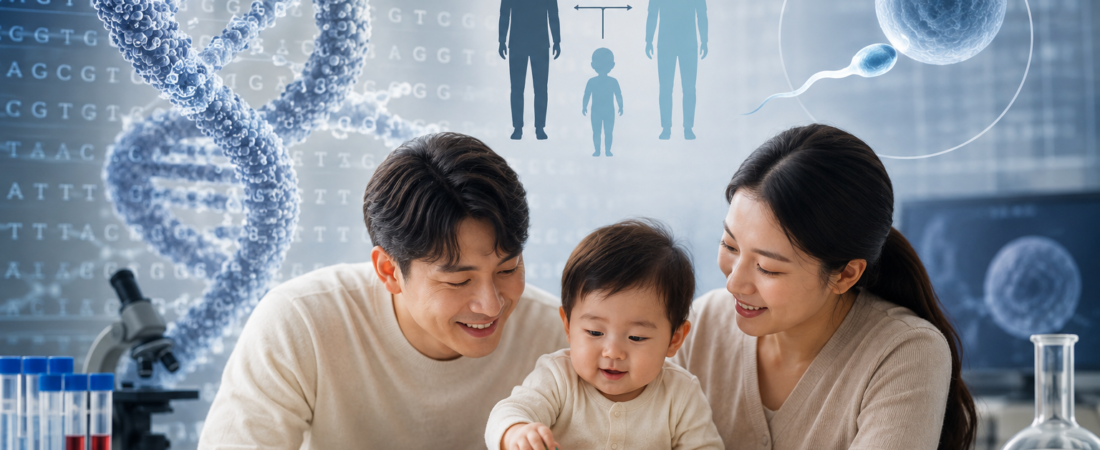
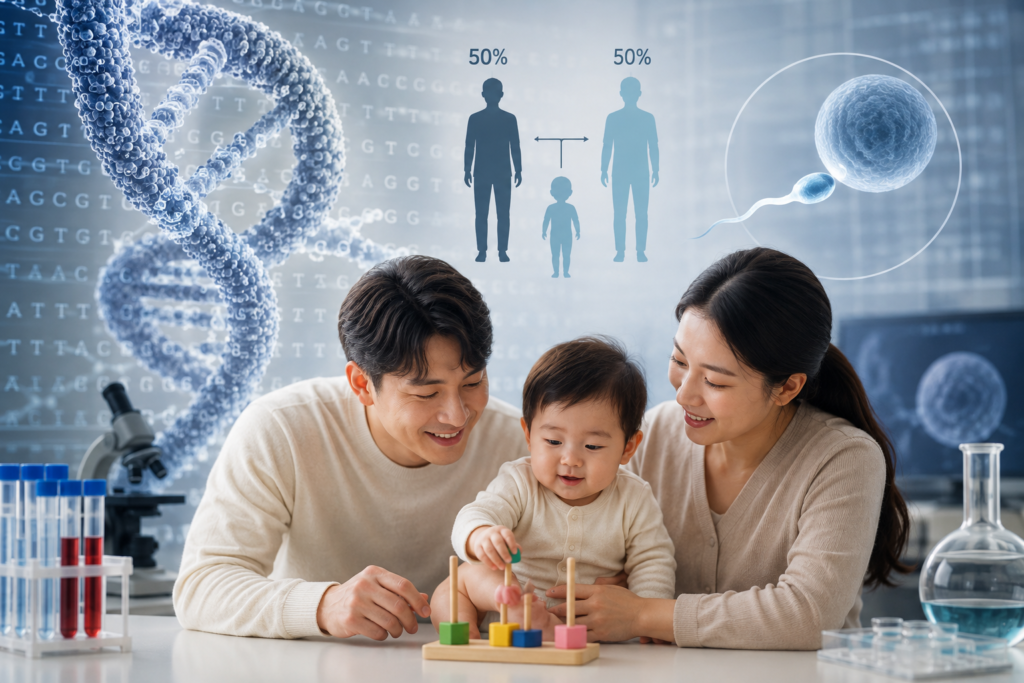
Is a Donor Sperm Really a “Stranger’s Genes”? Humans Share 99.9% of DNA, Yet the Half Passed Down to a Child Differs Distinctly What Bars the Path to Sperm Donation: Genetic Distance or the Mental Boundary of Bloodline?
“Can I truly accept a child born from another man’s sperm as my own?”
When the topic of sperm donation arises, this is the very first question infertile couples in Korea face.
Medically speaking, it represents an additional pathway to achieving pregnancy, but to those directly involved, it is far from a simple medical choice. The reality of conceiving a child using the sperm of a man other than one’s husband presents a psychological threshold that is difficult to cross in a society like Korea, which has traditionally placed immense emphasis on bloodlines, family names, and genealogical lines.
The Genetic Perspective: 99.9% Identical
Surprisingly, a fascinating picture unfolds through the lens of genetics.
How different are we from one another? Are the genes of one Korean man an entirely different blueprint from those of another Korean man? Does using the sperm of an Asian donor introduce a half-dose of “unfamiliar blood” into the child?
According to the U.S. National Human Genome Research Institute, the DNA sequences of any two humans are more than 99.9% identical. This means that the vast majority of the approximately 3 billion genetic letters are identical regardless of which human being in the world is compared. Husbands and sperm donors, Koreans and Japanese, Asians and Caucasians—all share nearly identical genetic prose within the single species of Homo sapiens.
Does this mean there is zero reason to fear sperm donation?
The story is not quite that simple. What makes individuals distinct are those small remaining differences.
Facial features like eyes and nose shapes, height and body type, skin and hair characteristics, vulnerability to specific diseases, and responses to medications arise from complex combinations of variants that occupy a minute fraction of the entire genome.
Humans are 99.9% identical, yet those tiny differences give rise to different faces, physiques, and personalities.
The Illusion of Genetic Borders
A common question here is, “Aren’t Asians genetically more similar to one another?” Generally speaking, individuals sharing ancestral groups tend to share a higher average frequency of certain genetic variants.
However, drawing a line with statements like “Asian DNA sequences are identical by X percent” is inaccurate. East Asians do not form a single homogeneous genetic population, and individual genetic differences exist even within Koreans.
Recent large-scale studies have shown that a significant proportion of gene expression and DNA variation is distributed among individuals within the same population rather than between continents or population groups.
Put simply, the label “Korean” does not render genes identical. Two Korean individuals are not necessarily genetically closer to each other than two individuals from different East Asian populations.
While we distinctly categorize ethnicities by borders, genes do not divide as neatly as national boundaries.
For thousands of years, humans migrated, mixed, and bore children, and the genomes of all living humans today harbor overlapping traces of countless ancestors.
The Reality of Biological Heritage
Of course, a husband’s sperm and another man’s sperm are not identical.
Sperm deliver half of the nuclear DNA to a child. A child born from a husband’s sperm inherits half of their genome from the husband, whereas a child born from a donor’s sperm receives that half from the donor.
Even though 99.9% of human DNA is shared, a clear distinction exists from the perspective of the genetic lineage connecting parents and children.
Precisely at this juncture, scientific similarity and the emotional distance felt by families diverge.
A geneticist asserts, “All humans are nearly identical,” whereas an infertile couple feels, “Still, that child does not carry my husband’s genes.” These two statements do not contradict one another. At the scale of all humanity, genomes are nearly identical, but at the scale of family lineage, it matters profoundly whose half was provided.
The deep-seated reluctance toward sperm donation in Korea is difficult to explain through pure genetic divergence alone.
Family in Korean society has long been defined primarily around blood ties, evidenced by everyday expressions like “continuing the ancestral line,” “sharing blood,” and “my own flesh and blood.”
Within a culture that inherits the father’s surname, continues memorial rites, and records names in family genealogies, sperm donation can feel less like receiving a simple cell and more like an event severing the continuity of the family line.
Beyond Genetics: Family and Rearing
Does this mean a child born through sperm donation cannot become a full-fledged family with a father who shares no genetic connection?
Accumulated international research demonstrates that parent-child relationships are not dictated solely by genetic links. There is no evidence showing that the emotional and behavioral development of children born through sperm or egg donation is inherently inferior to those born via natural conception or standard IVF.
Instead, research consistently indicates that what profoundly impacts family relationships is not the fact of donation itself, but the parents’ parenting attitudes, communication within the family, and when and how origins are disclosed.
This does not mean “genes do not matter.”
The right of donor-conceived individuals to know their biological roots cannot be lightly dismissed. The right to know the donor’s medical information, genetic disease risks, existence of biological siblings, and birth origins must be factored into the design of sperm donation systems.
Indeed, many countries are shifting systems to allow children reaching a certain age to identify donors rather than relying on anonymous donations, alongside a cultural trend where parents disclose donation facts in accordance with the child’s developmental stage rather than concealing them.
Conclusion
Science tells us that human DNA is astonishingly similar. Yet the human heart registers “from whom one came” far more intensely than a 0.1% difference.
The apprehension felt in the face of sperm donation is neither a product of ignorance nor an obsolete mindset. The desire for one’s own genetic offspring is a natural human aspiration.
Yet one thing remains certain.
The concept of “pure blood” is culturally potent but biologically untenable.
There are no unmixed ethnicities or genetically perfectly homogeneous groups on earth. We are all combinations of variants left behind by countless ancestors, and the genes received from parents will mix anew in the next generation.
The half of DNA received from a father may be important to a child. Yet an entire human life is never completed by that half alone.
The time invested by the person who feeds them daily, stays up through fevers, watches their first steps, and extends a hand when they fall cannot be measured by a sequencing test.
Whether one chooses sperm donation or not, that decision cannot be easily judged by anyone. Yet the moment we ask whether a family is forged solely by preserving bloodlines or by loving and taking responsibility, we encounter the true essence of family—reaching far beyond a single sperm.
As reiterated, human DNA is 99.9% the same. Yet the heart that embraces a child as one’s own cannot be calculated in numbers. Perhaps the highest threshold of sperm donation is not the distance between genes, but the boundary of bloodline we have drawn within our hearts for so long.
※ This article was synthesized based on human genomic data from the U.S. National Human Genome Research Institute (NHGRI), public materials and related research from international journals such as Nature, Human Reproduction, the European Society of Human Reproduction and Embryology (ESHRE), and the American Society for Reproductive Medicine (ASRM). It does not replace a specific individual’s diagnosis or treatment, and actual medical judgment must be made through consultation with a specialist.
※ Images: Created using generative AI (ChatGPT, OpenAI); depicts fictional individuals, not real people.