
Analysis of 5,032 Men Undergoing Fertility Evaluation: Higher Serum Homocysteine Correlates with Increased Sperm DNA Fragmentation
Highest Group Exhibited 20.25% with ‘DNA Fragmentation ≥ 30%’ vs. 10.53% in the Lowest Group
Even at Equivalent Homocysteine Levels, Association Stronger in Obese Men… “Not a Study Proving Cause and Effect”
Some men present with normal sperm counts and robust motility, yet pregnancy remains elusive. While routine semen analysis reveals no obvious abnormalities, scrutinizing the sperm’s genetic architecture often uncovers extensive DNA damage.
A recent large-scale study has highlighted the relationship between this “sperm DNA damage” and circulating homocysteine levels in the blood. Notably, the association between the two factors proved significantly stronger among obese men.
Published on September 1, 2026, in the international journal Journal of Translational Medicine, researchers from the Centre of Reproductive Medicine at The First Hospital of Jilin University in China analyzed blood and semen testing data from 5,032 men attending a fertility clinic for their initial evaluation.
What Exactly Is ‘Homocysteine’?
Homocysteine is an amino acid generated as an intermediate byproduct when the body metabolizes dietary protein. Under normal metabolic conditions, it is produced and subsequently converted into other substances; however, disruptions in metabolic pathways can cause its concentration in the bloodstream to accumulate.
Micronutrients such as folate, vitamin B12, and vitamin B6 are intimately involved in homocysteine metabolism. While homocysteine has long been investigated in the context of metabolic and redox imbalances, its specific relationship with sperm DNA damage in men had not been sufficiently clarified.
The researchers focused on Sperm DNA Fragmentation (SDF). Simply put, this metric assesses how extensively the DNA carrying genetic information inside the sperm head has been damaged or broken.
In this study, an SDF rate of 30% or higher was classified as ‘abnormal SDF.’
As Homocysteine Rose, DNA Damage Climbed
The investigators stratified the men into three tertiles based on serum homocysteine levels and compared their profiles.
The differences were distinct.
In the lowest homocysteine group, the median sperm DNA fragmentation rate stood at 13.65%. This rose to 14.93% in the intermediate group and climbed further to 17.10% in the highest group.
Even more striking was the proportion of men falling into the clinically ‘abnormal’ threshold:
- Lowest homocysteine group: 10.53% had an SDF ≥ 30%
- Middle group: 12.12%
- Highest group: 20.25%
Put simply, roughly 1 in every 5 men in the highest homocysteine group exhibited an abnormal sperm DNA fragmentation rate exceeding 30%, compared to only about 1 in 10 men in the lowest group.
Differences Emerged Beyond Simple Sperm ‘Counts’
An intriguing aspect was sperm concentration.
No meaningful variation in sperm concentration was observed across different homocysteine levels. In contrast, total sperm motility and the percentage of morphologically normal sperm were significantly lower in the highest homocysteine group.
This demonstrates that differences not captured by routine semen parameters—which typically prioritize “how many sperm are present”—can manifest clearly in sperm motility, morphology, and molecular DNA integrity.
The association persisted even after statistically controlling for potential confounding variables, including age, duration of sexual abstinence, frequency of intercourse, body mass index (BMI), and lifestyle factors.
For every 1 μmol/L increase in serum homocysteine, the sperm DNA fragmentation rate rose by an average of 0.132 percentage points. Furthermore, the odds of presenting with an abnormal SDF (≥ 30%) increased by 2.6% per 1 μmol/L increment.
Comparing the highest group directly to the lowest group revealed a more substantial divergence: the highest group showed an average SDF that was 3.383 percentage points higher, with the odds of abnormal SDF being approximately 2.18 times higher (odds ratio ≈ 2.18).
The Amplifying Effect in ‘Obese Men’
The most pivotal finding of this study emerged when accounting for weight status.
The research team classified the men into normal-weight, overweight, and obese categories based on BMI to evaluate whether the correlation between homocysteine and sperm DNA fragmentation shifted according to body mass.
The analysis revealed that the link between homocysteine and sperm DNA damage was most pronounced in obese men. The interaction term between homocysteine and BMI was statistically significant (P=0.011).
In short, rather than viewing homocysteine in isolation, clinical attention must be directed toward the concurrent presence of elevated homocysteine and obesity.
The researchers proposed that metabolic dysregulation and systemic oxidative stress tied to obesity likely underpin this synergy. Sperm cells are inherently vulnerable to oxidative stress, and excessive oxidative insult is a primary driver of sperm DNA fragmentation.
Will Losing Weight Repair Sperm DNA?
A strict line must be drawn regarding clinical conclusions.
This study alone cannot prove that “obesity drove up homocysteine, which directly damaged sperm DNA.” Nor can it conclude that “losing weight or pharmacologically lowering homocysteine will directly reduce sperm DNA fragmentation.”
Because this was a cross-sectional study examining blood and semen parameters at a single point in time, causal relationships cannot be definitively established. Moreover, the study population was derived from men seeking subfertility evaluations at a single reproductive medical center, limiting direct extrapolation to the general male population.
Consequently, men preparing for pregnancy should exercise caution against arbitrarily self-administering high-dose folate or vitamin B complexes simply to lower homocysteine based on these findings. This study was an observational evaluation, not an interventional clinical trial demonstrating whether nutritional supplementation improves sperm DNA integrity.
Nevertheless, by analyzing over 5,000 men, this research underscores the necessity of moving beyond simple sperm count and motility to comprehensively evaluate body weight, metabolic health, circulating metabolites, and sperm DNA integrity.
The observation that the link between homocysteine and sperm DNA damage was amplified in obese men provides an essential baseline hypothesis for future prospective cohorts and intervention trials.
For men undergoing fertility evaluations, body weight may represent far more than waist circumference. Evidence is mounting that the hidden DNA health behind sperm numbers is intricately connected to systemic metabolic status.
※ Study Source: Based on the research article published September 1, 2026, in the international journal Journal of Translational Medicine, titled “Obesity modifies the association between serum homocysteine and sperm DNA fragmentation: a cross-sectional study of 5,032 men undergoing fertility evaluation” by researchers from The First Hospital of Jilin University. The study included 5,032 men undergoing their initial fertility evaluation. DOI: 10.1186/s12967-026-08917-1.
※ This article provides informational coverage of recent scientific research and does not replace personalized medical diagnosis or clinical advice. Homocysteine testing, nutritional supplementation, weight management, and fertility interventions must be determined in consultation with medical specialists based on individual health profiles.
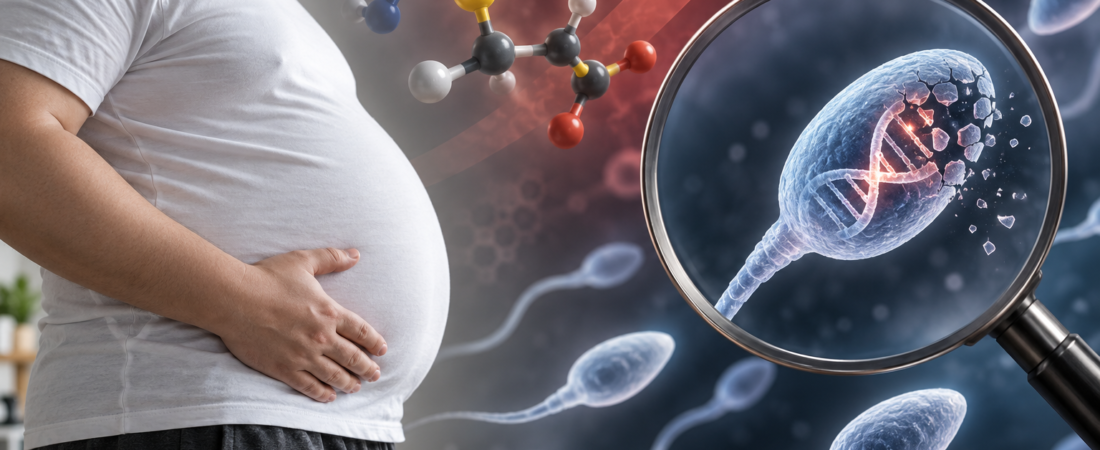
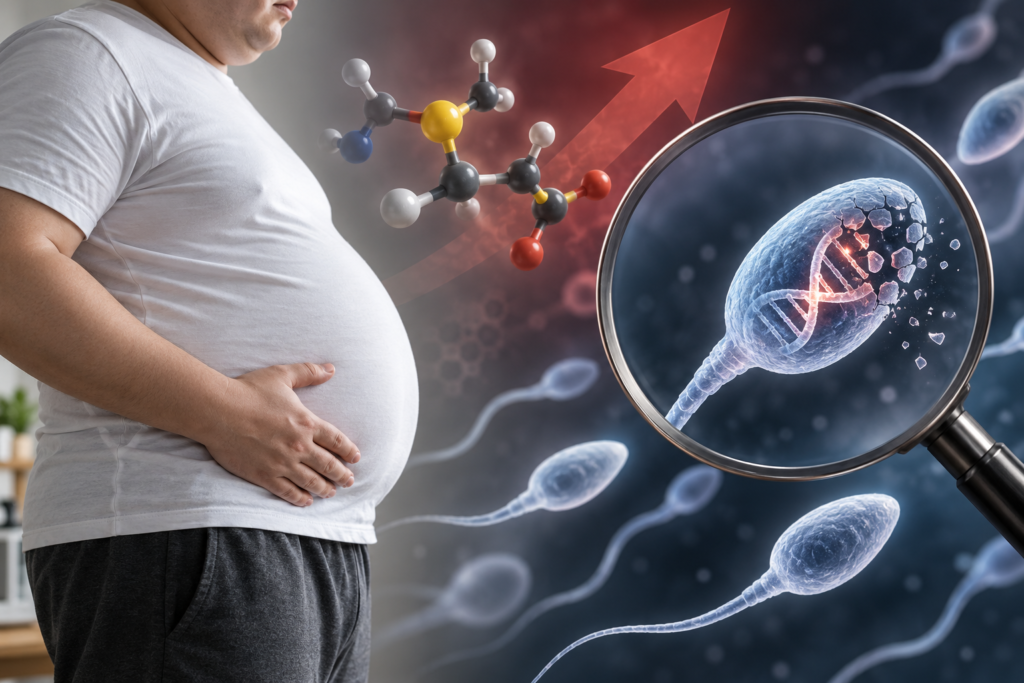
※ The images used in this article were generated using artificial intelligence (ChatGPT, OpenAI) as illustrative reference materials and do not depict real individuals.
※ Copyright © 2026 THE FERTILITY NOTES. All rights reserved. Unauthorized reproduction, duplication, distribution, scraping, AI training, or data utilization of all content, including articles, photos, and images, is strictly prohibited and subject to legal liability.