
- Comprehensive endometrial and serum profiling in 19 women with recurrent pregnancy loss (RPL), 41 with recurrent implantation failure (RIF), and 20 fertile controls
- Depleted medium-chain acylcarnitines alongside elevated storage lipids (diglycerides and triglycerides) detected during the window of implantation
- No distinct metabolic signature identified in RIF, suggesting RPL and RIF possess divergent underlying pathophysiologies
- “Clinical attention must broaden beyond the embryo to evaluate the uterine bioenergetic microenvironment”
A pregnancy is confirmed, only to halt weeks later. Even after comprehensive evaluations—parental karyotyping, uterine cavity imaging, thrombophilia panels, and endocrine screenings—many couples are left without a definitive explanation. What is occurring at the cellular level inside the uterine lining of women facing “unexplained recurrent pregnancy loss” at the exact moment of implantation?
A study offers a compelling biological clue: direct profiling of the endometrium during the peri-implantation window revealed that the biochemical machinery governing fatty acid synthesis, oxidation, and lipid storage operates distinctly in women with recurrent pregnancy loss compared to fertile controls.
The findings, published in the journal Reproductive BioMedicine Online (RBMO), were conducted by a research team from the University of Angers and Angers University Hospital in France. The investigators compared the metabolomic profiles of serum and endometrial tissue across 80 women undergoing assisted reproductive technology (ART): 19 women with unexplained recurrent pregnancy loss (uRPL), 41 with recurrent implantation failure (RIF), and 20 fertile controls undergoing treatment for male-factor subfertility.
Biopsying the Endometrium During the ‘Window of Implantation’
What distinguishes this study from routine clinical workups is that rather than relying solely on peripheral blood, the researchers directly analyzed endometrial tissue harvested during the exact period when an embryo would attach.
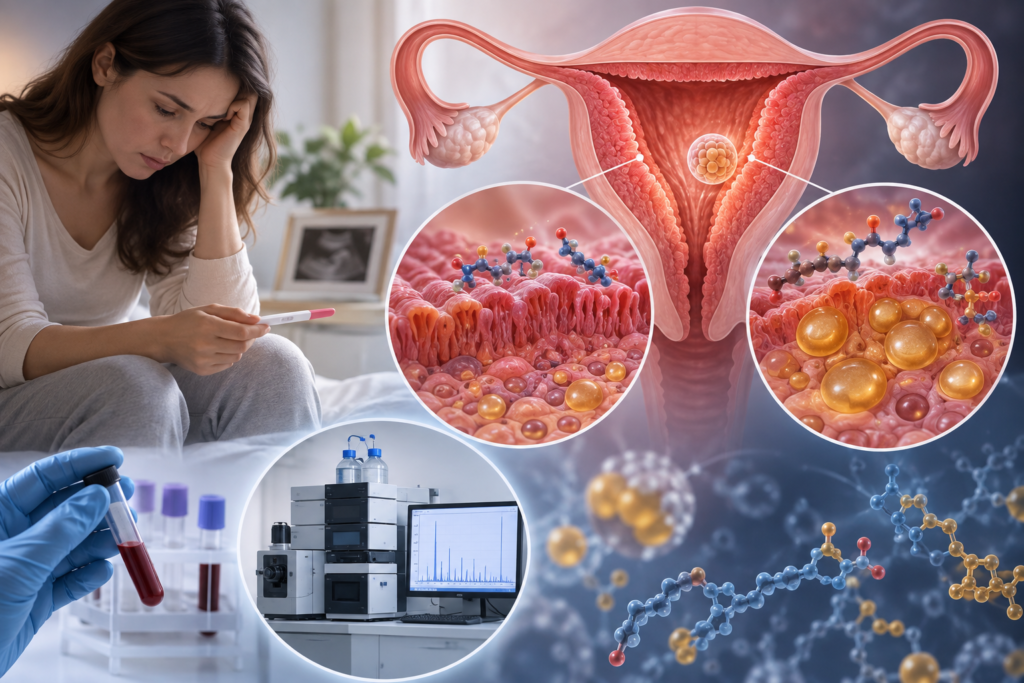
Endometrial biopsies and blood draws were performed 5 to 9 days post-ovulation (LH+5 to LH+9)—the physiologically defined window of implantation (WOI). Using high-performance liquid chromatography coupled with tandem mass spectrometry (LC-MS/MS), the investigators profiled up to 630 distinct metabolites spanning amino acids, acylcarnitines, phospholipids, sphingolipids, ceramides, and glycerides.
Among these, 494 metabolites in serum and 228 in endometrial tissue were reliably quantified. Employing multivariate statistics and machine learning algorithms, the team assessed whether metabolic signatures could reliably segregate the three clinical cohorts.
The results revealed a striking contrast:
- Recurrent Implantation Failure (RIF): Neither serum nor endometrial samples exhibited a distinct, reproducible metabolomic fingerprint separating them from controls.
- Unexplained Recurrent Pregnancy Loss (uRPL): Endometrial tissue exhibited a distinct, pronounced metabolomic signature compared to both controls and RIF patients.
Crucially, this metabolic disruption was absent in peripheral blood. Systemic circulating metabolism appeared largely normal, demonstrating that the metabolic perturbations in recurrent pregnancy loss are localized specifically to the endometrial microenvironment where pregnancy begins.
16 Core Metabolites Point to Dysregulated Fatty Acid Metabolism
Through orthogonal partial least squares discriminant analysis (OPLS-DA) and variable importance in projection (VIP) scoring, the researchers identified a signature of 16 key endometrial metabolites that distinguished women with uRPL.
The most prominent feature was a significant reduction in acylcarnitines, particularly medium-chain acylcarnitines.
Conversely, neutral storage lipids—including specific diglycerides (DGs) and triglycerides (TGs)—as well as select ceramides and phospholipids, were significantly elevated. Together, this metabolic pattern indicates a profound disturbance in how the endometrium processes fatty acids:
- Acylcarnitines are critical biochemical shuttles required to transport fatty acids across the mitochondrial membrane for $\beta$-oxidation and cellular ATP production.
- When acylcarnitines are depleted while storage glycerides accumulate, it suggests an impaired capacity to mobilize and burn fatty acids for energy, shifting lipid balance toward intracellular storage instead.
Lipids do not simply serve as inert stored energy. They constitute structural building blocks for cell membranes, drive secondary intracellular signaling cascades, and fuel the rapid cellular reorganization required to prepare the endometrium for gestation. In women with uRPL, the physiological equilibrium between lipid transport, fatty acid consumption, and lipid storage appears fundamentally altered.
Impaired Decidualization: Failing the ‘Pregnancy Preparation Mode’
The research team highlighted decidualization as the primary physiological process likely compromised by this metabolic shift.
Following ovulation, rising progesterone levels trigger endometrial stromal cells to differentiate into specialized, secretory decidual cells. Decidualization is not merely endometrial thickening; it is a bioenergetically demanding transformation where stromal cells reprogram their metabolism to nourish the incoming blastocyst, orchestrate local immune tolerance, and strictly control trophoblast invasion.
The authors hypothesized that impaired medium-chain fatty acid utilization disrupts the intense energy production required for optimal decidualization. An endometrium incapable of meeting these cellular bioenergetic demands may allow initial implantation, but fail to provide the sustained metabolic and structural support required to maintain the developing embryo, ultimately culminating in early pregnancy loss.
However, this does not mean that “a simple dietary deficiency in fatty acids causes miscarriage.”
This was an observational metabolomic study identifying a localized biochemical association. It was not an intervention trial testing whether modifying lipid intake or taking omega-3 supplements prevents pregnancy loss. These findings should not be interpreted as a justification for self-prescribing fatty acid supplements to treat recurrent miscarriage.
Recurrent Implantation Failure vs. Recurrent Pregnancy Loss: Distinct Pathologies
Another critical insight is the divergence between RIF and RPL.
In clinical practice, these two diagnoses are often grouped together as unexplained reproductive failures. One describes an embryo’s inability to implant in the uterine wall, while the other involves repeated embryonic arrest and demise after implantation has commenced.
In this study, RIF patients showed no distinct endometrial metabolomic clustering, whereas uRPL patients exhibited clear, localized lipid dysregulation.
This suggests that recurrent implantation failure and recurrent pregnancy loss may stem from fundamentally different molecular and cellular mechanisms rather than representing varying degrees of the same condition.
When Blood Tests Show “Normal”: Finding Answers Inside the Uterus
For patients navigating recurrent miscarriage, few experiences are more disorienting than undergoing batteries of exhaustive diagnostic workups only to be told: “Everything looks completely normal.”
Because standard diagnostics evaluate peripheral blood (clotting factors, autoantibodies, thyroid function) and macro-anatomy (sonohysterography, pelvic MRI), they are blind to the localized biochemical microenvironment of the peri-implantation endometrium.
This study underscores that localized endometrial metabolomics could serve as a foundation for developing novel, tissue-specific biomarkers of uterine receptivity and early gestational viability. In this cohort, the 16-metabolite panel distinguished uRPL endometrium with high diagnostic accuracy.
Nonetheless, significant clinical hurdles remain before endometrial metabolomic testing can be implemented in routine fertility clinics. The RPL cohort in this pilot investigation was small (19 patients), and extensive external validation across larger, multi-center prospective cohorts is required to establish clinical reference ranges.
Even so, the study expands our perspective on recurrent pregnancy loss. When early pregnancies repeatedly arrest, the etiology may not reside exclusively within embryonic genetics, but within the bioenergetic programming of the maternal endometrium—specifically, how uterine cells process and burn fats during the crucial days of implantation.
Medical Source & Study Reference
- Journal: Reproductive BioMedicine Online (RBMO), Paper ID: 105798 (Published online May 29, 2026).
- Study Title: Endometrial metabolomic profiling reveals disruption of fatty-acid metabolism in unexplained recurrent pregnancy loss
- Lead Institutions: University of Angers; Angers University Hospital, Angers, France.
- Study Cohort: 80 women undergoing assisted reproduction (19 unexplained recurrent pregnancy loss, 41 recurrent implantation failure, 20 fertile controls).
- DOI: 10.1016/j.rbmo.2026.105798
※ This article provides general scientific and medical information and does not replace individualized clinical diagnosis or treatment. The causes of recurrent pregnancy loss vary significantly across individuals; medical assessments and treatment regimens must be guided by a qualified reproductive endocrinologist or maternal-fetal medicine specialist.
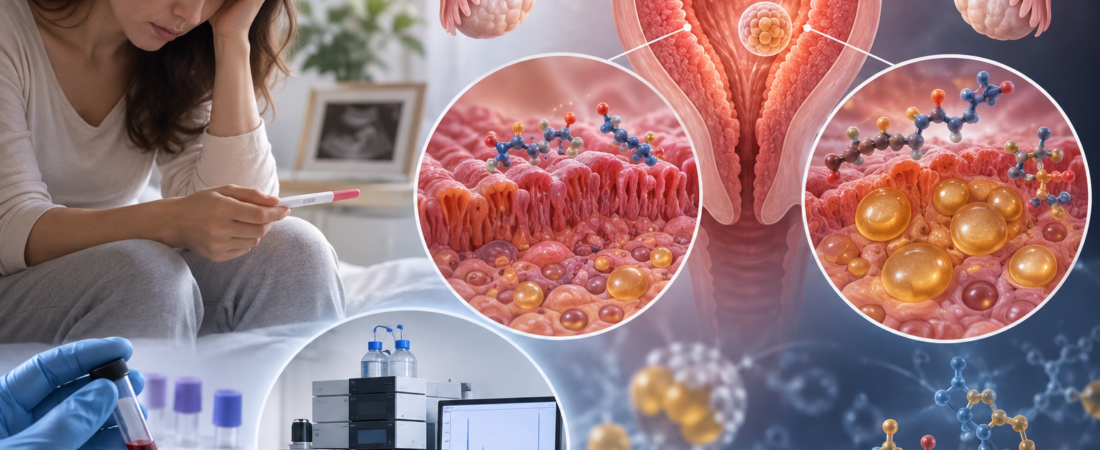
※ The images associated with this article were generated using generative AI (ChatGPT, OpenAI) as illustrative visual references and do not depict real individuals.
※ Copyright © 2026 THE FERTILITY NOTES. All rights reserved. Unauthorized reproduction, duplication, distribution, scraping, AI training, or data utilization of all content, including articles, photos, and images, is strictly prohibited and may result in legal liability.