
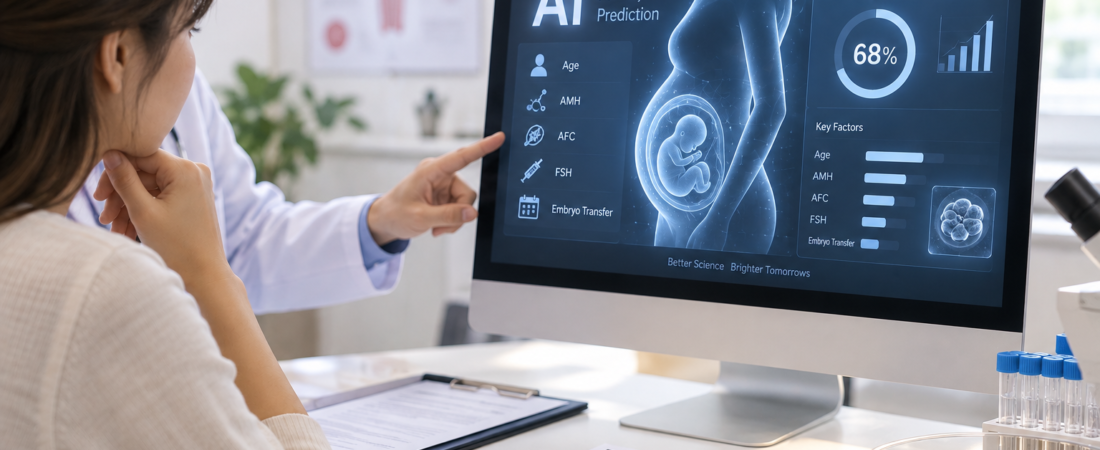
Can AI predict whether IVF will work? A study of 6,076 women used routine fertility-care information, including age, AMH and follicle count, to predict clinical pregnancy. Yet the best of seven machine-learning models achieved an internal-validation AUC of just 0.606, highlighting the gap between promising technology and reliable individual predictions.
For couples preparing for in vitro fertilization (IVF), one of the biggest questions is: “Will we become pregnant this time?”
Age, ovarian function, embryo characteristics and many other factors influence pregnancy outcomes. Combining them into an accurate prediction for an individual remains difficult.
Researchers in China have now reported a study that trained artificial intelligence on clinical information from 6,076 women experiencing infertility.
Published on October 12, 2026, in Scientific Reports, the study by the Affiliated Hospital of Jining Medical University compared seven machine-learning models using records from women undergoing IVF. Machine learning is a form of AI that learns patterns in data to predict outcomes.
6,076 women and five important predictors
Among the 6,076 women, 3,056 achieved a clinical pregnancy and 3,020 did not. Clinical pregnancy means a pregnancy confirmed by clinical evidence, such as ultrasound; it is distinct from delivering a live-born baby.
The researchers used 70% of the data for training and the remaining 30% for internal validation. They focused on information routinely available during fertility care, rather than expensive genetic tests or specialized investigations.
Five important predictors emerged: age, anti-Müllerian hormone (AMH), antral follicle count (AFC), embryo-transfer timing and follicle-stimulating hormone (FSH). Age had the greatest influence on predictions.
The best model reached an AUC of 0.606
XGBoost performed best among the seven models. This machine-learning approach combines predictive models sequentially to improve performance.
However, its predictive performance remained modest. In internal validation, XGBoost had an area under the receiver operating characteristic curve (AUC) of 0.606. AUC measures how well a model distinguishes women who became pregnant from those who did not. A value of 0.5 represents random discrimination, while a value closer to 1 indicates better discrimination.
An AUC of 0.606 was better than chance, but limited for reliably judging an individual’s pregnancy prospects. Sensitivity was 70.1%; that does not mean the model correctly predicted 70.1% of all pregnancy outcomes.
Predicting pregnancy is different from predicting live birth
The study illustrates the feasibility of building prediction models from existing clinical information without additional special tests. Combining more clinical and embryo-related data could eventually help develop tools for individualized counselling and decision-making.
However, this was a retrospective analysis of existing records. Performance in patients from other hospitals or countries has not been established. Its target was clinical pregnancy, not miscarriage risk or eventual live birth.
The researchers emphasized the need to improve performance and conduct external validation before clinical use.
The findings show both the potential of AI in fertility treatment and the challenges that remain. Even a model trained on thousands of women struggles to predict a complex biological outcome. AI therefore needs to develop as a tool that helps specialists integrate clinical information and discuss treatment, rather than replacing their judgment.
Read more
Embryo-development assessments also require careful interpretation: why slow-developing IVF embryos can still have normal chromosomes.
Study source
This article is based on “Machine learning-based prediction of clinical pregnancy in infertile women undergoing in vitro fertilization,” by Lin Zhang and colleagues at the Affiliated Hospital of Jining Medical University, China, published in Scientific Reports on October 12, 2026. DOI: 10.1038/s41598-026-75209-5.
The image was created with generative AI (ChatGPT, OpenAI) and depicts fictional people. The dashboard’s illustrative 68% is not a result of this study or an individual clinical prediction.
Copyright © 2026 The Fertility Notes. All rights reserved. Unauthorized reproduction, redistribution, scraping, AI training, or other data use of articles, photographs, images, and all other content is strictly prohibited and may result in legal liability.