
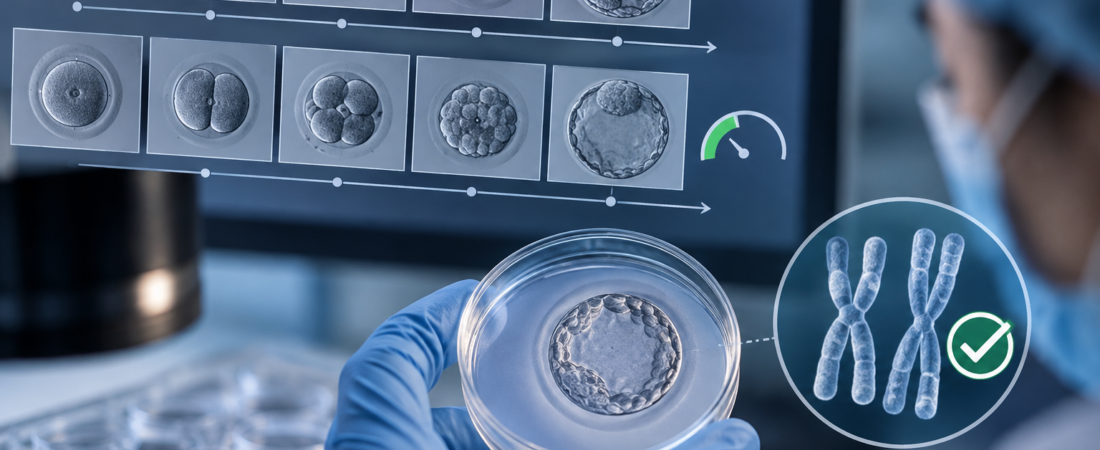
An analysis of 1,711 blastocysts found similar euploidy rates despite sharply different developmental-timing scores.
Slow embryo development in IVF does not necessarily mean an embryo has abnormal chromosomes. A study found substantial numbers of euploid embryos even among embryos assigned low developmental-timing scores.
The findings raise a concern about time-lapse embryo selection: prioritizing speed alone could push chromosomally competent embryos further down the transfer list. The study appeared in Reproductive BioMedicine Online on October 8, 2026.
What did the 1,711-blastocyst study examine?
Brazilian researchers analyzed 1,711 blastocysts from 611 ICSI cycles performed between September 2022 and August 2025.
They focused on how completely cells compacted as embryos developed from the morula to the blastocyst stage. A morula forms when cells become tightly associated after several divisions; a cavity subsequently develops as the embryo becomes a blastocyst.
The researchers distinguished embryos with complete compaction from those in which some cells were excluded from compaction, then compared developmental timing and chromosome results.
Low timing scores, similar chromosome results
Partially compacted embryos were more likely to receive low developmental-timing scores than fully compacted embryos.
The lowest KIDScore category, C, accounted for 73.9% of partially compacted embryos, compared with 25.5% of fully compacted embryos.
Chromosome results told a different story. Euploidy rates were 43.7% and 43.4%, respectively—almost identical despite the large difference in timing scores.
After adjustment for potential influencing factors, partially compacted embryos actually had higher odds of a euploid result: adjusted odds ratio 1.56, P=0.008.
This does not support assuming that slower development or incomplete morula compaction necessarily indicates a higher likelihood of chromosome abnormalities.
Embryo structure adds information beyond speed
The researchers also considered structural features, including fragmentation. These features could provide information about chromosome status beyond developmental timing alone.
Even among embryos in KIDScore category C, those without fragmentation had euploidy rates of 50.0–66.7%.
Consequently, lowering transfer priority simply because an embryo develops slowly may also disadvantage euploid embryos. The researchers emphasized considering morphological and structural features throughout development, alongside timing.
What time-lapse scores can—and cannot—tell us
Time-lapse systems repeatedly photograph embryos inside the incubator, allowing assessment of cell-division timing and developmental patterns without removing embryos for observation. These observations can help establish transfer priorities.
The study suggests that scores weighted toward developmental speed may not adequately capture chromosome status.
Euploidy, however, is not equivalent to pregnancy or live birth. A euploid embryo may still fail to implant or a pregnancy may not continue.
This was a retrospective observational study. It did not directly establish pregnancy or live-birth outcomes after transferring slower-developing embryos.
Its central implication is therefore about assessment: relying too heavily on speed may underestimate the potential of chromosomally competent embryos. Developmental timing should be considered together with morphological and structural findings.
Research source
“Good embryos left behind: morphokinetic prioritization may penalize chromosomally competent embryos.” Reproductive BioMedicine Online, October 8, 2026. DOI: https://doi.org/10.1016/j.rbmo.2026.106019.
Related reading
- Recurrent Implantation Failure: Why Did a Euploid Embryo Fail?
- Embryologists in IVF: Skill, Checks and Laboratory Safety
The illustration was generated with ChatGPT (OpenAI); any depicted people are fictional.
Copyright © 2026 Fertility Information TokTok Fertility News | THE FERTILITY NOTES. All rights reserved. Unauthorized republication, reproduction, redistribution, scraping, AI training and data use of any content, including articles, photographs and images, are strictly prohibited. Violations may result in legal liability.