
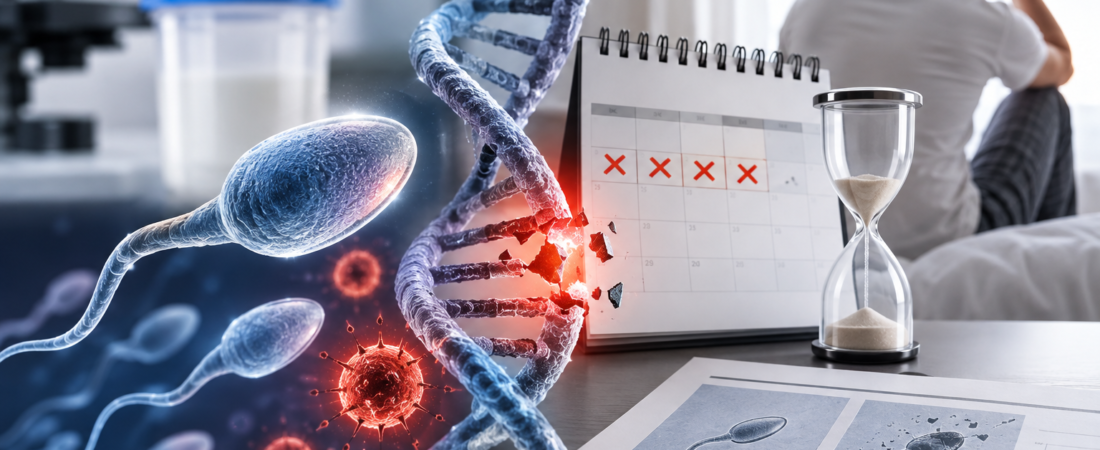
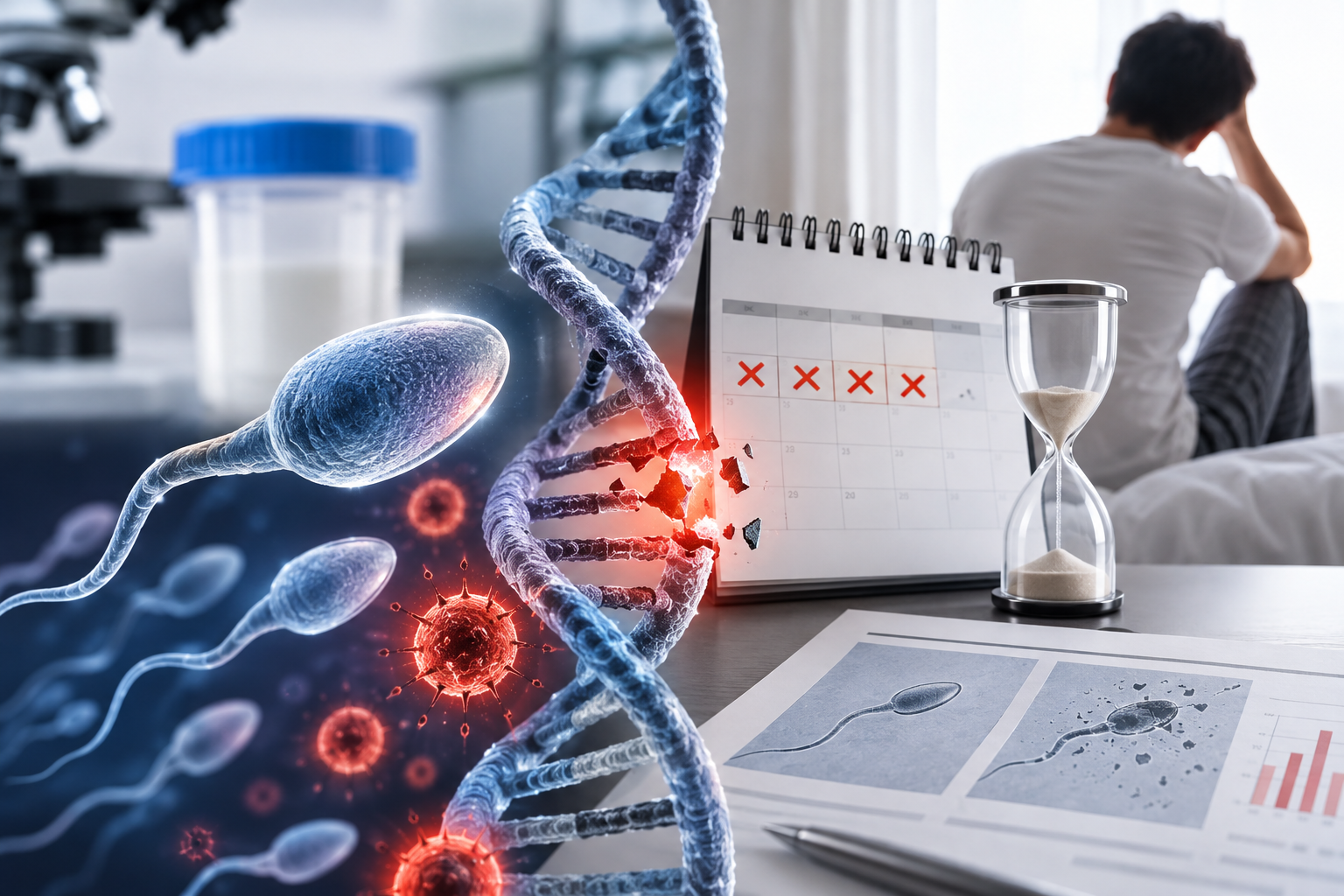
Longer abstinence was associated with higher sperm DNA fragmentation and oxidative stress in 2,782 men.
Age and oxidative stress also mattered; the study did not test whether shorter abstinence improves live birth.
Longer abstinence before a semen test may increase semen volume and sperm numbers while also being associated with more sperm DNA damage. A study of 2,782 men found that abstinence exceeding four days was associated with approximately 1.9-fold higher odds of elevated DNA fragmentation.
Male age and oxidative stress in semen were also associated with DNA damage.
Published in Frontiers in Urology on September 22, 2026, the study suggests that abstinence duration may be relevant to genetic integrity as well as sperm count.
Findings from 2,782 men undergoing infertility evaluation
The international research team analyzed records from men aged 18–73 attending for infertility assessment. They compared semen results, DNA damage, abstinence duration, oxidative stress and age.
Abstinence was grouped into 1–2 days, 3–4 days, 5–6 days and at least seven days.
Longer duration tended to accompany higher semen volume and sperm concentration, but DNA damage and oxidative stress also increased.
Sperm DNA fragmentation, or SDF, describes breaks or damage in the genetic material inside sperm. Standard semen analysis measures count, movement and shape, while fragmentation testing examines DNA integrity.
A high sperm count or favorable motility therefore does not guarantee intact DNA.
More than four days was associated with 1.91-fold higher odds
The researchers classified DNA fragmentation above 20% as elevated and examined its relationship with abstinence.
Men reporting more than four days had approximately 1.91-fold higher odds of exceeding that threshold than men reporting four days or less.
An odds ratio is not the same as a risk ratio: this does not mean the actual probability of damage increased exactly 1.91-fold.
DNA damage was significantly higher after at least seven days than after 3–4 days. The 5–6-day group also showed an upward trend, but its difference from the 3–4-day group was not statistically clear.
The authors proposed considering a limit of four days when testing sperm DNA damage.
That value arose from this study's statistical observations and is not an absolute rule for every man.
Age and oxidative stress were also associated with damage
Men older than 37 had approximately 1.74-fold higher odds of elevated DNA damage than younger men.
Higher oxidative stress in semen was also associated with damage. Men who were both older than 37 and had high oxidative stress had approximately 2.81-fold higher odds compared with men with neither characteristic.
Oxidative stress arises when reactive oxygen species become excessive relative to antioxidant defenses.
These molecules have roles in normal sperm function, but excessive levels can damage membranes and DNA.
Sperm have limited capacity to repair their own genetic damage, making them vulnerable to these effects.
The researchers reported independent associations of age, abstinence and oxidative stress with DNA fragmentation.
This does not mean damage suddenly increases on turning 38. Male reproductive function also reflects health, lifestyle and other influences.
Could longer storage increase exposure to reactive oxygen species?
The authors considered sperm storage as one possible explanation.
After production in the testes, sperm move to the epididymis to mature and be stored. A longer interval without ejaculation increases time in storage.
Longer exposure to reactive oxygen species could allow membrane and DNA damage to accumulate.
The WHO's commonly used 2–7-day abstinence interval for routine semen analysis helps standardize comparison of volume and sperm numbers.
The present study suggests that the most appropriate interval for DNA damage assessment may differ from the interval used for general semen analysis.
Increasing volume or count and minimizing DNA damage may not point toward the same preparation conditions.
Implications before IVF and ICSI
The findings may be relevant to couples preparing for IVF or ICSI.
Sperm DNA damage may relate to embryo development and pregnancy maintenance, and some earlier studies have associated high fragmentation with miscarriage.
However, this observational analysis did not directly test whether reducing abstinence to four days or less improves fertilization, pregnancy or live birth.
Smoking, obesity, diabetes and other potential contributors to DNA damage were not fully accounted for.
Shorter abstinence alone therefore cannot be presented as a proven treatment for male infertility or a way to increase IVF success.
Nor is DNA fragmentation testing required for every man with infertility. Its relevance depends on conventional results, infertility causes, recurrent miscarriage and previous treatment outcomes.
The study's message is that abstinence is more than a routine preparation detail: it can influence DNA measurements as well as sperm numbers and semen volume, so preparation should fit the purpose of testing.
When fragmentation is elevated, abstinence duration, age and oxidative stress may deserve consideration together.
Men preparing for semen testing or treatment should follow their clinical team's instructions rather than extending abstinence on their own to increase sperm count.
Study source
This article is based on a study of sperm DNA fragmentation, abstinence duration, seminal oxidative stress and male age published in Frontiers in Urology on September 22, 2026. DOI: 10.3389/fruro.2026.1926391. The Korean source notes that the exact English title and complete author list require further bibliographic verification; they have not been invented here.
The illustration was generated using ChatGPT (OpenAI). Any people depicted are fictional.
Related reading
High sperm DNA fragmentation: what laboratory sperm preparation can change
Copyright © 2026 THE FERTILITY NOTES. All rights reserved. Unauthorized reproduction, copying, redistribution, scraping, AI training, or data use of any content, including articles, photographs, and images, is strictly prohibited. Violations may result in legal liability.