

Irregular periods and ovulation can reveal changes in the hypothalamic–pituitary–ovarian axis, or HPO axis. PCOS, thyroid disease, prolactin disorders and low energy availability are among the possible causes. A changing cycle deserves context rather than blame—and pregnancy should be considered when possible.
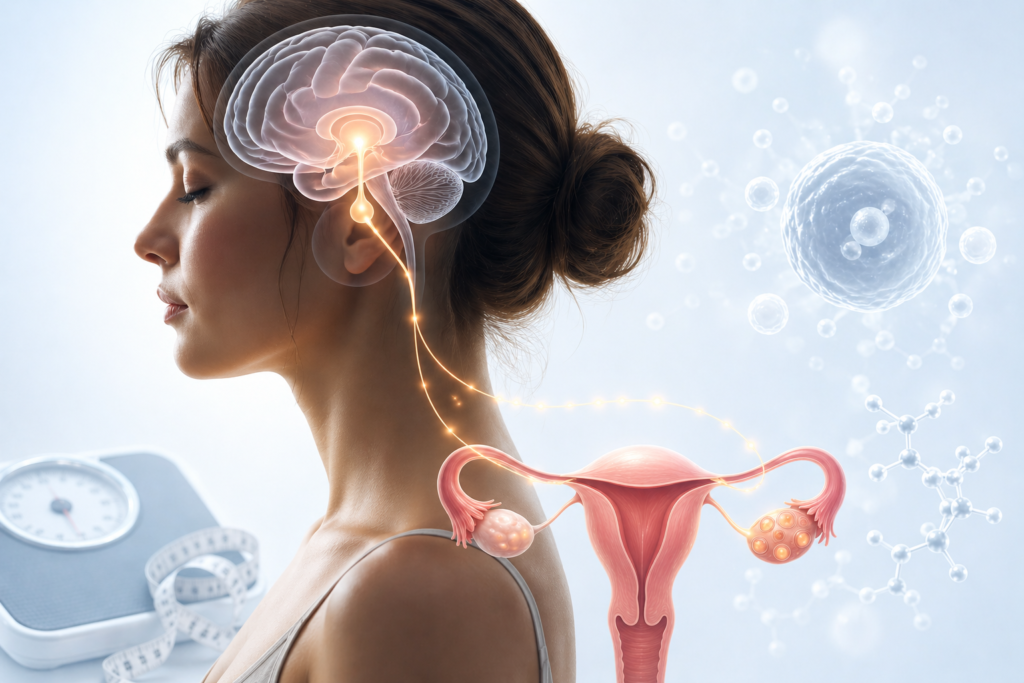
Ovulation depends on signals from the hypothalamus to the pituitary and ovaries: the hypothalamic–pituitary–ovarian (HPO) axis. Irregular or absent cycles can have several causes along this pathway and elsewhere.
The Multi-Factorial Drivers of Anovulation
Anovulation is not a single diagnosis; it is a clinical manifestation of a system struggling to maintain balance.
- PCOS: A common cause of ovulatory dysfunction, often associated with insulin resistance; its presentation and mechanisms vary.
- Energy availability: Undernutrition, intensive exercise or other health changes can disrupt hypothalamic signaling. Body weight alone does not diagnose the cause.
- Stress: It can contribute to hypothalamic dysfunction in some circumstances, but should not be assumed to explain an irregular cycle.
- Other endocrine causes: Thyroid disease, high prolactin and ovarian insufficiency require distinct evaluation.
More than a temporary glitch?
A persistent change deserves assessment, but absent bleeding can also occur with pregnancy, lactation or hormonal contraception. The meaning depends on the context.
A Call to Clinical Action
If your cycles are becoming infrequent (oligomenorrhea) or have ceased entirely (amenorrhea), it is a diagnostic red flag, not a lifestyle footnote.
- Consider context: Pregnancy, lactation, medications and contraception can alter bleeding.
- Targeted assessment: History and examination guide hormone tests, imaging and metabolic assessment.
- Treat the cause: Inducing bleeding can be appropriate for endometrial protection in some conditions, while the underlying diagnosis still needs attention.
A useful health signal
Cycle history can point toward endocrine or metabolic conditions, but irregularity is not proof that someone has failed to manage stress or lifestyle.
Understanding the cause helps guide care for symptoms, general health and reproductive plans. Treatment is individualized rather than an attempt to force every cycle into a fixed pattern.
Disclaimer: This report is for informational purposes. If you are experiencing cycle irregularities or amenorrhea, please consult with a board-certified gynecologist or reproductive endocrinologist to rule out underlying hormonal or metabolic conditions.
The first steps depend on context
Pregnancy, thyroid disease, high prolactin, PCOS, ovarian insufficiency and hypothalamic causes require different consideration. ASRM amenorrhea guidance (2024).
Related reading
Thyroid and Fertility: When the Silent Conductor Needs Attention