

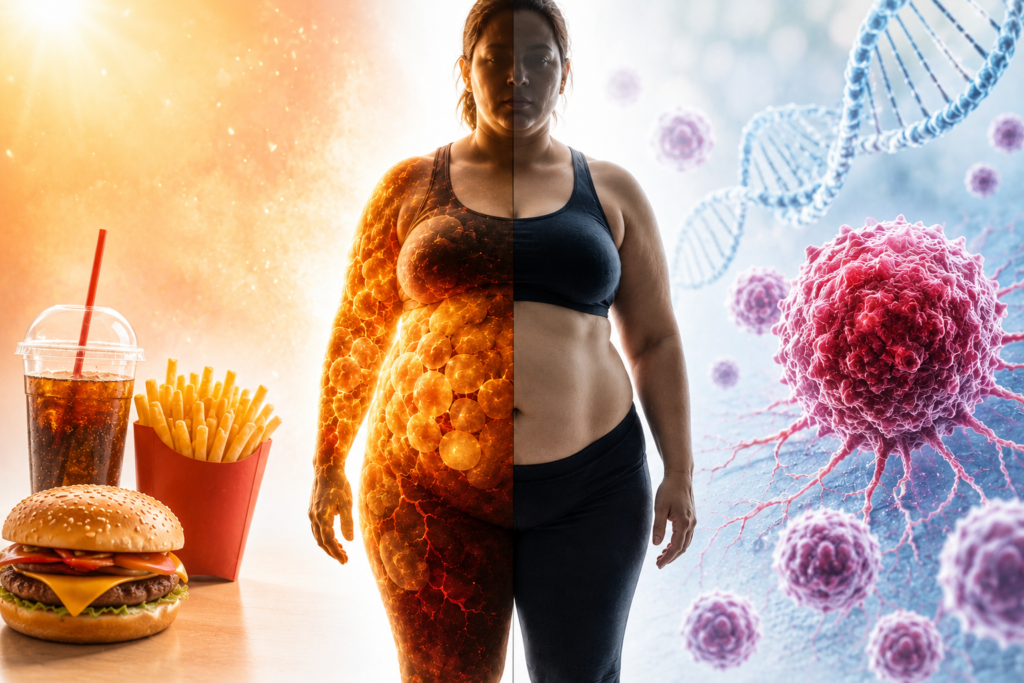
For many, cancer is viewed through the lens of genetics or bad luck. However, leading oncologists are increasingly framing cancer not as a sudden anomaly, but as the final consequence of metabolic dysregulation that has accumulated within the body over years, or even decades. At the center of this progression is obesity.
The “Hidden Obesity History” A study recently published in ESMO Real World Data and Digital Oncology has unveiled a startling finding: individuals who have been obese at any point in their lives—even if they are currently at a healthy weight—face a significantly higher risk for 13 types of cancer, including breast, colorectal, pancreatic, liver, and uterine cancers.
In clinical practice, physicians frequently hear patients say, “But I’m at a healthy weight now.” This new research, which analyzed medical records of approximately 79,000 cancer patients, reveals that the current weight is not the sole predictor of risk. The researchers identified a phenomenon termed “Hidden Obesity History.” While the prevalence of obesity among cancer patients at the time of diagnosis was 26.4%, when their past weight history was factored in, that figure jumped to 53.5%. More than half of the cancer patients studied had experienced obesity at some point in their lives.
The “Memory” of Obesity Researchers interpret this as the “biological memory of obesity.” Even if the scale reflects a lower number, the physiological changes triggered by obesity often persist.
Adipose tissue is not merely a storage unit for excess energy; it is a massive endocrine organ. It secretes hormones and inflammatory mediators that actively reshape the body’s internal environment. When a body is obese, it exists in a state of chronic, low-grade inflammation. Though often asymptomatic—lacking visible pain or fever—this inflammation silently damages the vascular system and internal organs.
In this environment, insulin sensitivity declines, cell growth signals become overactive, and the body’s innate cellular repair systems begin to fail. This is the exact environment that cancer cells thrive in. The World Health Organization (WHO) already classifies obesity as a primary risk factor for numerous cancers, but this study confirms that the damage done by past obesity leaves a lasting biological signature.
Metabolic Health as the New Preventive Frontier The research highlights that the battle against cancer begins on the dinner table, long before a diagnosis is made. The daily consumption of refined sugars, processed cereals, and sweetened beverages triggers repeated insulin surges, which fuel fat accumulation and inflammatory responses.
Conversely, diets rich in vegetables, fruits, whole grains, legumes, and nuts do more than just manage weight; they actively lower the body’s systemic inflammation. Many cancer patients, when looking back at their medical history, recognize that they had warning signs—such as non-alcoholic fatty liver, insulin resistance, or weight fluctuations—years before their cancer diagnosis.
Conclusion: How Healthy is Your Metabolism? The question we must ask ourselves is not just “What does the scale say today?” but “How healthy is my metabolism?”
Modern medicine is realizing that weight management is not merely an aesthetic endeavor—it is a proactive strategy in cancer prevention. By addressing metabolic health today, we are not just changing our weight; we are dismantling the inflammatory environment that cancer cells rely on to grow. The “memory of fat” may linger, but through deliberate, long-term commitment to metabolic health, we can rewrite our biological trajectory.
Sources: Research published in ‘ESMO Real World Data and Digital Oncology’; studies on obesity and cancer risk from the ‘Journal of Clinical Oncology’; data from WHO and ACS.
Disclaimer: This report is for informational purposes. If you have concerns about your metabolic health or cancer risk, please consult with a medical professional.