
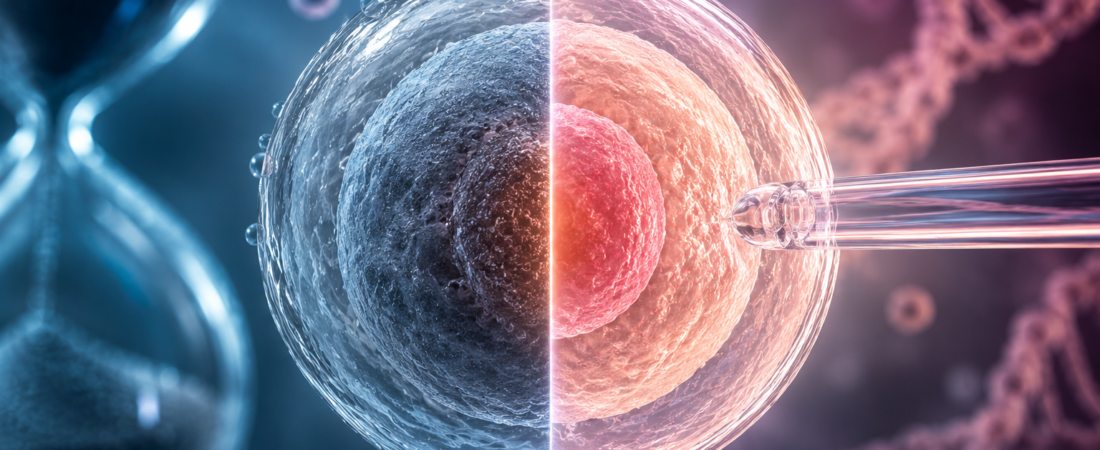
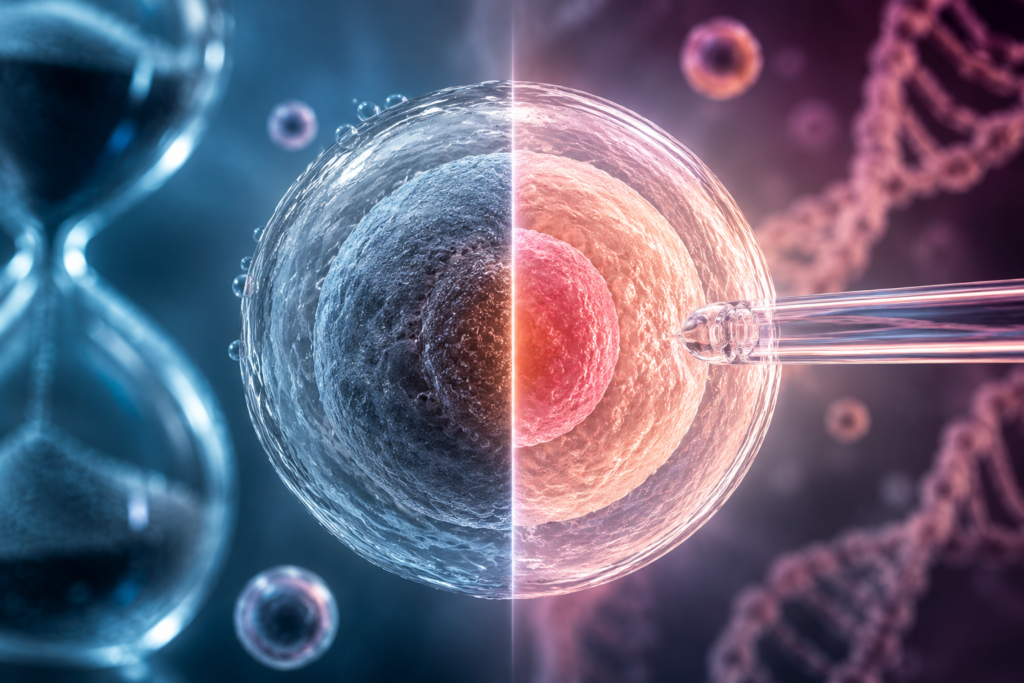
For the past four decades, IVF technology has witnessed monumental leaps: intracytoplasmic sperm injection (ICSI) revolutionized male infertility, pre-implantation genetic testing (PGT) allowed for precise embryo selection, and AI has begun to redefine laboratory workflows. Yet, despite these advancements, one wall remains stubbornly unbreached: the age of the egg.
Biological aging of the oocyte—the decline in egg quality—remains the single most significant factor limiting IVF success rates in women over 40. While we can now select the “best” embryo, we have lacked the ability to fundamentally improve the “raw material.”
Cracking the Code of Oocyte Aging Recent research out of Germany has ignited excitement within the reproductive medicine community. Researchers successfully demonstrated that certain cellular defects associated with oocyte aging could be reversed in a laboratory setting. While this remains in the experimental phase and is far from a clinical procedure, the significance is profound: for the first time, science is asking not just how to find a good egg, but how to make one better.
The cellular decline of an egg is not merely a numbers game; it is a structural failure. As women age, the machinery that divides chromosomes with precision falters, mitochondrial function—the cell’s powerhouse—wanes, and the cellular environment required to support embryo development degrades. This is why, even when eggs are retrieved and fertilized, the resulting embryos frequently arrest in development or fail to implant due to chromosomal errors. Until now, the clinical response to “poor egg quality” has been limited to observation and empathy.
A Paradigm Shift, Not a Commercial Quick-Fix If the findings regarding oocyte rejuvenation can be safely translated into clinical medicine, the strategy for IVF will undergo a tectonic shift. Instead of a passive reliance on the “survival of the fittest” among a limited cohort of eggs, medicine could move toward an active model of restoring oocyte function, thereby increasing the intrinsic potential for pregnancy.
However, the medical community urges profound caution. Terms like “egg rejuvenation” are highly attractive, but they are also potent catalysts for clinical over-promises. We must rigorously verify:
- Can these laboratory results lead to healthy, full-term pregnancies?
- Are there long-term genetic or epigenetic risks to the offspring?
- Is the process safe enough to be applied to human life?
History has seen numerous “miracle cures” that exploited the desperation of patients. This research must be viewed as a scientific starting point, not a current prescription.
Conclusion: The Final Revolution in IVF If the birth of Louise Brown in 1978 opened the door to IVF, and the introduction of ICSI in the 1990s demolished the barrier of male infertility, then “oocyte rejuvenation” could well be the final revolution. The egg is currently the primary bottleneck of reproductive medicine. If we can safely restore the function of aged eggs, the success rates for women in their late reproductive years could enter an entirely new dimension.
For now, the term “rejuvenation” remains a headline rather than a clinical reality. But should this science mature, we may finally possess the “time machine” that reproductive medicine has chased for decades. Until then, our path forward is clear: tempered expectations, rigorous scientific verification, and the steady pursuit of an innovation that could redefine the boundaries of human life.
Sources: Recent experimental research from German research institutions on oocyte aging; systemic reviews in reproductive medicine; expert commentary on the future of IVF technology.
Disclaimer: This report is for informational purposes only. “Oocyte rejuvenation” is currently in the experimental stage and is not an available clinical procedure. All medical decisions regarding IVF must be made based on established, FDA/KFDA-approved protocols in consultation with a board-certified reproductive endocrinologist.