
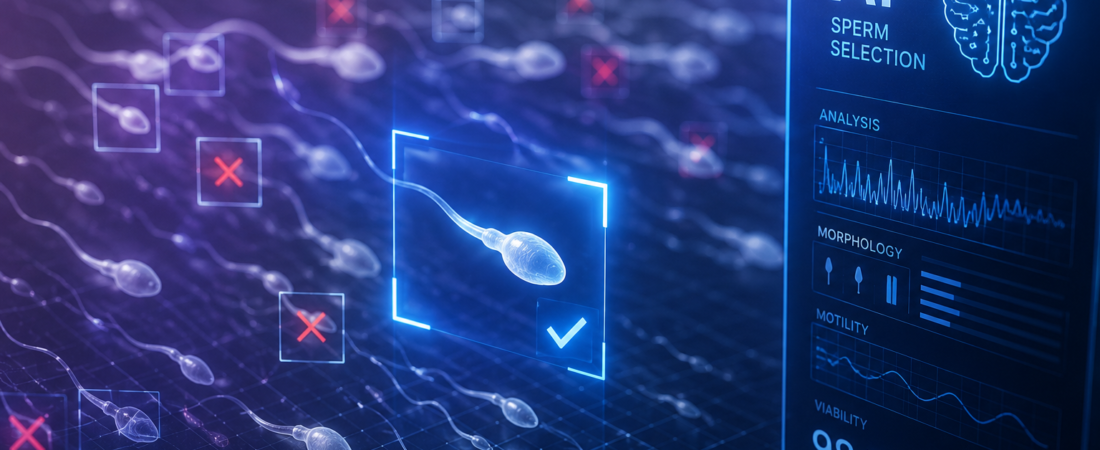
AI sperm recovery with Columbia’s STAR system seeks rare sperm that may be missed during a manual search. The reported pregnancy is an important early milestone, not proof that every case of azoospermia can be overcome. STAR can find existing sperm; it cannot create sperm that are absent.

Finding rare sperm in a sample can be extraordinarily difficult. AI-assisted search aims to help laboratory teams locate cells that a lengthy manual search may miss.
The STAR Breakthrough
Researchers at Columbia University Fertility Center recently unveiled a landmark success using an AI-driven sperm search system called STAR. This technology is designed to identify and retrieve viable sperm from patients suffering from severe male factor infertility—cases where traditional microscopic examination would often conclude that “no sperm are present.”
The reported pregnancy demonstrates a possible use of the system in a selected case. It does not provide a comparative pregnancy or live-birth success rate for all men with azoospermia.
Detection followed by recovery
STAR combines high-speed imaging, AI-based detection and microfluidic isolation to search for rare sperm. Recovered cells still require appropriate embryology assessment and treatment planning.
The potential use depends on whether sperm are present in the sample. A diagnosis such as Klinefelter syndrome or non-obstructive azoospermia does not itself establish that the system will recover usable sperm.
A limit that matters
Sometimes sperm are too rare to be found manually; sometimes no usable sperm are present. AI cannot turn the latter situation into the former. A reported pregnancy is an early outcome, not a universal success rate.
Read the illustration as a concept
The accompanying AI graphic is illustrative. Its displayed percentage is not a validated STAR success or viability rate.
Conclusion: Expanding the Boundaries of Possibility
AI in IVF is not a replacement for the clinician; it is a tool that expands the horizon of what human eyes and hands can achieve. If traditional IVF was the technology of creating life, AI-assisted IVF is the technology of finding the possibility of life where it was once invisible.
The next stage of competition in reproductive medicine will not be about who can generate the most embryos, but who can most precisely, swiftly, and reliably locate the hidden clues of life.
Disclaimer: This report is for informational purposes. Clinical implementation of AI in IVF is a rapidly evolving field and must be discussed with your fertility specialist regarding its current applicability and clinical outcomes.
An early milestone rather than a success guarantee
Columbia describes the imaging, detection and recovery process and reports its first pregnancy in March 2025. Patient selection and follow-up matter when judging clinical usefulness. Columbia University Fertility Center: STAR.
Related reading
Sperm Selection for ICSI: Can AI Replace the Embryologist’s Eye?