
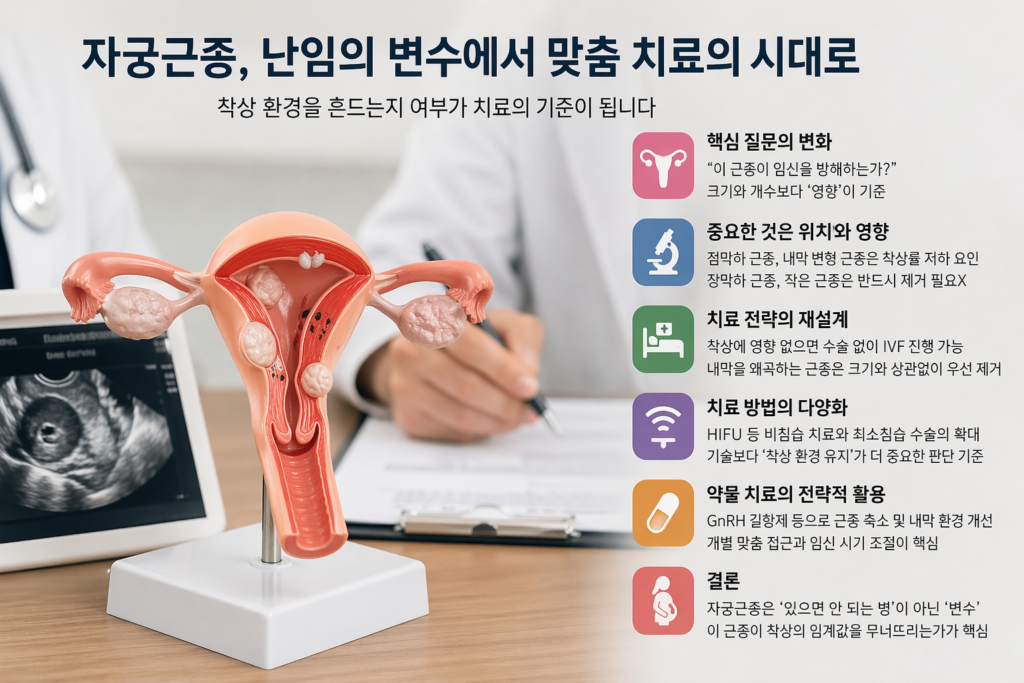
The clinical approach to uterine fibroids (leiomyomas) is undergoing a quiet but fundamental transformation. In the context of fertility care, the traditional question—”Is this fibroid large enough to be removed?”—has been replaced by a more precise, strategic query: “Does this fibroid impede implantation?” Infertility specialists are moving away from viewing fibroids as simple masses to be excised, and toward treating them as clinical variables that must be managed to secure an optimal environment for embryo implantation.
The Shift: Location Over Size The paradigm shift centers on the recognition that a fibroid’s location is far more critical than its dimensions. Submucosal fibroids, or those that distort the uterine cavity, are now recognized as major barriers to implantation. Conversely, subserosal fibroids or small intramural fibroids that do not affect the endometrial lining are increasingly left untouched. The standard has moved from “existence” to “influence.”
Strategy: Sequencing the Intervention This shift has revolutionized treatment sequencing. Historically, the removal of fibroids was often the preliminary step before starting IVF. Today, the clinical roadmap is highly customized:
- Fibroids that do not impede implantation: IVF may proceed immediately, avoiding the surgical stress on the uterus.
- Fibroids that distort the endometrium: Prioritization is given to surgical removal, even for small lesions, to clear the path for the embryo.
Infertility treatment is no longer a linear process but a complex sequence of “threshold management.” Fibroids are now integrated into this step-by-step structural plan.
Refining the Therapeutic Toolbox The methods for managing fibroids have also become more nuanced to prioritize uterine preservation:
- Minimally Invasive Approaches: Techniques like hysteroscopic or laparoscopic removal are preferred to minimize scarring. While High-Intensity Focused Ultrasound (HIFU) offers a non-invasive alternative for fibroid reduction, experts urge caution regarding its long-term effects on pregnancy outcomes, which remain under clinical study.
- Pharmacological Preparation: GnRH antagonists are increasingly used strategically as a “pre-treatment” to shrink fibroids and stabilize the uterine environment prior to IVF cycles. This requires a balanced approach to manage the potential effects on endometrial receptivity.
Conclusion: The Threshold Question It is critical to avoid the mistake of labeling all fibroids as absolute causes of infertility. Many women conceive naturally with fibroids present, and some fail to conceive even after fibroid removal. Uterine fibroids are not an inherent “disease to be erased” but a “variable whose impact depends on conditions.”
The central question in modern fertility care is: “Does this specific fibroid collapse the threshold for successful implantation?”
The era of indiscriminate fibroid removal has passed. We have entered an era of precision design—where the focus is on discerning what must be left and what must be removed, and determining the optimal timing for intervention within the broader design of the fertility journey.
Sources: Korean Society of Obstetrics and Gynecology Guidelines; Korean Society for Reproductive Medicine (KSRM) materials; ASRM Guidelines; ESHRE Recommendations; Global Market Analysis on Fibroid Treatment (PS Market Research).
Disclaimer: This content is provided for informational purposes, based on current reproductive medicine trends. Medical judgments and treatment decisions must always be made in consultation with professional medical personnel. Image: AI-generated (ChatGPT, OpenAI) / Visual reference for illustrative purposes only.