
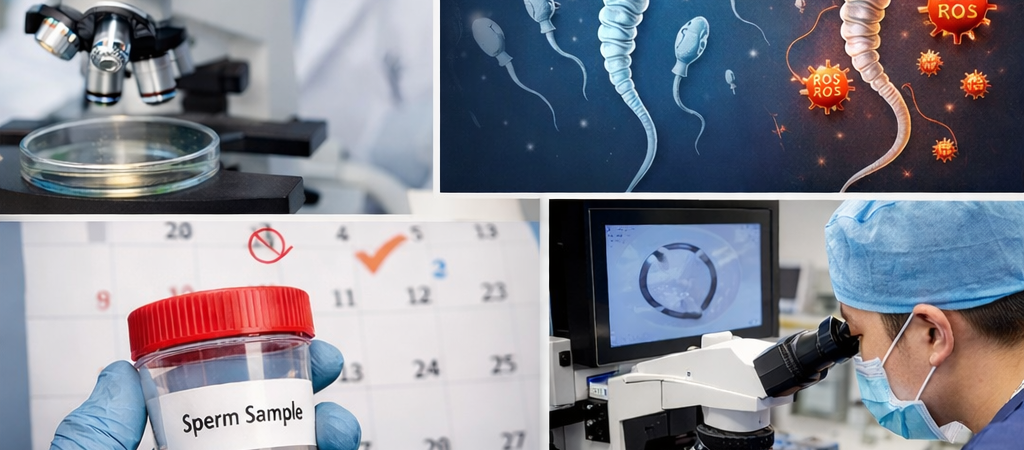
Ejaculation frequency before IVF raises a practical question: should sperm be saved up or collected sooner? Abstinence can change semen characteristics, but diagnostic collection instructions and treatment protocols serve different purposes. A shorter interval is not a universal prescription for a higher live-birth rate.
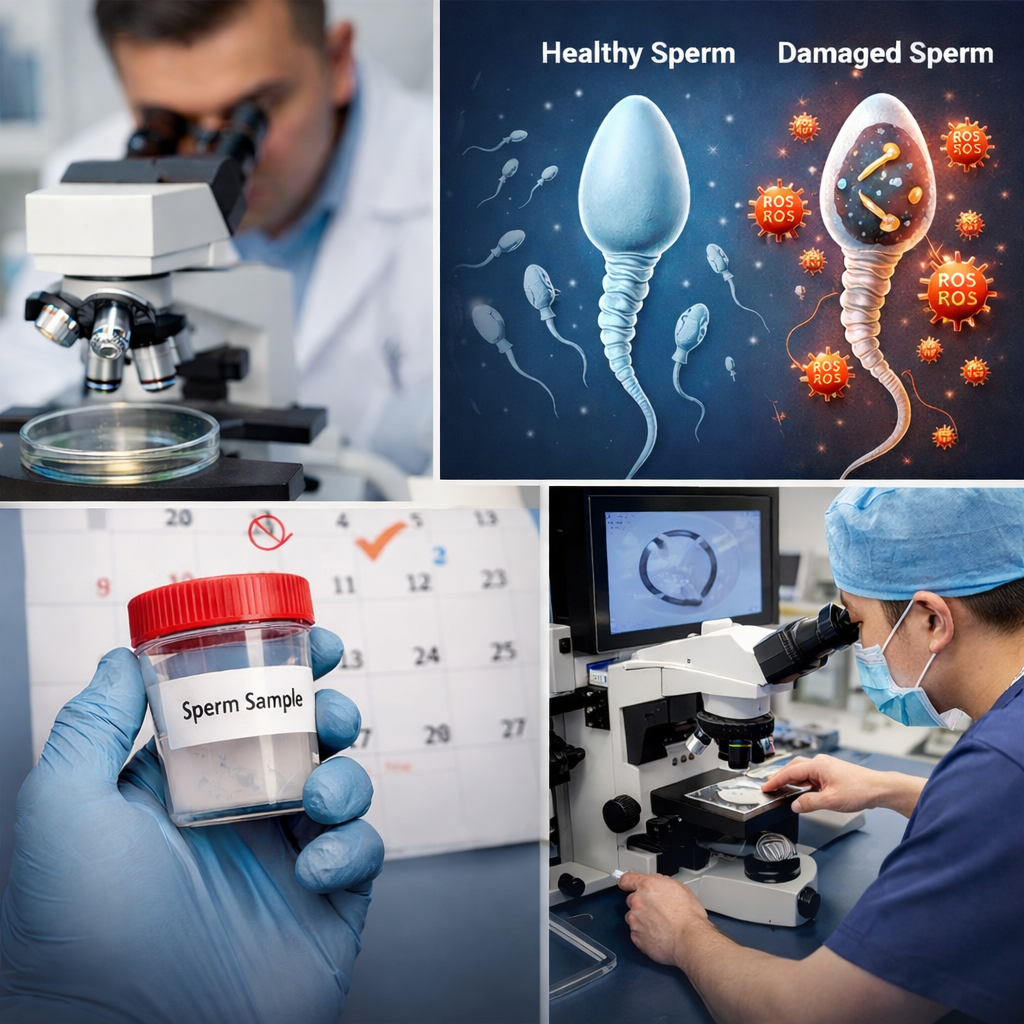
Collection instructions commonly include an abstinence interval. Standardization makes a diagnostic semen sample easier to interpret; it should not be confused with a claim that prolonged storage always improves treatment.
Research on shorter intervals asks whether different collection timing can improve particular semen measures or treatment outcomes. Results should be interpreted by population, protocol and endpoint.
Sperm DNA fragmentation, semen volume, pregnancy and live birth are different measures. A comparison without an identifiable study cannot establish a universal pregnancy-rate advantage for an interval below 48 hours.
Why the purpose of collection matters
A diagnostic sample and a sample used in IVF may require different instructions. Volume, total sperm availability and laboratory handling all form part of the clinical context.
Potential mechanisms involving storage and oxidative stress are research questions. They do not make count or motility irrelevant, nor do they prove that one collection schedule is best for everyone.
Sperm DNA integrity can be clinically relevant, but a single result cannot predict every embryo’s development. It should not be used to tell patients that fertilization must end in failure.
Some treatment protocols use shorter intervals or repeat collections. Patients should follow their clinic’s planned collection instructions rather than improvise a schedule based on a headline.
Individual instructions still matter
Available sperm numbers, the treatment method and previous findings may affect the plan. Ask the laboratory which interval applies and how to report a departure from it.
The useful shift is away from assuming that either more abstinence or more frequent ejaculation is automatically better. It is toward matching a protocol to its purpose.
Perhaps we have been thinking about sperm too simplistically. We assumed more was better, that collection was enough, and that numbers were the ultimate benchmark. But IVF is not a technology that ends with the semen analysis.
Fertilization is an intermediate endpoint. A claimed improvement in one laboratory measure should not be presented as proof of a better chance of a baby.
Disclaimer: This content is provided for informational purposes, based on reporting on infertility and various public data. Medical judgments and treatment decisions must always be made in consultation with professional medical personnel. Image: AI-generated (ChatGPT, OpenAI) / Visual reference for illustrative purposes only.
Collection has a purpose
Diagnostic collection standards are not a universal prescription for intercourse frequency or IVF outcomes. WHO laboratory manual for human semen, sixth edition (2021).
Related reading
Sperm Abstinence Before Testing: Is Saving Up Really Better?