

Weight loss and fertility do not follow a simple rule. Health benefits, ovulation and live birth are different outcomes, while inadequate energy intake can create its own problems. An individualized plan should consider nutrition, medical history and the time available for fertility care rather than demand one ideal BMI.
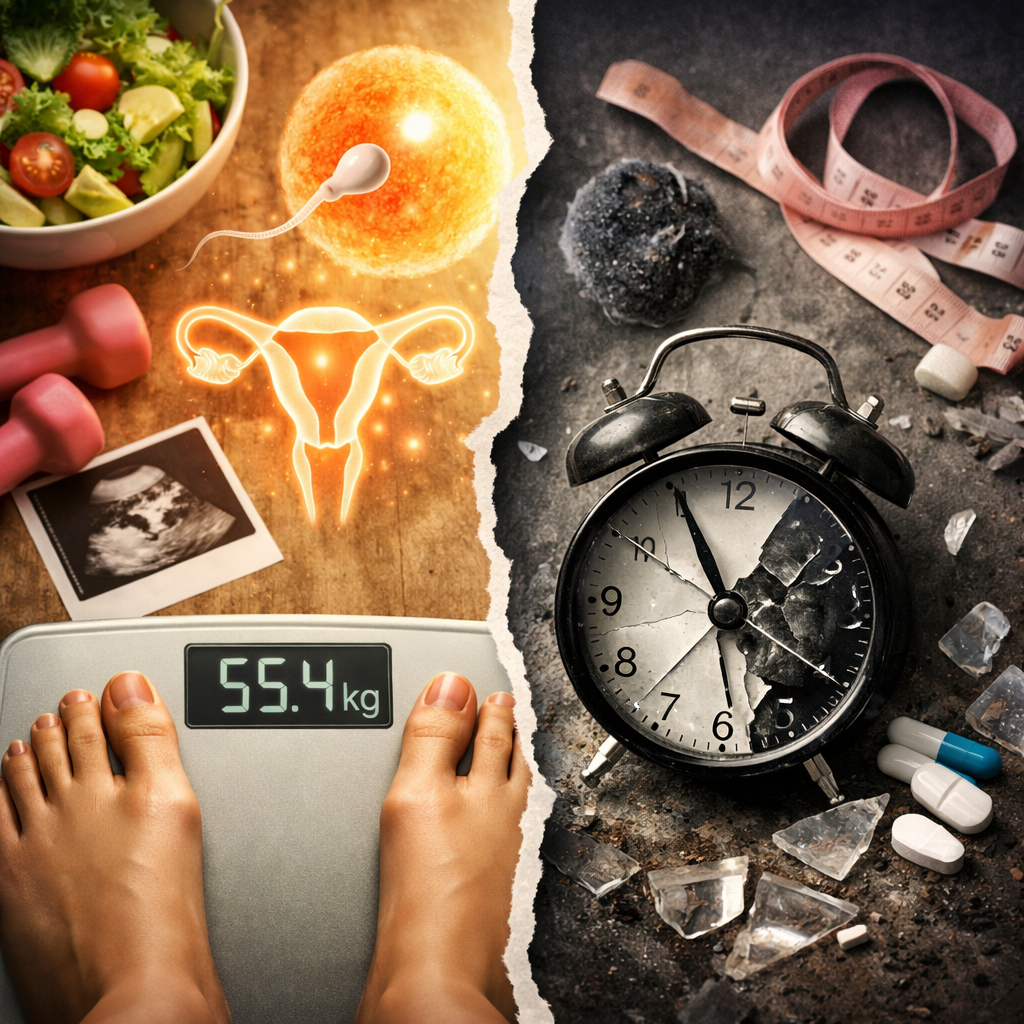
Does losing weight automatically translate into enhanced fertility?
The answer depends on the person and the outcome. A weight change is not automatically a fertility treatment or a cause of reproductive damage.
The familiar “less weight, more fertility” formula leaves out nutritional adequacy, health conditions and treatment timing.
Adipose tissue has endocrine functions. Its relevance to fertility does not mean every weight gain causes the same hormone changes or stops ovulation.
Male reproductive findings also vary. Body size alone cannot diagnose sperm DNA damage or fertilization failure.
Weight management may improve metabolic health and ovulation in some circumstances. That is not a guarantee of pregnancy, a universal percentage target or proof of better IVF live birth.
However, it is precisely at this juncture that the biological narrative completely inverts.
Low energy availability can affect menstrual function. There is no one body-fat threshold at which every reproductive system shuts down.
Severe restriction and excessive exercise can create health problems. Their effects should be assessed rather than described as an inevitable complete loss of fertility.
What outcome is being pursued?
A plan should identify whether it aims to address a health condition, nutrition, treatment safety or another concern. Those goals are not interchangeable.
The reproductive system does not operate as a binary switch controlled by a scale. Supportive care should avoid both guaranteed benefits and catastrophic predictions.
An exact kilogram target cannot answer every fertility question. The plan needs to fit the clinical situation.
There is no universally optimal BMI corridor of 20–24 that certifies reproductive function.
A BMI threshold alone does not diagnose amenorrhea or guarantee restoration of ovulation after weight loss.
Waist measures can contribute to general metabolic assessment. A single 90 cm boundary does not establish sperm DNA damage or infertility.
Changes in relevant clinical findings can be reviewed over time. A patient should not be required to demonstrate perfect ovulation or semen parameters before receiving support.
Rapid weight change warrants attention to nutrition and health. It does not invariably suppress reproduction in every person.
An individualized benchmark
Choose health goals that reflect medical history, nutritional needs and reproductive plans.
Discuss the costs of delaying fertility assessment alongside the potential benefits of weight management.
Success should be defined by a relevant health outcome, not a claim of peak fertility at one body size.
Nutrition and reproductive care
- American Society for Reproductive Medicine (ASRM)
- “Obesity and reproduction: a committee opinion.”
- ASRM Practice Committee Report.
- Significance: Establishes the definitive clinical correlation establishing that maternal obesity directly drives chronic ovulatory dysfunction, alters oocyte quality, and compromises baseline implantation success rates.
- Human Reproduction Update
- Longitudinal cohort analyses on PCOS interventions.
- Significance: Provides robust empirical data confirming that a systematic 5 to 10% reduction in baseline weight is clinically sufficient to restore regular ovulatory cycles and metabolic homeostasis in women with Polycystic Ovary Syndrome.
- World Health Organization (WHO)
- International baseline reference metrics for BMI and global health outcomes.
- Significance: The official international reference framework defining the precise epidemiological boundaries of low weight, normal weight, and progressive obesity phenotypes.
Both partners deserve assessment without blame or rigid universal targets.
- Fertility and Sterility
- Clinical evaluations of paternal metabolic syndromes.
- Significance: Documents a statistically significant, direct drop in total sperm concentration, morphological integrity, and progressive forward motility within paternal cohorts presenting with elevated BMIs.
- Human Reproduction
- Correlative analyses on paternal body mass and genomic integrity.
- Significance: Establishes the molecular link demonstrating that a linear escalation in male BMI directly scales up the sperm DNA Fragmentation Index (DFI) via localized systemic oxidative stress pathways.
Editor’s Note: This content is an analytical commentary prepared by a specialized fertility journalist through the collection and evaluation of domestic and international reproductive medicine research, clinical policies, and statistical data. All medical diagnoses and treatment decisions must exclusively be established through direct consultation with a qualified medical professional.
Image Source: AI-generated (ChatGPT, OpenAI) / Provided solely as a supplemental visual aid for conceptual understanding.
Health goals and treatment timing
Weight-management decisions should balance metabolic health, nutritional adequacy and reproductive plans. Weight loss is not a guaranteed route to live birth. ASRM: obesity and reproduction.
Related reading
Intermittent Fasting and Fertility: Metabolic Tool or Biological Trap?