
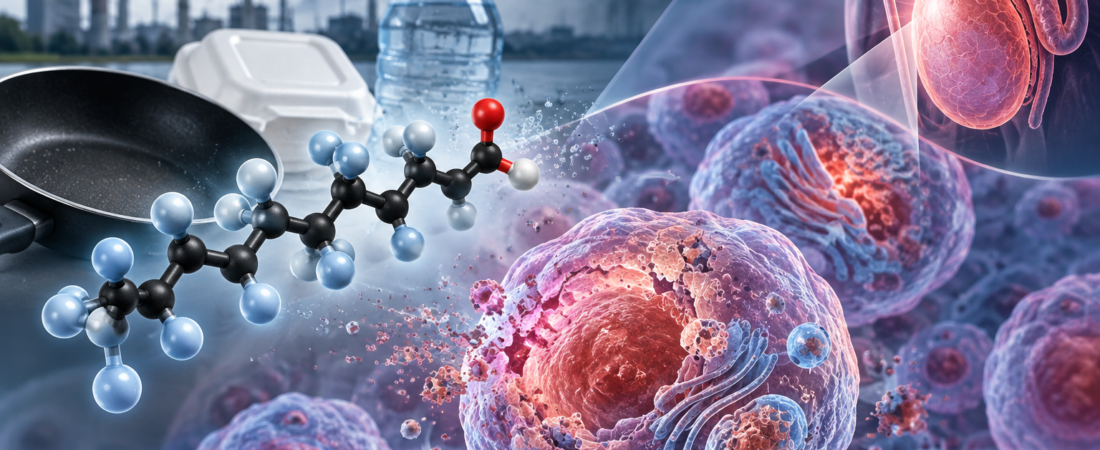
Exposure to the PFAS chemical reduced cell viability and increased early cell death, with changes in autophagy and endoplasmic-reticulum stress.
A Chinese–Singaporean team studied a germ-cell-related cell line; a direct causal link to human infertility remains unproven.

Could chemicals encountered in daily life threaten male reproductive health? Laboratory findings suggest that a PFAS chemical, part of the group often called “forever chemicals,” can injure cells involved in sperm formation.
Researchers at Dongguan Maternal and Child Health Hospital, Southern University of Science and Technology and the National University of Singapore reported reduced viability and increased early cell death after exposure to perfluorooctanoic acid, or PFOA. They also observed changes in autophagy, the recycling of damaged material inside cells, and endoplasmic-reticulum stress responses.
The study was published in Cell Biology and Toxicology on October 27, 2026.
Persistent chemicals and reproductive health
PFAS are a group of chemicals used in industrial processes and consumer products for their water- and oil-repellent properties. Some break down very slowly in the environment and can remain in the body for long periods, prompting concern about environmental and health effects.
PFOA is a prominent member of this group. Its potential effects following environmental contamination and human exposure have been studied extensively, with increasing interest in male reproductive hormones, semen quality and testicular function.
The researchers used the experimental GC-1 cell line to investigate effects on cells related to sperm formation. After PFOA exposure, they performed multi-omics analyses integrating changes in gene expression, proteins and metabolites.
The aim was not merely to identify injury but also to explore the biological pathways through which it might occur.
Cell viability declined as PFOA concentrations increased
Higher exposure concentrations were associated with lower cell viability. Early cell death also increased.
Programmed cell death removes damaged or unnecessary cells through regulated biological processes. Although essential for normal tissue maintenance, excessive activation by harmful exposures can impair cellular function.
Sperm formation is a complex sequence of division and differentiation through which germ cells become mature sperm. Survival and normal functioning of the cells involved are therefore important for sperm production.
The experiment suggests potential toxic effects on these cellular functions. However, GC-1 cells are not equivalent to human testicular tissue or mature sperm, so the results do not establish that PFOA reduces sperm counts in people.
Changes in the cell's internal recycling system
Autophagy was another focus of the study.
This is the process by which cells break down and recycle damaged proteins or unnecessary components. In plain terms, it is an internal cleaning and resource-reuse system.
Normal autophagy helps maintain cell health and survival. Toxic exposures can disrupt its regulation.
The researchers observed changes in autophagy-related signaling after PFOA exposure, along with altered stress responses in the endoplasmic reticulum, which is involved in protein synthesis and quality control.
Endoplasmic-reticulum stress occurs when proteins are not processed normally or the cell is under excessive strain. Persistent stress can impair function and lead to cell death.
The results suggest that autophagy and endoplasmic-reticulum stress may contribute to PFOA-related injury. Changes in signaling alone should not be interpreted as showing that autophagy has stopped completely.
Some drug treatments reduced injury, but clinical benefit is unknown
The team also observed partial mitigation of injury after applying drugs that regulate particular cellular responses.
This provides experimental clues about the signaling and metabolic pathways involved: modifying a pathway can alter the toxic response.
It does not amount to the discovery of a male infertility treatment. Effects in cultured cells have not been shown to translate directly to the human body.
Animal and human studies are needed to establish how these mechanisms affect sperm production and reproductive capacity in living organisms.
The connection to human infertility needs further study
The study contributes a cellular explanation for how an environmental pollutant might affect male reproductive health.
It examined not only viability and cell death but also autophagy, endoplasmic-reticulum stress and metabolic changes.
The subjects were laboratory-grown cells, not men whose semen parameters, natural conception rates or IVF outcomes were measured. The relationship between the experimental concentrations and typical human exposure also needs further assessment.
The findings therefore cannot establish that PFOA directly reduces human sperm counts or causes male infertility.
They do suggest that research should consider injury during sperm formation and environmental influences, alongside abnormalities in sperm themselves.
Male reproductive health is affected by genetics, hormones, lifestyle and disease. Future studies should integrate actual PFAS exposure with semen quality, reproductive hormones and pregnancy outcomes.
Concern about pollutants should not lead someone to diagnose infertility or choose a treatment on the basis of this cell experiment alone. Men with abnormal semen tests or reproductive-health concerns should discuss an appropriate assessment with a urologist.
Source: This article is based on research published in Cell Biology and Toxicology on October 27, 2026, by Jiawei Duan, Yan Sun, Wenting Ye and colleagues at Dongguan Maternal and Child Health Hospital, Southern University of Science and Technology and the National University of Singapore. Using GC-1 cells, the team examined gene-expression, protein and metabolite changes, viability, cell death, autophagy and endoplasmic-reticulum stress after PFOA exposure. This was not a human clinical study. DOI: 10.1007/s10565-026-10322-9.
Image disclosure: The image was created using generative AI (ChatGPT, OpenAI). Any people depicted are fictional, not real individuals.
Related guide: Understanding the tests at a first fertility clinic visit.
Copyright © 2026 Fertility Information TokTok Fertility News | THE FERTILITY NOTES. All rights reserved. Unauthorized reproduction, copying, redistribution, scraping, AI training, and other data use of any articles, photographs, images, or other content are strictly prohibited. Violations may result in legal liability.