
A retrospective study analyzed 14,420 eggs from 1,856 ICSI cycles.
Age showed the most consistent adverse associations; diagnoses alone did not uniformly predict poor egg development.
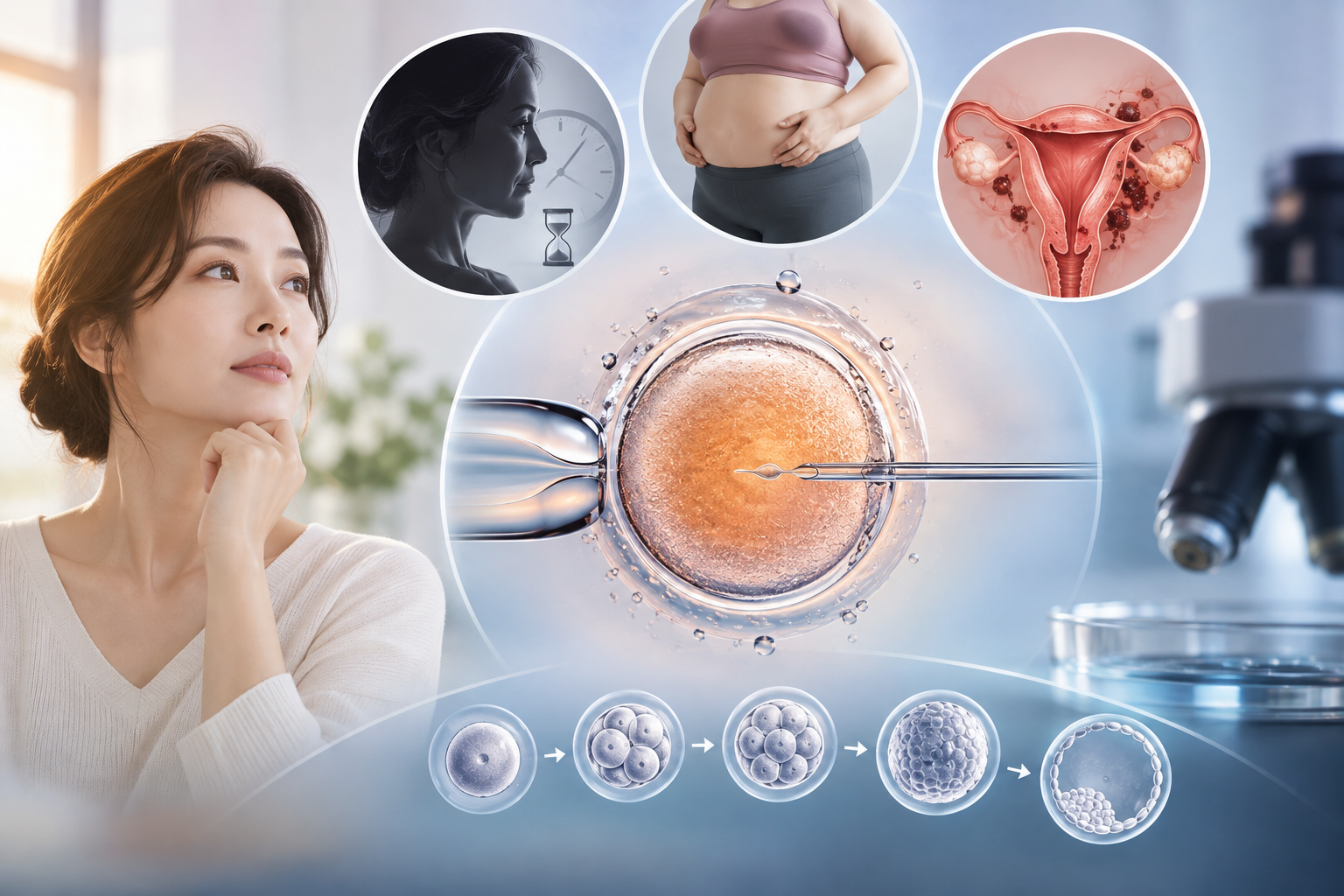
What does “egg quality” really mean in IVF, and do age, obesity and endometriosis affect it in the same way? An analysis of 14,420 eggs from 1,856 ICSI cycles found that these factors did not show identical patterns across maturation, fertilization and embryo development.
Older age had comparatively consistent adverse associations. Obesity and endometriosis were not associated with a uniform decline across every laboratory or clinical measure.
The findings argue against judging every egg solely from body weight or a diagnostic label, while preserving the importance of age and individual reproductive circumstances.
Age showed consistent associations with blastocysts and euploidy
The retrospective cohort covered ICSI treatments using patients' own eggs from 2020–2025.
Investigators assessed fertilization, blastocyst formation, embryo morphology, chromosome status and cumulative pregnancy outcomes.
Controls were divided into under-38 and at-least-38 groups, and analyses of obesity and endometriosis accounted for age differences.
Older age showed the most consistent unfavorable pattern, including lower blastocyst formation, a lower proportion of chromosomally normal embryos and poorer cumulative pregnancy outcomes.
Blastocysts develop after roughly five to six days, while a euploid result indicates no detected chromosome-number abnormality. Both are important measures, although neither alone guarantees birth.
Age was relevant not only to the number of eggs available but also to development after fertilization.
Obesity and endometriosis did not uniformly impair every outcome
Endometriosis can involve inflammation and adhesions outside the uterus and may affect ovarian function when involving the ovary. Obesity can alter hormonal and metabolic function and affect ovulation and pregnancy.
Nevertheless, neither factor showed consistent reductions across all laboratory and clinical outcomes in this study.
This does not mean they have no reproductive consequences. Endometriosis varies by location, severity and surgical history; obesity is associated with ovulatory problems and pregnancy complications.
The narrower conclusion is that neither diagnosis establishes that every egg has poor developmental potential.
The overweight group did show lower top-quality blastocyst formation and poorer cumulative reproductive outcomes. Alongside the absence of a uniform obesity pattern, this suggests that relationships with BMI may not be simply linear.
Developmental potential was largely maintained in a PCOS-related group
The researchers also examined a group with polycystic-ovary-related endocrine and metabolic conditions.
This group had more mature metaphase-II (MII) eggs, generally preserved laboratory developmental outcomes and a higher observed cumulative pregnancy rate.
MII eggs have reached the stage suitable for ICSI. Not every retrieved egg is mature, so total egg yield differs from the number available for injection.
A condition affecting ovarian function therefore need not reduce the developmental potential of every egg.
The pregnancy comparison does not establish that having a particular disorder is beneficial. Age, response and treatment differences can influence outcomes between groups.
An AI egg score was associated with fertilization and blastocyst development
The study also assessed MAGENTA, an AI-derived composite score intended to evaluate egg developmental potential.
Higher scores were associated with fertilization, blastocyst formation and top-quality blastocyst formation, with odds ratios of 1.53, 1.67 and 1.26, respectively.
These values are odds ratios, not findings that fertilization or pregnancy rates increased by 53%, 67% and 26%.
Associations were broadly maintained across the female-factor groups analyzed.
However, adding the AI score to existing clinical information produced only modest gains in prediction. The results do not establish that AI can definitively classify egg quality or predict pregnancy success.
Egg quality is not a single number
Egg quality encompasses more than microscopic appearance: maturation, ability to fertilize, subsequent embryo development and chromosome status are distinct steps.
A factor may affect one stage without clearly affecting another. Conversely, a good egg yield or fertilization rate may coexist with less favorable later development or euploidy.
Age stood out for its comparatively consistent associations across several stages. This does not mean every egg from an older woman is poor quality; population trends cannot determine an individual's outcome.
The observational design also cannot establish a specific factor as a direct cause.
Assessment therefore needs to consider age, ovarian function, disease characteristics and actual developmental results together. A diagnosis of obesity or endometriosis should prompt a stage-specific assessment, not an automatic verdict on every egg.
Study source
“Revisiting common female infertility factors traditionally associated with impaired oocyte quality: insights from IVF outcomes and AI-derived oocyte score performance.” Frontiers in Endocrinology, accepted October 5, 2026, according to the Korean source. Retrospective analysis of 1,856 ICSI cycles and 14,420 eggs from 2020–2025. DOI: 10.3389/fendo.2026.1957168.
The illustration was generated using ChatGPT (OpenAI). Any people depicted are fictional.
Related reading
Endometrioma and IVF: egg retrieval and surgery decisions
Copyright © 2026 THE FERTILITY NOTES. All rights reserved. Unauthorized reproduction, copying, redistribution, scraping, AI training, or data use of any content, including articles, photographs, and images, is strictly prohibited. Violations may result in legal liability.