
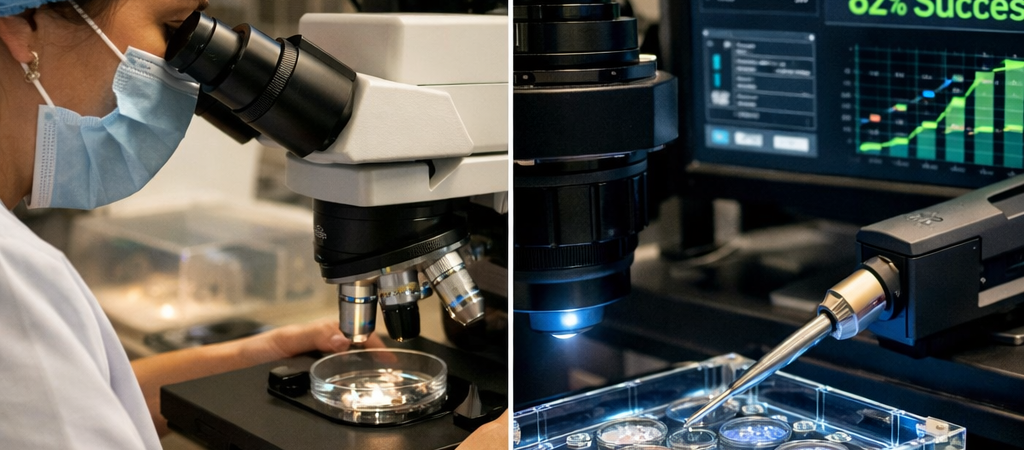
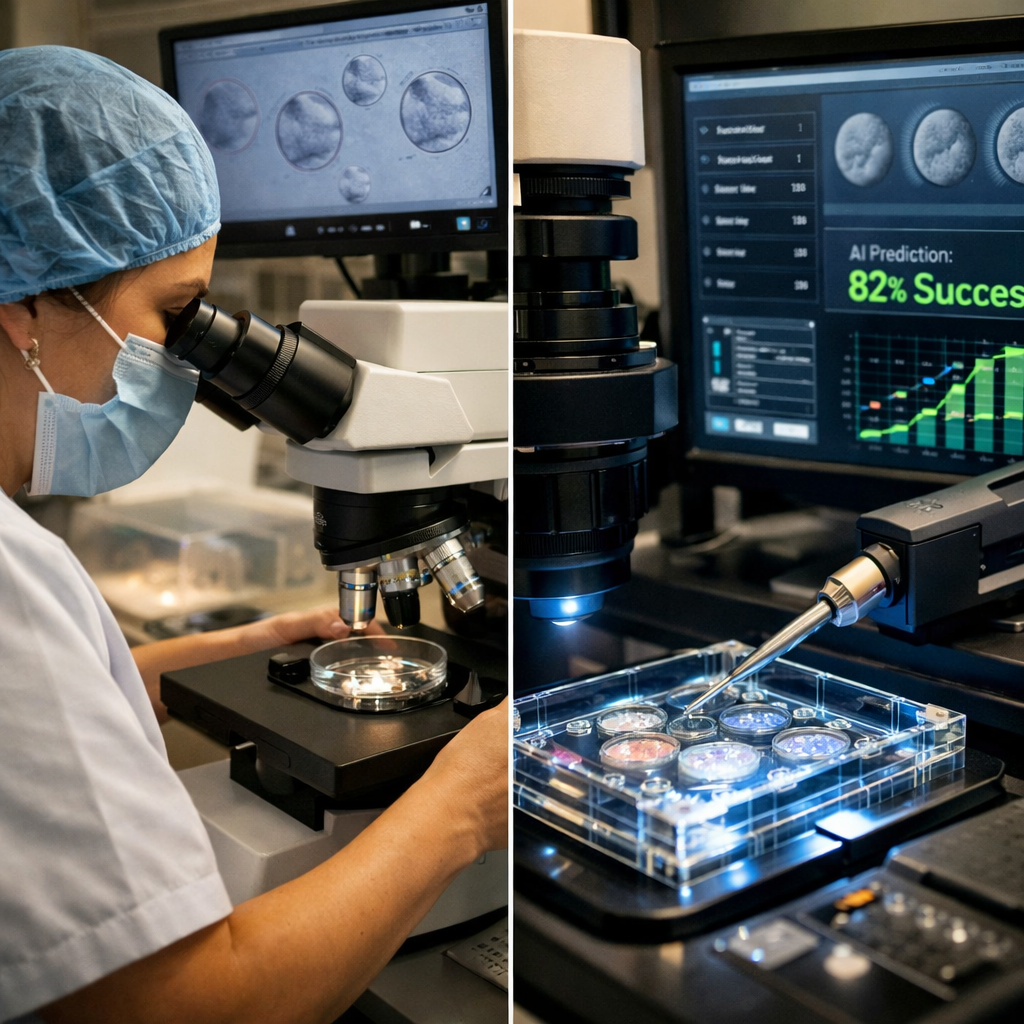
Artificial Intelligence is making a definitive entry into the world of In Vitro Fertilization (IVF). Historically, the assessment of embryos relied almost entirely on the human eye—a process of grading embryos based on perceived quality, symmetry, and visual appeal. It was a practice rooted in “observation” and “experience.”
Today, however, the paradigm is shifting as data enters the equation. A study published in npj Digital Medicine in 2026 exemplifies this transformation. Researchers have introduced a multimodal AI model that predicts pregnancy potential by analyzing Time-Lapse Imaging (TLI) in conjunction with comprehensive clinical patient data.
This technology is more than just a sophisticated image-recognition tool. It does not merely look at a single snapshot; it reads the narrative of time. It tracks when an embryo divides, the velocity of its development, and specific morphological patterns at precise intervals. It then integrates this with clinical variables such as the patient’s age, hormonal status, and the number of eggs retrieved. It does not just look at a single embryo; it analyzes the entire “context” of the cycle.
On the surface, this is an alluring prospect: an AI that quantifies pregnancy potential and recommends the most viable embryo. One might ask, “Are we entering the era where AI picks our embryos?”
However, the reality remains grounded. This technology is not a “magic wand” that instantly spikes success rates. Instead, it is an instrument designed to refine the judgment that physicians have spent years honing through experience. Simply put, it is a device that translates clinical intuition into numbers; a facilitator that converts sensory perception into actionable data.
The most difficult moment in IVF is always the act of selection. Choosing one embryo from many can alter the final outcome. In this process, AI adds a new layer of criteria—it reveals patterns invisible to the naked eye and illuminates subtle differences through numerical analysis. Yet, the physician is still the one who presses the “final button,” and the patient is the one who bears the weight of that decision.
The reason is simple: pregnancy cannot be explained by the embryo alone. It is a multi-dimensional interplay of the uterine environment, immune response, hormonal balance, and the precise timing of the procedure. AI has not yet reached the stage of fully understanding or controlling all these variables. Therefore, AI is not a “replacement” but an “assistant”—not an entity that decides for us, but a tool that makes the decision-making process clearer.
Nevertheless, the shift is undeniable. The standard of IVF is gradually evolving. We are moving from selecting “what looks good” to choosing “what has the highest probability based on data.” It is a transition from an experience-based practice to a data-driven science; from intuition to evidence.
Of course, challenges remain: data bias, variations in laboratory environments between hospitals, and the complex issue of accountability for AI-driven decisions. Above all, the most critical question remains: “How do we interpret the numbers?” We must remember that AI does not provide the ultimate answer; it provides a more sophisticated way to ask the right questions.
Infertility treatment has always existed in the space between hope and uncertainty. AI can help narrow that gap, but the final choice—the weight of that decisive moment—remains firmly in the realm of human responsibility.
Disclaimer: This content is provided for informational purposes, based on reporting on infertility and various public data. Medical judgments and treatment decisions must always be made in consultation with professional medical personnel. Image: AI-generated (ChatGPT, OpenAI) / Visual reference for illustrative purposes only.