
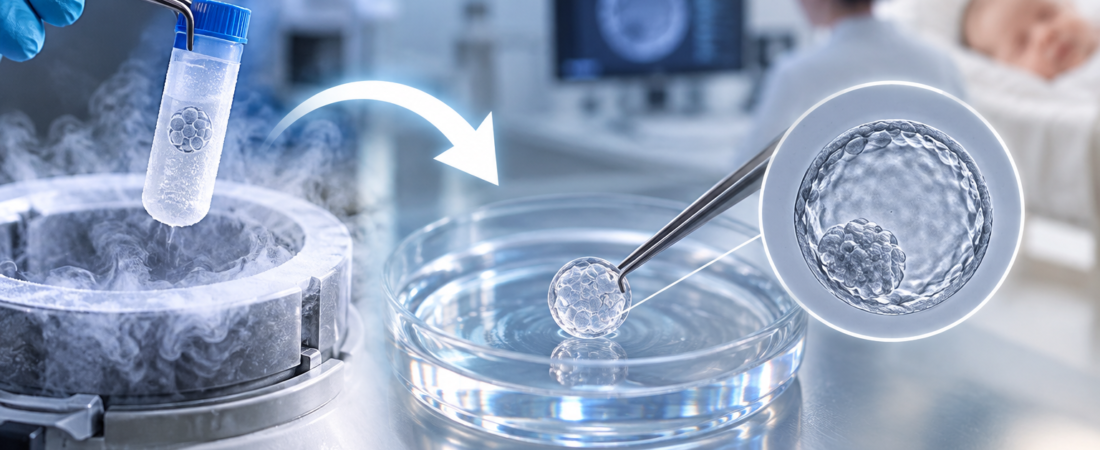
One-step blastocyst warming reduced a roughly 10-minute frozen embryo warming process to one minute in a UK study, while embryo survival reached 97.7%. Across 15 fertility centers and 3,887 blastocysts, survival was higher than with the conventional multistep protocol. Clinical pregnancy and live birth rates, however, did not improve significantly. The 97.7% figure describes survival after warming, not the chance of having a baby.
The findings challenge the assumption that a frozen embryo must always pass through several different solutions during warming. Simplifying the process did not reduce observed survival; in this cohort, survival was higher.
The comparison of standard warming and one-step warming was published online in Reproductive BioMedicine Online on September 28, 2026.
Why conventional embryo warming involves several steps
Vitrification is widely used to freeze embryos during IVF. Extremely rapid cooling turns the solution into a glass-like state, helping prevent ice crystals from damaging cells.
The challenge comes when the embryo is warmed again. Standard warming protocols gradually reduce cryoprotectant concentrations because abrupt removal could cause damaging osmotic shifts.
In the standard protocol evaluated in this study, embryos spent one minute in thawing solution, three minutes in dilution solution, five minutes in washing solution, and another minute in a second washing solution before being moved into culture medium. The sequence took about 10 minutes.
The one-step protocol was much simpler: one minute in thawing solution, followed by direct transfer into culture medium. The intermediate dilution and washing steps were omitted.
Blastocyst survival rose from 95.9% to 97.7%
The study included 3,887 day 5 or day 6 blastocysts. With standard warming, 1,905 of 1,987 survived, a survival rate of 95.9%. With one-step warming, 1,857 of 1,900 survived, or 97.7%.
The absolute difference was approximately 1.9 percentage points when calculated from the underlying counts, and was statistically significant (P=0.013). The reported relative risk was 1.019 and the odds ratio was 1.86.
Centers with relatively lower survival under the standard protocol tended to show greater improvement after switching to one-step warming.
The outcome must be interpreted correctly. A 97.7% survival rate means that this proportion of embryos survived warming. Whether a surviving embryo subsequently implants and results in pregnancy or live birth is a separate question.
Clinical pregnancy differed numerically; live birth rates were similar
For the clinical-outcome comparison, the researchers restricted the analysis to single blastocyst transfers using untested embryos from patients' own eggs, with the woman younger than 38 when the embryos were frozen.
Clinical pregnancy rates were 44.7% with one-step warming and 41.2% with standard warming. Although the one-step percentage was numerically higher, the difference was not statistically significant (P=0.088).
Among cycles with a known final pregnancy outcome, live birth rates were 35.8% and 36.1%, respectively (P=0.946). Thus, this analysis did not find evidence that removing intermediate warming steps worsened live birth outcomes. It also did not establish an improvement in live birth.
Less handling and a faster return to culture
The potential significance is more than saving a few minutes. Gradual cryoprotectant removal has traditionally been considered protective, but prolonged processing and repeated manipulation may not always be advantageous.
Moving an embryo through several solutions increases both handling and time outside the incubator. The researchers highlighted the possibility that one-step warming could reduce manipulation and return the embryo to its culture environment sooner.
Drawing on recent research, the paper also discussed the possibility that cryoprotectant removal and cellular rehydration may occur faster than previously assumed. These explanations remain possible mechanisms rather than proof of why the observed difference occurred.
For a busy fertility laboratory, the operational implications could be substantial. The researchers reported that standard warming required about 10 times as much working time per embryo as the one-step protocol. Centers preparing many frozen embryo transfers each day could therefore see meaningful changes in embryologist workload and laboratory efficiency.
Why this does not prove one-step warming is superior
This was not a randomized controlled trial. It was a retrospective multicenter cohort comparison of two consecutive three-month periods before and after 15 UK fertility centers changed protocols.
Standard warming data came from August 10 to November 10, 2024. One-step warming data came from November 11, 2024, to February 11, 2025. Differences between the periods, laboratory conditions and other unmeasured factors could have influenced the results.
The survival difference was statistically significant, but its absolute size was about 1.9 percentage points. Neither clinical pregnancy nor live birth showed a significant improvement. The findings therefore should not be interpreted as “warming embryos faster increases pregnancy success.”
The more defensible message is that embryo warming may be substantially simplified without an observed sacrifice in survival or subsequent clinical outcomes in the population studied. Further research is needed before generalizing across all laboratories, patients and protocols.
Progress in IVF does not always mean adding another intervention. Sometimes it involves questioning whether every established step is necessary. This study provides an example: a process involving several solutions may be reducible to a single initial warming step.
Study source
This article is based on “Successful introduction of a one-step blastocyst warming protocol: a UK multicentre large cohort comparison,” published online in Reproductive BioMedicine Online on September 28, 2026. The study analyzed 3,887 blastocysts across 15 UK fertility centers. DOI: 10.1016/j.rbmo.2026.105968.
Related reading
- Natural-cycle FET: ovulation, LH surges and transfer timing
- Fluid in the uterus during FET preparation
The illustration was created with generative AI (ChatGPT, OpenAI). Any people depicted are fictional.
Copyright © 2026 THE FERTILITY NOTES. All rights reserved. Unauthorized reproduction, copying, redistribution, scraping, AI training, or data use of any content, including articles, photographs, and images, is strictly prohibited. Violations may result in legal liability.