
By Seungjoo Lee
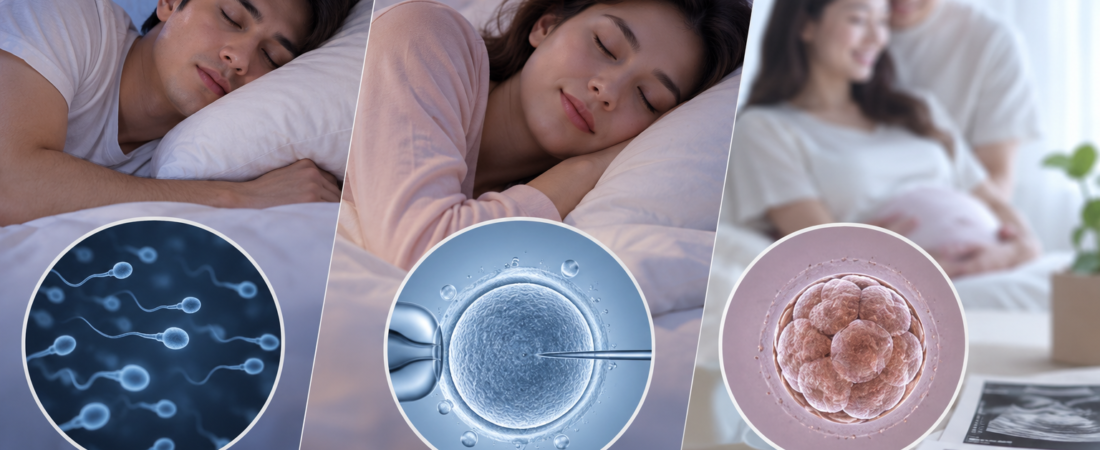
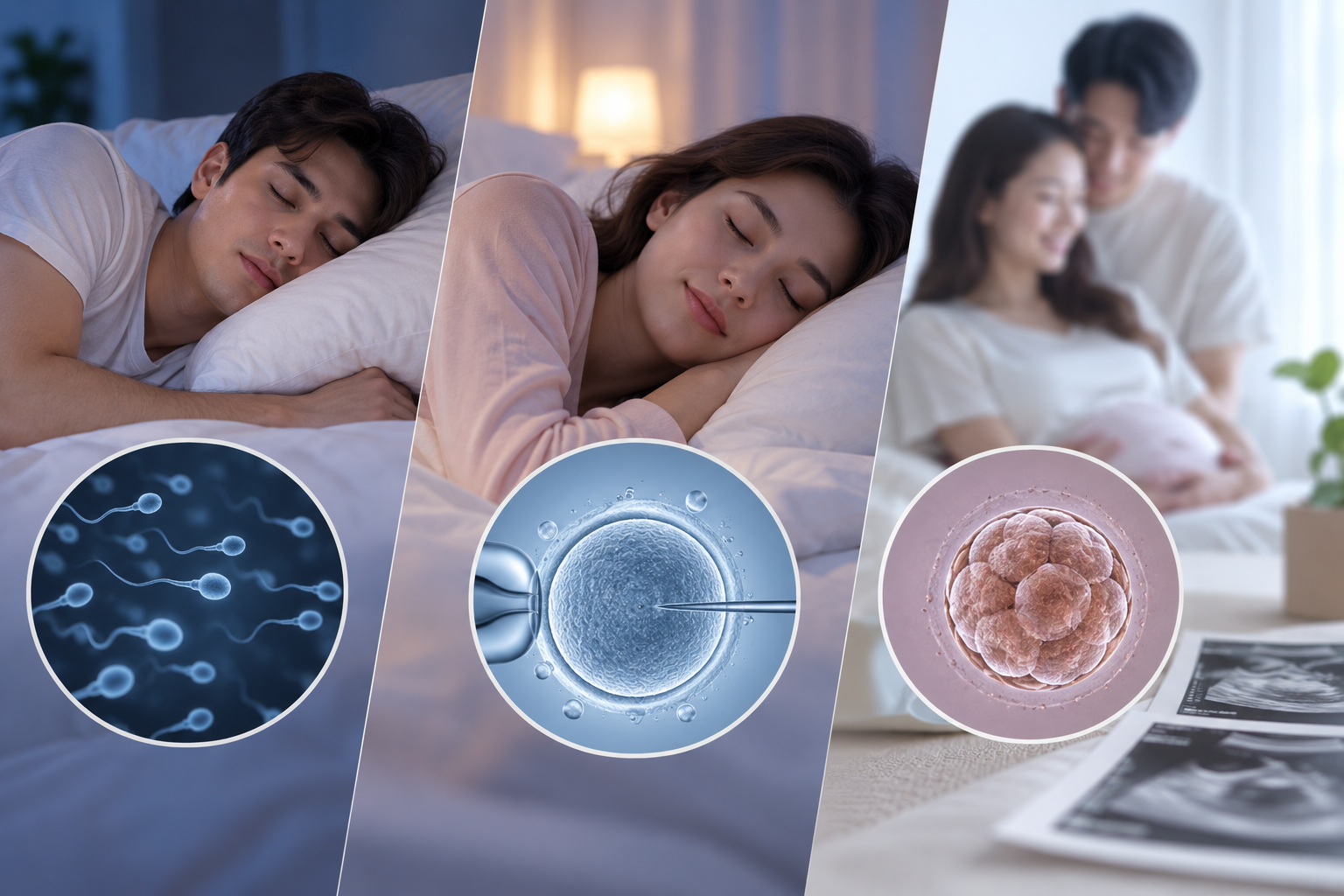
Sleep quality, semen quality and IVF outcomes may be connected. Recent studies link poor sleep with some less favorable sperm measures, and sleep-disordered breathing with lower clinical-pregnancy and live-birth odds after IVF/ICSI. These are associations, not proof that improving sleep alone increases fertility or guarantees implantation.
People starting fertility treatment often take folate, reduce alcohol and smoking, and manage their weight. Sleep can receive less attention, even though research increasingly connects it with reproductive health in both men and women.
Does sleeping well actually relate to the chance of pregnancy? Three recent studies approach that question from different directions.
Sleep duration and quality were associated with semen measures
A North American preconception study published in Human Reproduction analyzed 1,247 semen samples from 690 men. Investigators assessed sleep duration, frequency of sleep problems and subjective sleep quality, then examined semen volume, sperm concentration, total count and motility.
The pattern was not simply “more sleep is better.” Compared with men sleeping 7–8.9 hours, those sleeping less than six hours tended to have lower semen volume, concentration, total count and total motile sperm count. Some measures also tended to be lower among those sleeping at least nine hours.
Men with poor sleep quality on the Pittsburgh Sleep Quality Index (PSQI) had an average 18.1% lower sperm concentration, 19.2% lower total sperm count and 16.3% lower total motile sperm count than men with better sleep quality. Of these comparisons, the concentration difference was statistically significant.
The findings suggest that how someone sleeps, as well as how long, may be relevant to male reproductive health.
Sleep-disordered breathing and outcomes in 9,902 IVF/ICSI patients
A 2026 systematic review and meta-analysis in BMC Pregnancy and Childbirth combined 14 prospective studies involving 9,902 women undergoing IVF or ICSI.
The review examined sleep duration, sleep quality and sleep-disordered breathing, including obstructive sleep apnea, in relation to oocyte retrieval, fertilization, embryo quality, implantation, clinical pregnancy and live birth.
Sleep-disordered breathing was associated with lower odds of clinical pregnancy, with a pooled odds ratio (OR) of 0.52. The pooled OR for live birth was 0.47.
These findings indicate an association between breathing problems during sleep and less favorable reproductive outcomes. They do not prove that sleep apnea itself causes IVF failure: the review predominantly combined observational evidence rather than randomized treatment trials.
Better sleep quality was associated with implantation and clinical pregnancy
A separate meta-analysis in Archives of Gynecology and Obstetrics focused specifically on sleep quality in women receiving assisted reproduction.
Across eight studies with 6,754 participants contributing to the clinical-pregnancy analysis, good sleep quality was associated with higher clinical-pregnancy odds (pooled OR 1.53). Three studies examining implantation also found an association with better sleep quality (OR 1.41).
The result did not extend clearly to live birth. Only two studies contributed live-birth data, and the association was not statistically significant: OR 0.84, with a wide 95% confidence interval of 0.44–1.61.
Odds ratios describe relative odds in study groups; they should not be read as percentage-point changes in an individual’s chance of pregnancy.
Sleep is not an established infertility treatment
The three studies broadly suggest connections between sleep and reproductive health: poor sleep and lower semen measures in men, sleep disturbances and IVF/ICSI outcomes in women, and good sleep quality with implantation and clinical pregnancy.
Possible biological pathways include hormonal regulation, metabolism, inflammation and stress responses affected by sleep deprivation or disrupted circadian rhythms. Researchers are investigating how these changes may relate to sperm production and female reproductive function.
However, the evidence does not establish that sleeping well directly improves pregnancy success. These are not trials proving that seven or eight hours of sleep improves sperm or that deeper sleep causes embryos to implant. Age, weight, stress, lifestyle and underlying health conditions may influence both sleep and fertility.
Sleep is nevertheless a basic element of health that can be addressed during fertility care. Persistent sleep problems, loud snoring, apparent pauses in breathing or marked daytime sleepiness warrant discussion with a healthcare professional, rather than being dismissed as ordinary tiredness.
The message is not that sleeping more makes pregnancy happen. Appropriate, good-quality sleep may be one part of caring for reproductive health in both partners.
Study sources and limitations
A North American preconception study of sleep health and semen quality, Human Reproduction, 2026: 690 men and 1,247 semen samples. DOI: 10.1093/humrep/deaf228; PMID 41330355.
Sleep disturbances and assisted reproduction outcomes in women undergoing IVF/ICSI, BMC Pregnancy and Childbirth, 2026: systematic review and meta-analysis of 14 studies involving 9,902 women. DOI: 10.1186/s12884-026-08808-9; PMID 41709190.
Associations between sleep quality and assisted reproductive technology outcomes: a meta-analysis, Archives of Gynecology and Obstetrics, 2026: eight studies and 6,754 participants in the clinical-pregnancy analysis; only two studies supplied live-birth data. DOI: 10.1007/s00404-025-08241-x; PMID 41606172.
This article introduces research associations and does not predict individual fertility or treatment outcomes. Evidence that treating a sleep problem improves IVF live birth requires further study.
Related reading
Images were created using generative AI (ChatGPT, OpenAI) for illustration and do not depict actual patients.
Copyright © 2026 Fertility Information TokTok | THE FERTILITY NOTES. All rights reserved. Unauthorized republication, reproduction, redistribution, scraping, AI training and data use of articles, photographs, images and all other content are strictly prohibited. Violations may result in legal liability.