
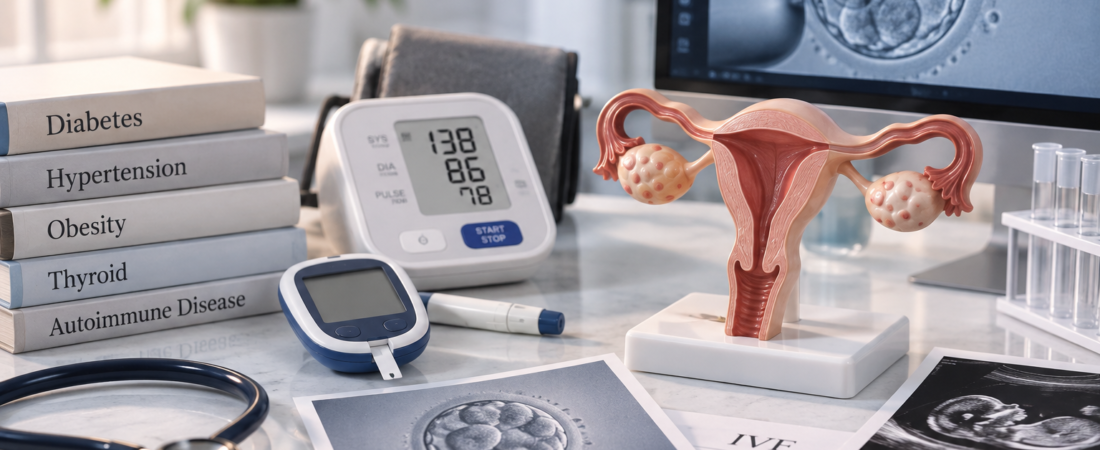
IVF with diabetes, hypertension or obesity raises questions about both live birth and pregnancy safety. Studies suggest lower live-birth outcomes with type 2 diabetes, high blood pressure and obesity, while findings for type 1 diabetes and hypothyroidism differ. As more women seek IVF in their 40s, preconception health deserves attention alongside ovarian reserve.
Blood glucose, blood pressure and weight are part of preparation for pregnancy. A chronic disease diagnosis does not, by itself, mean IVF will fail.
Age is one of the most important factors for a woman preparing for in vitro fertilization. With increasing age, egg numbers decline and embryo chromosome abnormalities become more likely.
However, as more women plan pregnancies in their 40s, there is another issue to consider alongside ovaries and eggs: existing chronic conditions, including hypertension, diabetes, obesity and thyroid disease.
Do these conditions only raise the risk of complications after pregnancy begins, or can they also affect the chance of pregnancy and live birth through IVF?
The research to date suggests that the answer depends on the condition. Not every chronic disease is associated with lower IVF success, but less favorable live-birth outcomes have been observed with type 2 diabetes, hypertension and obesity.
Type 2 diabetes was associated with lower odds of live birth
A study using Denmark’s national assisted reproduction registry found different outcomes for type 1 and type 2 diabetes.
Women with type 1 diabetes did not have a statistically clear difference in live-birth odds per embryo transfer compared with women without diabetes. The adjusted odds ratio was 1.10.
For women with type 2 diabetes, the adjusted odds ratio was 0.50. The less favorable association remained after accounting for other measured factors. A similar pattern was seen among women with type 2 diabetes who were of normal weight, suggesting that obesity alone did not explain it.
An odds ratio of 0.50 should not be read as meaning that an individual’s probability of having a baby is exactly halved. This was an observational study, and metabolic factors such as glucose control and insulin resistance may also have contributed.
Blood pressure before IVF was associated with outcomes
Hypertension may matter before pregnancy, not only after it begins.
In a 2026 study, researchers at Shandong University in China analyzed 43,629 women undergoing the first embryo transfer of their first IVF cycle. The live-birth rate was 49.2% among women with normal blood pressure.
It was 46.1% in women with stage 1 hypertension and 41.4% in those with stage 2 hypertension. Associations with lower live-birth rates remained after adjustment for multiple variables. Pregnancy loss, preeclampsia and preterm birth were also more frequent.
High blood pressure is often considered a risk that becomes relevant during pregnancy—for example, through preeclampsia or problems with fetal growth. This study suggests that blood pressure before pregnancy may already be associated with the final outcome of IVF treatment.
Obesity and an approximately 15% lower relative live-birth rate
The evidence on obesity is comparatively extensive. A systematic review and meta-analysis in Human Reproduction Update analyzed 609,881 IVF cycles in its comparison of women with obesity and women of normal weight.
For women with a body mass index of at least 30, the relative risk of live birth was 0.85 compared with women of normal weight. At the group level, this corresponds to an approximately 15% lower relative rate, not a reduction of 15 percentage points.
Obesity can be relevant from the ovarian stimulation stage onward. Greater gonadotropin requirements and less favorable egg retrieval or pregnancy maintenance have been reported. Once pregnant, women with obesity also face increased risks of complications such as gestational diabetes and hypertension.
It is therefore useful to consider blood glucose, blood pressure, abdominal adiposity and lipid metabolism together, rather than looking at weight in isolation.
Hypothyroidism does not tell the same story
Having thyroid disease does not automatically mean that the chance of IVF success is lower.
A Danish registry study included 3,692 embryo transfers among women with hypothyroidism. Their chance of live birth was not significantly lower than that of women without thyroid disease.
The practical issue is therefore not simply whether a thyroid diagnosis exists, but whether thyroid function is appropriately managed for pregnancy. A finding of similar live-birth odds should not be interpreted as meaning that every thyroid condition, or inadequately treated disease, is harmless.
Autoimmune diseases cannot be treated as one group
Autoimmune conditions also differ. A 2026 meta-analysis in the Journal of Reproductive Immunology found lower live-birth odds per embryo transfer in women with Sjögren’s disease and rheumatoid arthritis than in controls. However, the authors rated the evidence as very low to low certainty.
Disease type and severity, treatment, age and other characteristics are intertwined. These findings do not establish that an autoimmune disease directly causes IVF failure.
IVF in your 40s: assess more than ovarian reserve
A woman’s age remains one of the strongest influences on IVF outcomes at older reproductive ages. These studies do not show that blood pressure or glucose is more important than egg aging.
The concern is that declining ovarian reserve and an increasing burden of chronic disease may occur together as women get older.
For someone planning IVF in her 40s, assessing anti-Müllerian hormone, follicle count and the expected number of eggs may therefore be only part of the preparation. Blood pressure, glucose, glycated hemoglobin, thyroid function, weight and metabolic health, existing diagnoses and medications also deserve review before pregnancy.
The key message is that a medical condition does not automatically equal IVF failure. For some conditions, including type 1 diabetes and hypothyroidism in the available treatment cohorts, a reduction in live-birth odds has not been clearly demonstrated. For type 2 diabetes, hypertension and obesity, less favorable associations have been observed.
IVF care in the 40s calls for attention to the health of the whole woman preparing for pregnancy, as well as the reproductive potential of her ovaries.
Study sources and limits of the evidence
These studies involved different populations and methods; they were not all restricted to women in their 40s. Their averages cannot directly predict an individual woman’s IVF outcome, and the reported odds ratios, relative risks and percentages should not be combined as if they came from one experiment.
- Diabetes: a Danish nationwide registry cohort of 594 women with type 1 or type 2 diabetes receiving ART in 2006–2017, published in Diabetologia (2020). DOI: 10.1007/s00125-020-05193-6; PMID: 32548699.
- Blood pressure: the Shandong University retrospective cohort of 43,629 women, published in Hypertension (2026). DOI: 10.1161/HYPERTENSIONAHA.125.25872; PMID: 41669843.
- Obesity: Sermondade and colleagues’ 21-study systematic review and meta-analysis, Human Reproduction Update (2019); the obese-versus-normal-weight comparison included 609,881 cycles. DOI: 10.1093/humupd/dmz011.
- Thyroid disorders: a Danish nationwide ART cohort, Clinical Epidemiology (2019), including 3,692 embryo transfers in women with hypothyroidism. DOI: 10.2147/CLEP.S208574; PMID: 31496823.
- Immune-mediated rheumatic diseases: a systematic review and meta-analysis of 12 studies, Journal of Reproductive Immunology (2026), with very low to low-certainty evidence and possible confounding. DOI: 10.1016/j.jri.2026.104836; PMID: 41547043.
Management of chronic disease and changes to medication before pregnancy require coordinated assessment by the fertility specialist and the clinician managing the underlying condition.
Related reading
- IVF Success After Three Cycles: What a 68.2% Cumulative Live Birth Rate Means
- Mitochondria and Egg Aging: What Can Treatment Change?
Images were created with generative AI (ChatGPT, OpenAI) for educational illustration and are not clinical photographs of the study participants.
Copyright © 2026 Fertility Information TokTok | THE FERTILITY NOTES. All rights reserved. Unauthorized republication, reproduction, redistribution, scraping, AI training, or other data use of any content, including articles, photographs and images, is strictly prohibited. Violations may result in legal liability.