
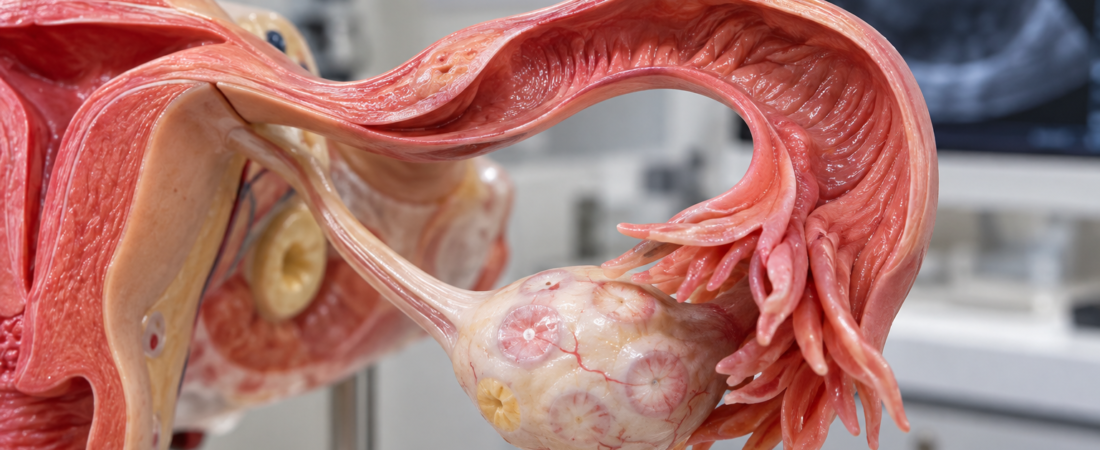
Salpingectomy before IVF raises questions about ovarian response, egg retrieval and cycle cancellation. A French study comparing 114 women after removal of one fallopian tube with 228 matched controls found a less favorable follicle response on the operated side and more cancelled cycles. However, among women who reached egg retrieval, total and mature egg numbers did not differ clearly. The findings do not establish that removing one tube inevitably reduces ovarian reserve.
Women preparing for in vitro fertilization (IVF) may worry when told that one fallopian tube must be removed because of hydrosalpinx or an ectopic pregnancy.
Could removing the tube also affect the ovary immediately beside it?
The fallopian tube does not produce eggs. Removing one tube therefore does not, by itself, mean that ovarian function immediately declines. Yet a recent study identified a signal that deserves attention: during IVF ovarian stimulation, follicle recruitment appeared less favorable in the ovary on the side where the tube had been removed.
The research was published in the Journal of Ovarian Research in May 2026. The investigators suggested that an effect on blood flow around the ovary could be one possible explanation.
How 114 women after unilateral salpingectomy were compared
Researchers in obstetrics, gynecology and reproductive medicine at Hôpital Foch in France analyzed 114 women who underwent IVF between September 2016 and April 2024 after having one fallopian tube removed.
The main reasons for tube removal were hydrosalpinx and ectopic pregnancy.
For comparison, the team selected 228 women of similar age, body mass index (BMI) and anti-Müllerian hormone (AMH) level, a marker of ovarian reserve. Each woman who had undergone salpingectomy was matched with two controls with comparable characteristics.
The investigators focused on how many follicles grew in response to ovarian stimulation.
A follicle is a small sac that contains an egg. During IVF, hormones are given to encourage several follicles to grow at the same time so that several eggs can be collected. The number that grow in response to stimulation is therefore an important indicator of how the ovaries respond to fertility medication.
Fewer follicles were recruited on the side of tube removal
The results showed a difference in follicular response between the ovary beside the removed tube and the opposite ovary.
In particular, when the investigators compared follicles measuring at least 13 mm on the day of the final maturation trigger before egg retrieval, recruitment was relatively less favorable on the side of salpingectomy.
In plain terms, of the same woman’s two ovaries, the ovary beside the removed tube appeared to respond somewhat less well to stimulation than the other ovary.
This should not be interpreted as proof that removing one tube reduces the number of eggs a woman can obtain.
Among women who went on to egg retrieval, there was no clear difference between the salpingectomy and control groups in the total number of eggs collected or the number of mature eggs.
That distinction is central to the study. It identified a difference in the response during ovarian stimulation, rather than demonstrating a lower baseline ovarian reserve or a lower final egg yield among women who reached retrieval.
IVF cycle cancellation was reported more often after salpingectomy
The most striking difference concerned IVF cycle cancellation.
The reported cancellation rate was 13.2% among women who had undergone salpingectomy, compared with 3.1% among controls.
In this study, an IVF cycle could be cancelled after stimulation had begun if ovarian response was inadequate—for example, if the estradiol response was insufficient or there were fewer than three mature follicles. Relatively more women in the salpingectomy group therefore started stimulation but did not reach egg retrieval.
The paper reported a similar direction of association when women were divided by the reason for tube removal.
For women whose tube had been removed because of hydrosalpinx, the paper reported cancellation rates of 12.5%, versus 4.4% in the corresponding controls. For women whose tube had been removed after an ectopic pregnancy, it reported rates of 8.8% and 1.8%, respectively.
Subgroup analyses involve fewer patients. These figures alone cannot establish that salpingectomy directly caused a cycle to be cancelled.
Reporting note: the subgroup percentages above are reproduced as published. They do not reconcile arithmetically with the paper’s overall cancellation rate, so the precise subgroup estimates require particular caution.
Why could fallopian tube surgery affect ovarian response?
The anatomy helps explain the proposed mechanism.
The fallopian tube and ovary lie close together, and their surrounding blood-vessel networks are closely connected.
Salpingectomy may require cutting the mesosalpinx, the tissue around the tube, and coagulating blood vessels to control bleeding. The researchers explained that this process could affect some of the small vessels supplying the ovary.
The concern is therefore not simply that the disappearance of the tube reduces ovarian function. How well blood flow to the ovary is preserved during the operation may matter.
Other possible influences include the severity of pelvic adhesions at the time of surgery, how closely the tube adheres to the ovary, and the surgical technique used.
Does this mean hydrosalpinx should be left untreated before IVF?
That is not the conclusion to draw.
Hydrosalpinx occurs when a blocked fallopian tube fills with fluid. That fluid may flow back into the uterus. Because hydrosalpinx can adversely affect implantation and pregnancy outcomes in IVF, removing or blocking the affected tube before embryo transfer may be considered, depending on the circumstances.
This study does not show that women with hydrosalpinx should avoid having the affected tube removed.
Instead, it points to the need to weigh the benefits of treating hydrosalpinx against a possible effect of salpingectomy on ovarian response when planning IVF.
The researchers said the timing of salpingectomy should be individualized with ovarian reserve in mind. In some women with limited ovarian reserve, one option to consider may be ovarian stimulation and egg retrieval first, to secure eggs or embryos, followed by treatment of the hydrosalpinx.
Preserving the vessels and blood flow around the ovary as much as possible during surgery is also important.
Ovarian reserve and response to stimulation are different questions
This is the main point to keep in mind when interpreting the findings.
The salpingectomy and control groups were matched on baseline characteristics including AMH. Among women who reached retrieval, total egg numbers and mature egg numbers did not differ clearly.
It would therefore go beyond the evidence to conclude that removal of one fallopian tube necessarily reduces ovarian function or egg numbers.
The picture is more nuanced. A woman may still obtain a similar overall number of eggs after tube removal, while follicle recruitment on the operated side may be less favorable during stimulation. In this study, some women were also more likely to stop an IVF cycle because the ovarian response was inadequate.
There are important limitations. This was a single-center retrospective study of past clinical records, and only 114 women were in the salpingectomy group. The underlying hydrosalpinx or ectopic pregnancy may itself have affected the environment around the ovary. That possibility cannot be completely excluded, and the study cannot establish a causal relationship between surgery and poorer ovarian response.
Nevertheless, the findings raise a relevant issue for women considering fallopian tube removal because of hydrosalpinx or ectopic pregnancy before IVF.
The question “Will removing a tube reduce ovarian function?” does not have a simple yes-or-no answer.
The available evidence does not mean that unilateral salpingectomy inevitably reduces ovarian reserve or the number of eggs retrieved. It does suggest that follicular response on the operated side, and blood flow around the ovary, could be affected.
For women whose ovarian reserve is already low, and for whom one or two eggs may be particularly important, detailed discussion with a fertility specialist is warranted: should hydrosalpinx surgery or egg retrieval come first, and, if surgery is needed, how can ovarian blood flow best be preserved?
Study source and limits
This article is based on research by investigators in obstetrics, gynecology and reproductive medicine at Hôpital Foch and the University of Versailles, France, published on May 22, 2026. It was a single-center retrospective matched case-control study of 114 women after unilateral salpingectomy and 228 controls matched on age, AMH and BMI. Its findings do not replace individualized medical advice.
Benchimol Y, Sanchez S, Racowsky C, et al. Impact of salpingectomy on ovarian response to hormonal stimulation in in vitro fertilization (IVF) cycles. Journal of Ovarian Research. 2026;19:236. DOI: 10.1186/s13048-026-02114-w. PMID: 42174704.
Related reading
- IVF egg numbers and live birth: what one more egg may mean
- Freeze-all versus fresh embryo transfer: the evidence on live birth
The image used in this article was created using generative AI (ChatGPT, OpenAI). Any people depicted are fictional, not real individuals.
Copyright © 2026 Fertility Information TokTok Fertility News | THE FERTILITY NOTES. All rights reserved. Unauthorized republication, reproduction, redistribution, scraping, AI training, or use of any content, including articles, photographs, and images, as data is strictly prohibited. Violations may result in legal liability.