
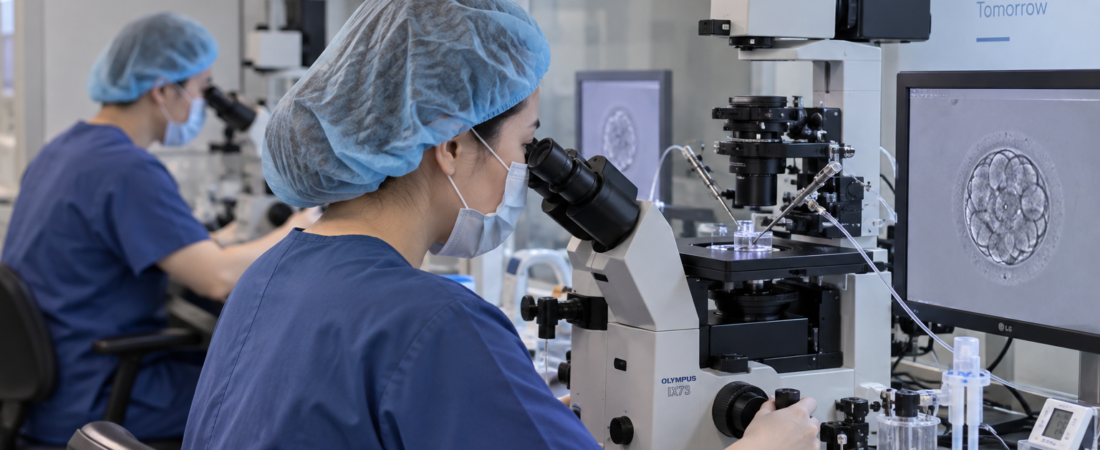
A good IVF laboratory needs more than advanced incubators. The people handling eggs, sperm and embryos, the procedures they follow, and their ability to speak up when something seems wrong are also central to reliable care. Research links ICSI experience with some laboratory outcomes, but does not prove that a particular personality type improves pregnancy or live birth.
Temperature, oxygen and carbon dioxide levels must remain stable, and culture media must be of good quality. Air quality, light and even vibration require careful control. It is understandable that patients choosing a fertility clinic ask whether its laboratory facilities are good.
Yet the laboratory contains more than equipment. In front of that equipment is an embryologist: the person who directly handles the eggs, sperm and embryos.
Studies suggest that results can vary with embryologist experience and competence even when facilities, culture media and equipment are the same. Human factors are also receiving attention: remaining calm, working carefully, and communicating concerns rather than concealing them.
The laboratory is not a place where machines simply grow embryos
For patients, the embryology laboratory is largely out of sight. It is easy to imagine eggs and sperm being placed in an incubator and embryos appearing several days later.
The real process is much more complex. Retrieved eggs must be found and assessed for maturity, sperm processed, fertilization checked and embryo division monitored.
With intracytoplasmic sperm injection (ICSI), an embryologist uses a microscope and a needle much finer than a human hair to introduce one sperm directly into an egg.
Freezing and warming embryos also involve skilled handling. If preimplantation genetic testing (PGT) is performed, a small number of cells must be biopsied from a blastocyst.
This is a setting of continuous fine manipulation and judgment, not a sequence that equipment carries out independently.
That is why the 2026 ESHRE recommendations on good practice in the IVF laboratory identify personnel as one of the most important elements. Procedures should be performed by appropriately trained, skilled practitioners following standard operating procedures (SOPs). New staff should receive structured training under the supervision of experienced embryologists.
Skilled eyes and hands matter from egg identification to ICSI
Differences in competence can appear throughout laboratory work. Immediately after retrieval, eggs must be found accurately and promptly in the follicular fluid collected by the clinician.
This is not a matter of picking out an egg with the naked eye. Under a microscope, the embryologist identifies and isolates the cumulus–oocyte complex, in which the egg is surrounded by cumulus cells. Inexperience can mean taking longer to find eggs or handling them less smoothly.
Sperm selection also requires judgment. One sperm is chosen from many after assessing movement and morphology.
During ICSI, the injection needle must pass through the egg membrane and deliver the sperm precisely. Excessive force or unskilled manipulation may increase the risk of damaging the egg.
Further small manipulations follow: assessing fertilization, culturing and observing embryos, changing media, moving embryos, and freezing and warming them.
Experience therefore means more than a count of years in employment. It is reflected in consistently handling eggs and sperm and making sound decisions at each stage.
Does the person performing ICSI affect outcomes?
A large US study examined 14,362 ICSI procedures performed at a major fertility center between 2008 and 2018.
The investigators used situations in which eggs from the same patient were divided between at least two embryologists for ICSI. This allowed them to examine associations between operator experience and outcomes within an egg cohort.
When the least experienced embryologists performed ICSI, average fertilization rates were lower, and the risk of complete fertilization failure was higher. The adjusted odds of obtaining no fertilization were 4.3 times greater in the least experienced category.
The overall proportion of fertilized eggs that developed into usable blastocysts did not show a clear association with operator experience. However, the least experienced category had higher odds of obtaining no usable blastocysts at all.
The findings show that operator experience can be associated with actual outcomes during IVF. They do not mean that one person's characteristics explain every treatment result.
Are years of experience enough?
Ten years of work does not mean every embryologist approaches a task in the same way.
One person notices a small change, checks again when something seems unusual and follows every step even during repetitive work. With increasing familiarity, another may be tempted to skip a check without thinking.
In the embryology laboratory, these differences can matter as work behaviors. Patients' eggs, sperm and embryos are not interchangeable laboratory samples. Samples must not be mixed up, and the location of frozen material must not be confused.
Microscope-based procedures such as ICSI and embryo biopsy demand concentration and steady hands. Carefulness, composure, sustained attention, adherence to repetitive procedures, and the habit of checking one's own judgment can therefore form part of professional competence.
There is an important boundary to this interpretation. No direct evidence establishes that embryologists with a particular personality produce higher pregnancy or live-birth rates. Nor is there a basis for linking classifications such as MBTI personality types to embryo development.
What matters is how a person's tendencies translate into observable work, rather than a personality label itself.
Being able to speak about a mistake is part of a safe laboratory
A related study presented at the 2026 ESHRE annual meeting surveyed 331 embryologists in Europe, the Americas and the Asia-Pacific region about psychological safety.
Psychological safety means being able to say that something went wrong, or that something unusual has been noticed, without fear of blame.
The survey found a moderate level of psychological safety, with variation by region and experience. Leadership that encouraged open communication and constructive feedback was closely associated with it.
This was a survey presented as a conference abstract. It cannot demonstrate that psychological safety directly increases blastocyst formation, pregnancy or live birth.
Nevertheless, it helps explain why behavior and workplace culture are relevant to embryo laboratories. An embryologist who decides alone that a possible problem is probably harmless behaves differently from someone who calls a colleague and asks for a second check.
Excellent manual technique may therefore be only one part of being a good embryologist.
A good laboratory combines facilities, people and systems
Embryo development should never be explained entirely by the ability of one embryologist.
Patient factors such as egg quality, female age and sperm condition interact with culture media, incubators, temperature, gas concentrations, air quality and many other environmental influences. People work within that whole system.
The 2026 ESHRE recommendations address appropriate staffing, training, competence assessment, adherence to SOPs, continuing education, incident reporting and investigation, and communication between staff as parts of laboratory quality management.
A clinic's laboratory cannot therefore be judged simply by how many new incubators it owns.
Equipment and the culture environment provide the facilities; skilled embryologists make their operation reliable. Their contribution includes qualities not fully captured by a number of years on a résumé: noticing small differences, following the sequence of a repetitive task, staying calm under pressure, checking a judgment, and reporting a problem rather than hiding it.
IVF is advanced life science. Yet during the days when an egg and sperm fertilize and an embryo develops, there is always a person beside the incubator. Good facilities, good systems and good embryologists work together to make a good laboratory.
This article draws on the ESHRE IVF laboratory working group's 2026 good-practice recommendations, published online in July and in the August issue of Human Reproduction; the ESHRE 2026 conference survey on psychological safety and leadership; and the study of ICSI operator experience, fertilization, usable blastocyst development and sustained implantation.
The ESHRE guideline has DOI 10.1093/humrep/deag096 and PMID 42405499. The psychological-safety abstract has DOI 10.1093/humrep/deag083.925. These sources support the importance of competence, standard procedures, communication and safety culture. They do not establish that a particular personality directly increases pregnancy or live birth.
Research references
ESHRE recommendations on Good Practice in the IVF laboratory. Human Reproduction 2026;41(8):1245–1269. PMID42405499. DOI: 10.1093/humrep/deag096.
The missing puzzle of in vitro fertilization success: how embryologists’ psychological safety and leadership dynamics shape team culture, laboratory performance, and treatment outcomes. Human Reproduction41, Supplement1, July8,2026. ESHRE abstract L26/P-594. DOI: 10.1093/humrep/deag083.925.
Evaluation of fertilization, usable blastocyst development and sustained implantation rates according to intracytoplasmic sperm injection operator experience. Reproductive BioMedicine Online2020;41(1):19–27. PMID32466993. DOI: 10.1016/j.rbmo.2020.03.008.
Related reading
The images used in this article were created using generative AI (ChatGPT, OpenAI). Any people depicted are fictional, not real individuals.
Copyright © 2026 Fertility Information TokTok Fertility News | THE FERTILITY NOTES. All rights reserved. Unauthorized republication, reproduction, redistribution, scraping, AI training, or use of any content, including articles, photographs, and images, as data is strictly prohibited. Violations may result in legal liability.