
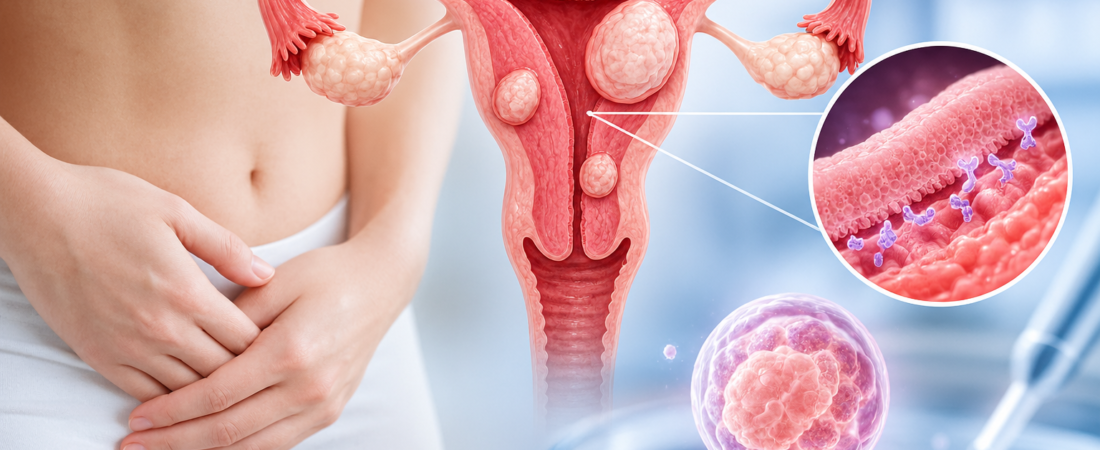
Uterine fibroids and implantation may be connected through changes in the uterine lining’s molecular signals, not only through distortion of the uterine cavity. A small study found reduced expression of leukemia inhibitory factor (LIF) in women with fibroids and an increase after myomectomy. It did not establish that surgery improves IVF pregnancy or live birth rates.
Fibroids that touch the endometrium without protruding into the cavity may also be relevant; larger studies must test clinical outcomes.
Why can uterine fibroids make it harder to become pregnant?
Women receiving fertility care may have heard that a fibroid protruding into the uterine cavity can distort the space where an embryo must implant and affect surrounding blood flow. That is why discussions usually focus on how many centimeters a fibroid measures and how far it projects into the cavity.
Recent research raises another possibility: a fibroid may do more than occupy space. It may also alter signals within the endometrium—the tissue that must receive the embryo. More intriguingly, a reduced implantation-related signal rose again after the fibroids were removed.
What does the uterine lining need before an embryo can implant?
In a study published online in July 2026 in the European Journal of Obstetrics & Gynecology and Reproductive Biology, researchers recruited 42 women with uterine fibroids and 25 fertile women without fibroids.
The focus was the endometrium, not the embryo. IVF understandably places considerable emphasis on producing good embryos, but a good embryo does not automatically produce a pregnancy. The lining must also be ready to receive it—a property called endometrial receptivity.
If the embryo is a seed, the endometrium is the ground in which it must take root. Even a good seed may struggle if the ground is not ready. This is why endometrial readiness involves more than thickness alone.
The researchers measured leukemia inhibitory factor, or LIF, in the lining. Despite “leukemia” in its name, this was not a leukemia test. LIF is a protein involved in communication between cells; in the uterus, it participates in the processes through which an embryo attaches and begins implantation.
It can be understood as one of several signals involved in creating an environment that tells an embryo, “You can settle here now.”
LIF expression was about half as high in women with fibroids
Endometrial LIF expression was about twofold lower in the fibroid group than in fertile women without fibroids.
The researchers also examined two other implantation-related genes: homeobox A10 (HOXA10) and histone deacetylase 3 (HDAC3). Neither showed a clear difference between the groups.
The finding therefore does not mean that every implantation-related function was impaired at once. A distinctive difference appeared in LIF among the signals studied.
What changed after the fibroids were removed?
The researchers examined the endometrium again after myomectomy, the operation that removes fibroids while preserving the uterus.
LIF expression, which had been low before surgery, increased afterward to levels similar to those of fertile controls. The completeness of fibroid removal also mattered in the observed measurements.
Postoperative LIF expression was 0.017 in women whose fibroids were completely removed, compared with 0.0059 in women with residual fibroids. The implantation-related signal was higher after complete removal.
This addresses an important distinction. Even if fibroids affect the lining, that does not tell us whether the change persists or can reverse after removal. In this study, at least one signal—LIF—showed evidence of recovery.
One possible interpretation is that fibroids had been altering the surrounding endometrial environment and that the signal changed when they were removed. A change in a molecular marker, however, is not the same as a demonstrated improvement in the chance of having a baby.
Can a fibroid matter without protruding into the cavity?
A particularly relevant subgroup had FIGO type 3 fibroids, according to the International Federation of Gynecology and Obstetrics classification.
Fibroids are classified partly by their location. Submucosal fibroids, which project into the uterine cavity, are among those most clearly associated with reproductive problems because they directly affect the space where an embryo implants.
FIGO type 3 fibroids are different. They lie entirely within the uterine muscle, or myometrium, but their innermost surface touches the endometrium. They do not project into the cavity itself.
They are more like a lump just behind a room’s wall than one bulging into the room. The shape of the cavity may therefore appear relatively undisturbed.
In this study, the reduction in LIF was particularly evident in women with FIGO type 3 fibroids. This suggests that contact with the endometrium may matter, as well as the amount of protrusion into the cavity. The small sample, however, limits conclusions about other fibroid types. For background, see how fibroid location relates to infertility.
Should fibroids be removed before IVF?
For patients, the practical question is often: “If I have fibroids, should I have them removed before IVF?”
This study cannot answer that question on its own. Its outcome was the expression of molecular signals in the endometrium, not implantation rate, pregnancy rate or live birth rate.
Although the investigators initially recruited 42 women with fibroids and 25 controls, only 21 preoperative samples, 15 postoperative samples and nine control samples were eligible for the endometrial analysis. The analyzed sample was therefore small.
“LIF recovered” and “the chance of having a baby increased” are different findings. Connecting them requires larger studies that directly compare implantation, pregnancy, miscarriage and live birth outcomes before and after fibroid removal.
Nor does this study imply that every fibroid should be removed before IVF. Size, location and number matter, alongside cavity distortion, symptoms, previous implantation failures, age and ovarian reserve.
Surgery can itself place a burden on the uterus. Having a fibroid is not, by itself, a reason to “remove it first and see.” Our coverage of five-year outcomes after HIFU and laparoscopic myomectomy addresses a separate clinical-outcome comparison.
Looking beyond whether a fibroid is present
The study’s significance is not that it recommends fibroid surgery. It changes the question.
Alongside “How large is the fibroid?” and “How far does it protrude into the cavity?”, another question may be useful: “What is this fibroid doing to the endometrium that must receive the embryo?”
Producing good embryos remains central to IVF. Yet implantation also requires a prepared uterine lining. This study suggests that some fibroids may affect invisible molecular signals as well as visible uterine anatomy, and that one such signal can rise again after removal.
It is a small study, and it did not measure birth outcomes. Still, it offers a reason not to explain fibroid-related infertility solely as a mass physically getting in an embryo’s way.
The uterus’s preparation is important alongside the embryo itself. Research on fibroids is beginning to look beyond the size of the mass to what actually changes within the endometrium.
Study source
This article is based on “Reduced endometrial LIF expression in women with uterine fibroids and its restoration following myomectomy,” published online on July 26, 2026, in the European Journal of Obstetrics & Gynecology and Reproductive Biology. Researchers compared LIF and other receptivity-related factors in the endometrium of women with fibroids and fertile controls, and assessed changes after myomectomy. DOI: 10.1016/j.ejogrb.2026.115340; PMID: 42607506.
Medical note: This article introduces reproductive medicine research. It does not replace an individual diagnosis or medical advice about fibroid surgery or IVF treatment.
Image disclosure: The image used in this article was created using generative artificial intelligence (ChatGPT, OpenAI). Any people depicted are fictional, not real individuals.
Copyright © 2026 Fertility Information TokTok · Fertility News | THE FERTILITY NOTES. All rights reserved. Unauthorized republication, reproduction, redistribution, scraping, AI training, and data use of any content, including articles, photographs, and images, are strictly prohibited. Violations may result in legal liability.