
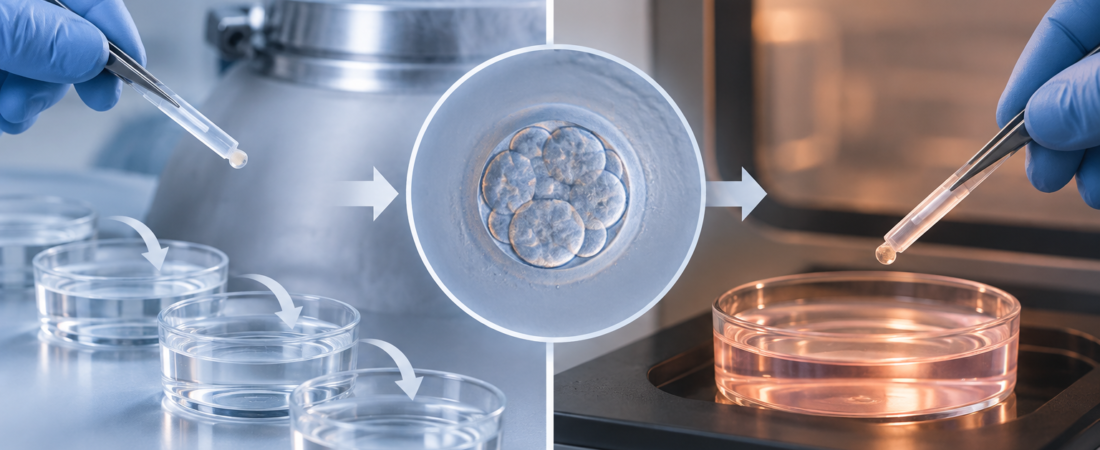
Direct embryo warming moves a frozen embryo straight into warm culture medium instead of through several warming solutions.
A study examined 490 mouse embryos and 15 donated human embryos, comparing development and molecular activity.
Mouse survival, blastocyst development, and live birth outcomes were similar between methods. Human clinical use still requires further research.
Warming a frozen embryo in IVF is more than simply making something cold become warm. Cryoprotectants are used during freezing to prevent ice crystals from forming inside cells. During warming, these substances must be removed while allowing the cells to return to their usual environment without excessive stress.
If this happens too abruptly, embryo cells may swell or shrink suddenly, causing osmotic shock. Conventional practice has therefore generally involved moving embryos through solutions of different concentrations to remove cryoprotectants step by step.
It is reasonable to ask whether all those steps are essential.
What would happen if a frozen embryo were moved directly into warm culture medium?
A study published in Human Reproduction explored that question. The researchers compared conventional warming with direct warming, looking at embryo survival and development as well as changes inside the cells.
From several warming solutions to culture medium at 37°C
Conventional warming transfers embryos sequentially through solutions of different concentrations. This gradually removes cryoprotectants and gives the cells time to adapt to the change in their environment.
Direct warming is simpler. Instead of passing frozen embryos through several warming solutions, the researchers placed them directly into culture medium prewarmed to 37°C. The warming process took approximately three minutes.
Reducing repeated transfers between solutions could simplify laboratory work. However, convenience is not the main question in fertility treatment. What matters is whether the warmed embryo survives and develops appropriately afterward.
For that reason, the researchers did more than examine embryo appearance under a microscope.
Development and live birth were assessed in mouse embryos
The study used 490 vitrified mouse embryos and 15 human embryos donated for research. Mouse embryos were divided between direct and conventional warming groups, with comparisons covering survival after warming, blastocyst development, implantation, and live birth.
The outcomes were similar between the methods.
Mouse embryo survival after warming was 95.8% in the direct-warming group and 93.8% in the conventional-warming group. Blastocyst formation rates were also close: 88.6% and 88.2%, respectively.
Similar results followed embryo transfer in mice. Implantation rates were 82.5% with direct warming and 83.0% with conventional warming. Live birth rates were 69.6% and 71.1%, respectively, with no statistically significant difference.
The researchers also examined the offspring’s growth and major organs. They found no clear differences in growth or developmental milestones. Histological examination of organs including the heart, liver, lungs, kidneys, and reproductive organs did not identify meaningful abnormalities that distinguished the warming methods.
Looking beyond embryo appearance with multi-omics
The study went a step beyond conventional developmental assessment.
Even if embryos survive and appear to develop normally, that does not prove that two warming methods affect them in exactly the same way. Subtle changes could still have occurred inside apparently intact cells.
To investigate this, the researchers used multi-omics analysis. Rather than examining appearance alone, this approach considers which genes are active and whether the chemical marks that regulate gene activity have changed.
Specifically, they examined the transcriptome, which reflects gene activity, and DNA methylation, which is involved in regulating that activity.
Mouse embryos showed very few differences in gene activity or DNA methylation between the warming methods. The analyses did not identify changes suggesting disruption of entire biological pathways.
Some gene-level differences were observed in human embryos, but no clear, coordinated disruption of a specific biological function was identified.
Within the scope of this experiment, the findings therefore did not reveal a clear molecular signal supporting the concern that simplifying warming would leave embryos looking normal while causing hidden problems inside them.
Only 15 human embryos: clinical conclusions remain limited
There are clear limitations to applying these findings immediately in fertility treatment.
Only 15 donated human embryos were included. The direct comparisons of implantation, pregnancy-related development, and live birth came from mouse experiments, not a human clinical trial. Mouse and human embryos differ in size, membrane properties, and early development, so animal findings cannot be directly translated into human frozen embryo transfer outcomes.
This study does not establish that direct warming is superior to conventional warming or that fertility clinics should change their current protocols. Further clinical studies must evaluate pregnancy rates, live birth rates, and long-term safety in humans.
Even so, the research question is worthwhile.
For many years, a central measure of embryo cryopreservation was how well an embryo survived freezing and warming. Researchers are now examining the process more deeply: which warming methods preserve not only developmental potential but also the molecular state inside the cells?
Warming takes only a few minutes. Yet the environment an embryo experiences during those minutes is itself an important subject of fertility research.
Related reading: how embryo culture medium is studied in IVF and why freeze-all decisions differ in low-prognosis IVF.
Research source
This article is based on “Multi-omics and developmental comparison of direct and conventional warming methods in vitrified human and mouse cleavage-stage embryos,” published in the September 2026 issue of Human Reproduction (online July 6, 2026). DOI: 10.1093/humrep/deag105. The original study abstract describes the animal and donated-human-embryo experiments separately.
This article presents recent reproductive-medicine research. It does not replace medical advice about an individual’s fertility treatment or the choice of an embryo-warming method.
The image used in this article was created using generative artificial intelligence (ChatGPT, OpenAI). Any people depicted are fictional, not real individuals.
Copyright © 2026 Fertility Information TokTok Fertility News | THE FERTILITY NOTES. All rights reserved. Unauthorized republication, reproduction, redistribution, scraping, AI training, and data use of any content, including articles, photographs, and images, are strictly prohibited. Violations may result in legal liability.