
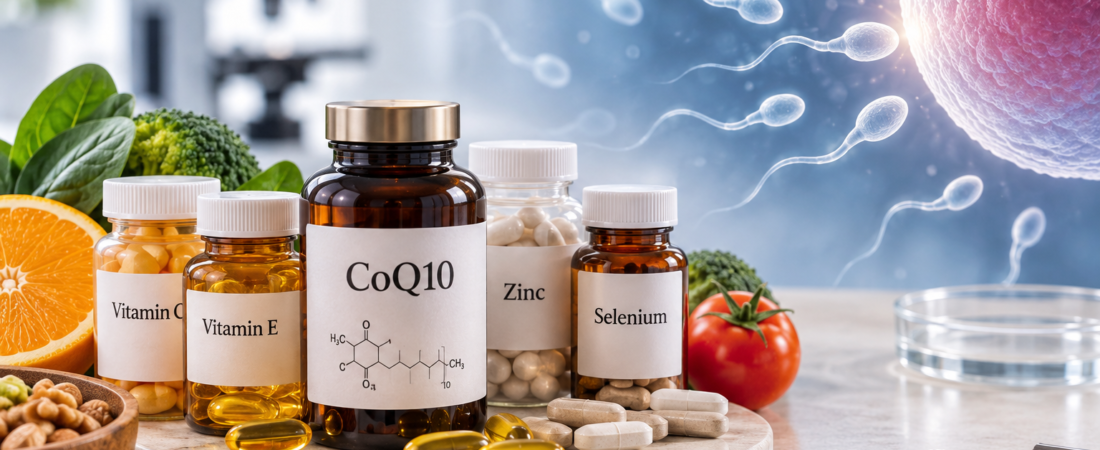
CoQ10 and other antioxidants are often used for male infertility to try to improve sperm concentration and motility. But better semen-analysis results do not necessarily mean a higher chance of pregnancy or live birth. This article examines why antioxidants have attracted interest, what a Cochrane review of 90 randomized trials found, and why current WHO and AUA/ASRM guidance remains cautious. The key question is whether changes in sperm measures translate into outcomes that matter to couples.
Coenzyme Q10, vitamins C and E, zinc, selenium: how they aim to reduce oxidative stress in sperm
Sperm motility and concentration may improve, but benefits for pregnancy and birth remain uncertain; the WHO has also withheld a recommendation
Open the supplement drawer of a couple preparing for infertility treatment, and the husband’s share may be substantial. Coenzyme Q10 (CoQ10), vitamins C and E, zinc, selenium, L-carnitine—the products differ, but their stated purpose is much the same: to make sperm healthier.
Antioxidants are often the first thing people seek out after a test shows a low sperm count or poor motility.
But there is a question that must be asked. Is sperm moving a little better the same thing as achieving a pregnancy and having a baby?
For now, the answer is closer to “we still do not know for certain.”
How oxidative stress affects sperm
Antioxidants have drawn attention in male infertility because sperm are vulnerable to oxidative stress.
The body produces reactive oxygen species as it generates energy. Moderate amounts are necessary for normal sperm function, but an excess can become a problem. They can damage the sperm cell membrane, reduce motility, and harm sperm DNA.
Put simply, sperm are exposed to an excessively oxidative environment. This led to the idea: “If antioxidants reduce reactive oxygen species, could sperm become healthier?”
CoQ10 and sperm motility: what has improved in studies?
One of the best-known ingredients is coenzyme Q10.
CoQ10 participates in cellular energy production and also has antioxidant activity. Sperm use a great deal of energy because they must move their tails to travel toward the egg.
Some studies have indeed found improvements in sperm concentration or motility after CoQ10 supplementation.
The question is what happens next.
If sperm parameters improve, do pregnancies and births actually increase as well?
Analyses combining studies of CoQ10 have observed improvements in sperm concentration and motility but have not clearly demonstrated an increase in pregnancy rates. This is precisely where a semen-analysis report card must be distinguished from the chance of a baby being born.
Antioxidants and live birth: findings from 90 randomized trials
Cochrane researchers analyzed data from 90 randomized controlled trials involving 10,303 men that examined antioxidants for male infertility. The trials included various vitamins and antioxidants, not only CoQ10.
Some results suggested that antioxidant supplementation in men might increase pregnancies and live births.
There was a problem, however. Of the 90 studies, only 12 actually reported live births. The certainty of the evidence was also very low when study quality, risk of bias, and other factors were considered. In particular, after studies of low quality or at high risk of bias were excluded, there was no longer clear statistical evidence that antioxidants increased live births.
In other words, we cannot definitively say that they have no effect, but there is also insufficient evidence to say that they increase the chance of having a baby.
Why WHO and AUA/ASRM guidance remains cautious
A similar conclusion appeared in the World Health Organization’s first global infertility guideline, published in 2025.
The WHO examined whether men with infertility and abnormal semen-analysis results should take antioxidants when trying to conceive naturally or through assisted reproductive technology.
Its conclusion was to make neither a recommendation for nor a recommendation against their use.
The antioxidants, doses, and treatment durations differed across studies, as did the causes of male infertility. Most importantly, many studies focused on semen-analysis measures such as sperm count and motility rather than pregnancy or live birth.
The American Urological Association (AUA) and the American Society for Reproductive Medicine (ASRM) likewise explain that the clinical usefulness of vitamin or antioxidant supplements is uncertain and that there are insufficient data to recommend specific ingredients.
Why taking more antioxidants is not necessarily better
Even with antioxidants, a larger amount is not necessarily more beneficial.
Reactive oxygen species are not simply “bad substances” that must always be eliminated. A certain amount is needed for sperm to function normally. Excessive suppression could instead disrupt the balance between oxidation and reduction.
That is why indiscriminately combining several types of male fertility supplements cannot be assumed to be a better approach.
What the evidence means for couples with abnormal semen results
The current research can be expressed in one sentence:
“It may improve sperm parameters, but there is still not enough evidence to say that it will help bring home a baby.”
Sperm concentration or motility may improve in some men. But it remains unclear which men should take which antioxidants, and in what amounts, to increase their actual chances of pregnancy and birth.
If semen-analysis results are abnormal, identifying the cause should therefore come before assembling a collection of supplements. It is necessary to consider whether there is a treatable cause, such as a varicocele or a hormonal abnormality, whether repeat testing is needed, and whether to wait for natural conception or proceed to IUI, IVF, or ICSI in light of the couple’s ages and the duration of infertility.
What couples with infertility really want to know goes beyond whether sperm parameters will improve.
“So, if we take this, will it really increase our chance of having a baby?”
More research is still needed before medicine can confidently answer “yes” to that question.
Related reading
For a related question about sperm DNA integrity, read our coverage of homocysteine, obesity and sperm DNA fragmentation. That observational study does not establish that supplements improve sperm DNA or fertility outcomes.
※ This article draws on “Antioxidants for male subfertility,” published in the Cochrane Database of Systematic Reviews in 2022, which analyzed 90 studies involving 10,303 men; the WHO’s 2025 infertility guideline; and the AUA/ASRM male infertility guideline. DOI: 10.1002/14651858.CD007411.pub5.
※ This article provides information about medical research. Decisions about an individual’s diagnosis, treatment, or use of supplements should be made in consultation with a medical professional.
※ The image used in this article was created with generative artificial intelligence (ChatGPT, OpenAI) and depicts fictional people, not real individuals.
※ Copyright © 2026 Fertility Information TokTok Fertility News | THE FERTILITY NOTES. All rights reserved. Unauthorized republication, reproduction, redistribution, scraping, AI training, and data use of any content, including articles, photographs, and images, are strictly prohibited. Violations may result in legal liability.