
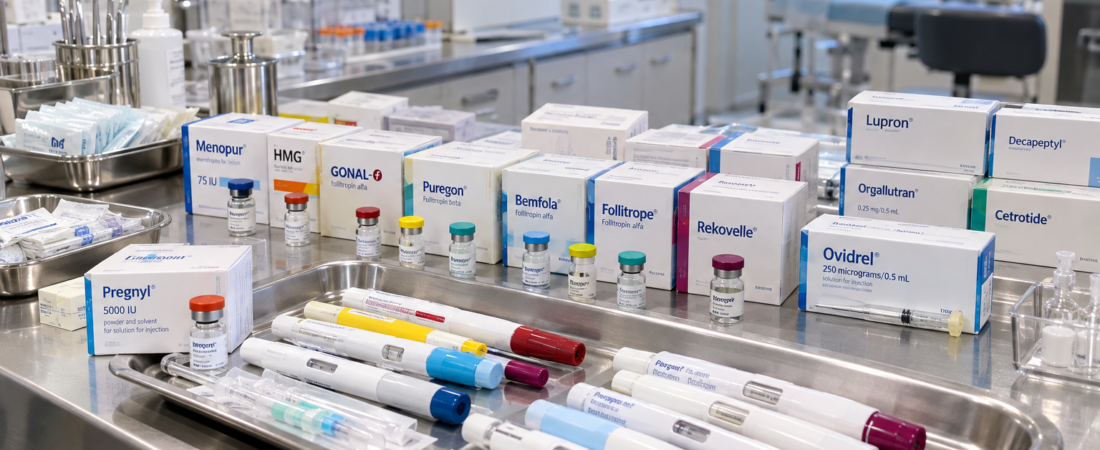
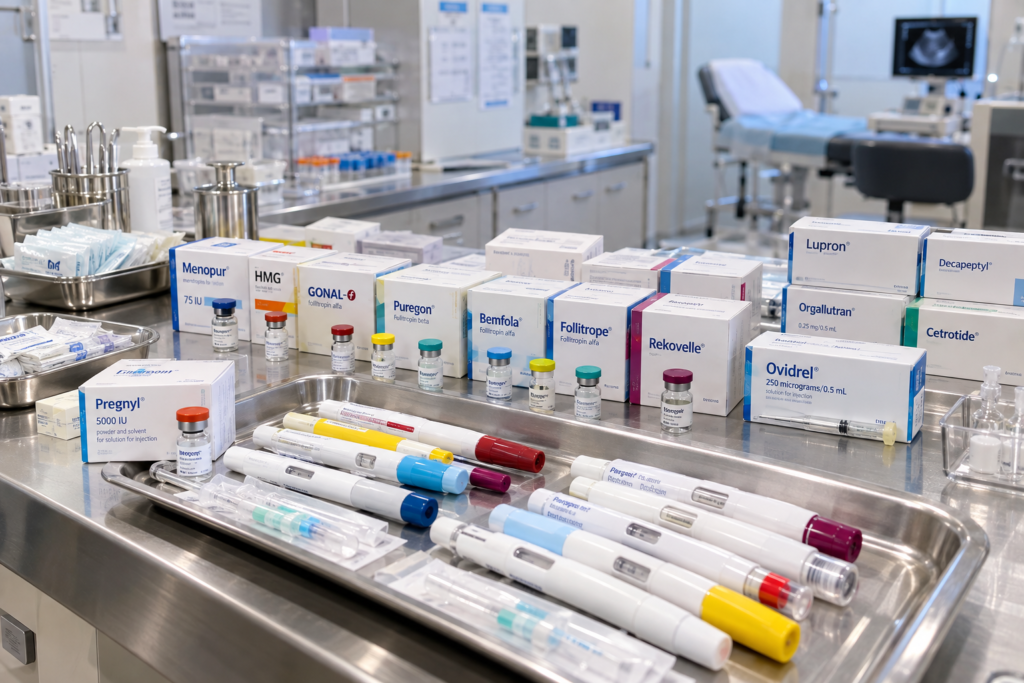
“The Same Stimulation Injections, Yet Why 15 Eggs for One and 3 for Another?”
- FSH alone, LH-supplemented, and hMG formulations: Active biological ingredients diverge, and individual ovarian responsiveness varies widely
- A shifting paradigm in reproductive medicine: Moving away from “maximal gonadotropin dosing” toward precision stimulation tailored to individual ovarian biology
- The biological reality of the “FSH ceiling effect”: Administering higher doses does not yield infinite eggs once receptor saturation is reached; for high responders, controlled mild stimulation prevents OHSS
When starting In Vitro Fertilization (IVF), nearly every woman becomes intimately familiar with ovarian stimulation injections. Administering a shot into the abdomen at the exact same hour each evening, she returns to the clinic days later to watch dark, circular follicles appear across the ultrasound monitor.
Yet even when patients begin treatment at the exact same clinic during the exact same week, the outcomes diverge dramatically.
One woman recruits more than ten growing follicles, while another sees only two or three. In other instances, a woman who showed a lackluster response in her prior cycle switches medications and suddenly recruits a substantially larger cohort of eggs. Fertility forums are filled with recurring questions and personal anecdotes: “This specific injection didn’t work for my body,” or “Switching to that other brand gave me so many more eggs.”
Does the human body truly respond differently to different stimulation medications? The short answer is yes. The explanation is straightforward: ovarian stimulation injections do not all share the same active ingredients, and no two ovaries interpret those hormonal signals in the exact same way.
FSH Drives the Follicular Engine
In an unmedicated menstrual cycle, a cohort of small antral follicles begins growing in the early follicular phase, but natural physiological feedback ensures that only one dominant follicle is selected for ovulation, while the remaining follicles undergo atresia and die off.
Because assisted reproduction requires securing multiple oocytes to produce viable embryos, this natural selection process must be pharmacologically overridden. Exogenous Follicle-Stimulating Hormone (FSH) is administered to sustain the entire recruited cohort, allowing multiple follicles to mature in parallel.
Consequently, the core driver in the vast majority of stimulation medications is FSH. However, formulation differences begin immediately:
- Some medications deliver recombinant FSH alone.
- Some combine FSH with Luteinizing Hormone (LH) bioactivity.
- Some are purified from the urine of postmenopausal women, while others are bioengineered using recombinant DNA technology.
While they are all broadly categorized as “ovarian stimulation shots,” the precise molecular dialogue they establish with the ovary varies.
While FSH Grows the Follicle, LH Supplies the Building Blocks
FSH acts directly on granulosa cells to power follicular expansion. Why, then, would an injection need LH?
Within the developing follicle, multiple cell types cooperate through continuous biochemical crosstalk—a process governed by the classic two-cell, two-gonadotropin model:
- Theca Cells & LH: Circulating LH binds to LH receptors on outer theca cells, stimulating the enzymatic conversion of cholesterol into androgens (such as androstenedione and testosterone).
- Granulosa Cells & FSH: These androgens diffuse across the basement membrane into adjacent granulosa cells, where FSH activates the aromatase enzyme to convert those androgens into estradiol (estrogen).
Put simply, LH provides the raw biochemical substrates, while FSH utilizes those substrates to drive follicular growth.
However, this does not mean an injection with high LH activity is universally superior. Many women—particularly younger patients with robust baseline ovarian reserve—produce sufficient endogenous LH and respond excellently to pure FSH alone.
Conversely, older women, patients with profound pituitary suppression, or individuals with specific LH receptor polymorphisms often demonstrate more synchronous follicular recruitment when exogenous LH activity is added. For others, adding LH produces no measurable difference whatsoever.
Modern reproductive endocrinology has largely moved past debating “Is LH good or bad?” to focus on “Which specific patient phenotype genuinely benefits from LH supplementation?”
Understanding hMG: The Dual-Action Formulation
A mainstay in ovarian stimulation protocols is Human Menopausal Gonadotropin (hMG).
Clinicians and patients often refer to hMG as a combined “FSH + LH injection.” More precisely, it is a medication that delivers both follicle-stimulating and luteinizing bioactivity:
- The hCG Mechanism in hMG: In widely used highly purified hMG preparations (such as Menopur), the LH-like bioactivity is primarily derived from trace amounts of human chorionic gonadotropin (hCG) naturally present in postmenopausal urine. Because hCG shares the same cellular receptor as LH (the LH/CGR) but possesses a vastly longer metabolic half-life and higher receptor affinity, it provides potent, sustained luteinizing support.
- Recombinant Co-Formulations: In contrast, dual-recombinant medications (such as Pergoveris) deliver bioengineered recombinant human LH (r-hLH) paired directly with recombinant human FSH (r-hFSH) in a precise fixed ratio.
For patients, both strategies serve the same functional purpose: pairing the primary follicular growth stimulus of FSH with supporting LH bioactivity.
“I Switched Injections and Got More Eggs”… Was It Really the Medication?
This is one of the most common questions raised in patient communities. A woman uses recombinant FSH in her first cycle and retrieves only 3 eggs; in her next cycle, her physician switches her to an hMG-containing regimen, and she retrieves 8.
While pharmacological differences between medications can certainly influence follicular recruitment, it is difficult to attribute that change entirely to the drug.
The human ovary is not biologically identical from one month to the next.
The baseline pool of resting antral follicles available at the start of a menstrual cycle fluctuates naturally. Age, fluctuating baseline FSH and LH levels, varying androgen microenvironments, and residual suppression from oral contraceptives or prior stimulation cycles all alter the starting line.
While switching medications may have played a constructive role, the ovary’s biological starting point that particular month may simply have been far more receptive.
What the Clinical Evidence Shows: hMG vs. Recombinant FSH
What do large-scale trials demonstrate when comparing these formulations head-to-head?
An updated Cochrane Systematic Review analyzing 59 randomized controlled trials across roughly 18,000 women compared recombinant FSH directly against urinary hMG or highly purified hMG (HP-hMG):
- In pooled analyses, regimens incorporating hMG demonstrated a small, statistically significant increase in live birth rates and clinical pregnancy compared to rFSH alone, an effect most visible in GnRH agonist long protocols.
- However, this cannot be translated into a blanket clinical rule that “hMG is superior for every woman.” The included trials spanned diverse patient demographics, baseline ovarian reserves, and protocol designs.
Above all, raw egg counts do not determine clinical success. A retrieval that yields 20 oocytes can suffer from high rates of post-maturity or poor blastocyst conversion, while a controlled retrieval of 6 mature eggs can yield top-quality euploid blastocysts that result in a healthy baby.
Does a Higher Dose Guarantee More Eggs? The “FSH Ceiling Effect”
When starting a cycle, patients often become preoccupied with daily dosages. Prescriptions range from 150 IU to 225 IU, 300 IU, or even 450 IU daily, sparking the intuitive belief: “If we push the dose higher, won’t my ovaries produce more eggs?”
The ovary does not function like an open water faucet where turning the handle further produces an endless stream of eggs.
In clinical trials evaluating predicted normal responders, comparing starting doses of 150 IU against 225 IU of FSH demonstrated that increasing the gonadotropin dose failed to yield more retrieved oocytes or improve live birth rates.
Once all available FSH receptors on the recruited follicle pool are fully saturated, injecting additional hormone produces zero incremental recruitment. This biological boundary is known as the FSH ceiling effect.
In fertility medicine, “administering more medication” is not synonymous with “stimulating the ovary better.”
For Women with High AMH, Less Is More
Certain patient cohorts require deliberate restraint—most notably women with elevated AMH levels or Polycystic Ovary Syndrome (PCOS).
Anti-Mullerian Hormone (AMH) reflects functional ovarian reserve, and high readings indicate an extensive cohort of sensitive antral follicles primed to respond. In these women, standard gonadotropin doses can trigger explosive, multi-follicular development, dramatically increasing the risk of Ovarian Hyperstimulation Syndrome (OHSS).
To navigate this, modern protocols increasingly utilize personalized dosing algorithms calculated from baseline AMH and body weight prior to cycle start. A prime example is follitropin delta.
Clinical registration trials (such as the ESTHER trials) demonstrated that individualizing daily doses based on AMH and weight maintained equivalent pregnancy and live birth rates while significantly reducing excessive follicular recruitment and the incidence of OHSS.
For women with high ovarian reserve, reducing the daily gonadotropin dose is often the safest, most biologically appropriate clinical choice.
The Optimal Egg Window: Why More Is Not Always Better
Every woman undergoing egg retrieval wonders: “How many eggs will we get?”
While human instinct leans toward maximizing numbers, large epidemiological analyses demonstrate that IVF success does not climb indefinitely with rising egg counts.
In fresh embryo transfer cycles, the optimal balance between high cumulative live birth rates and patient safety peaks around 8 to 14 retrieved oocytes. Beyond this range, live birth rates plateau while the risk of OHSS climbs sharply.
Consequently, modern reproductive medicine has shifted away from historical “collect as many as possible” strategies toward securing a safe, developmentally competent cohort of mature eggs capable of yielding healthy blastocysts.
Why Do Two Women with the Same AMH Yield Different Egg Counts?
This remains a frequent source of frustration for patients. A woman compares notes with a friend of identical AMH: one retrieves 10 eggs, while the other retrieves only 3.
AMH provides a macroscopic estimate of the remaining primordial follicular pool; it is not a daily forecast predicting how many follicles will synchronously respond in a single calendar month.
Actual in vivo ovarian response is governed by a constellation of interacting variables:
- Chronological age and baseline Antral Follicle Count (AFC)
- Body mass index (BMI) and pharmacological volume of distribution
- Genetic variations (polymorphisms) in the FSH receptor (FSHR) and LH receptor (LHCGR)
- Baseline androgen concentrations within the ovarian stroma
- The specific stimulation protocol, starting day, and gonadotropin formulation
This biological complexity explains why the exact same woman can retrieve 3 eggs in her initial cycle and 7 eggs in her next.
The First Cycle as an ‘Ovarian Instruction Manual’
When an initial IVF cycle yields fewer eggs than anticipated, patients understandably feel devastated, often interpreting the outcome as an absolute failure.
From a clinical perspective, however, that first stimulation provides critical biological data that no blood test could ever reveal:
- At what precise FSH threshold did the follicles initiate growth?
- Did the follicular cohort develop synchronously, or was growth uneven?
- What percentage of retrieved eggs reached Metaphase II (MII) maturity?
- How did fertilization and blastocyst conversion progress?
Using these physiological insights, the reproductive endocrinologist can adjust the strategy for the subsequent cycle: refining starting doses, introducing LH bioactivity, incorporating hMG, or altering the ovulation trigger.
A first retrieval is not merely an attempt to secure oocytes; it is the process of deciphering how a woman’s unique ovaries respond to hormonal stimulation.
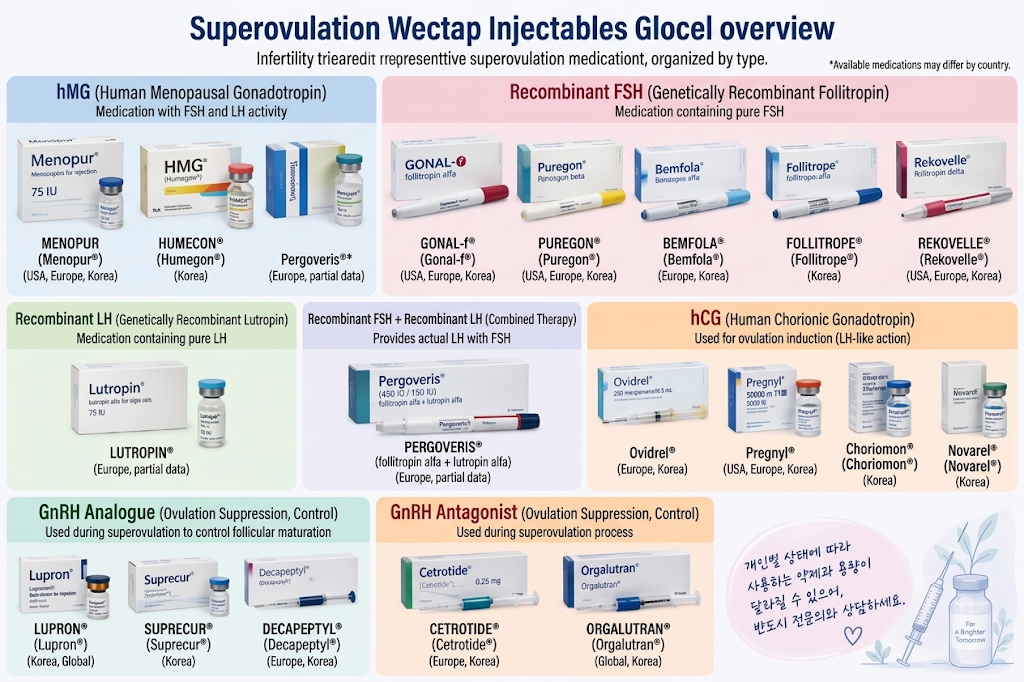
Classifying Medications by Mechanism Rather Than Brand
The commercial names for stimulation medications can be overwhelming, but memorizing individual brands is unnecessary. Grouping them by their active endocrine mechanisms clarifies why prescription changes are made:
| Medication Category | Common Examples | Biological Mechanism & Clinical Rationale |
| Recombinant FSH Monotherapy | Gonal-F, Puregon, Rekovelle (follitropin alfa, beta, delta) | Pure FSH receptor stimulation; drives granulosa cell proliferation and follicle growth without endogenous LH interference |
| Dual Recombinant FSH + LH | Pergoveris (follitropin alfa + lutropin alfa) | Fixed-ratio recombinant FSH and LH; designed for targeted dual-receptor stimulation in advanced age or hypo-responders |
| Human Menopausal Gonadotropin (hMG) | Menopur (highly purified hMG) | Urine-derived FSH enriched with LH-like bioactivity (primarily mediated by natural hCG); supports theca cell androgen production |
| Long-Acting Recombinant FSH | Elonva (corifollitropin alfa) | Sustained-release chimeric FSH molecule; maintains therapeutic levels for 7 days with a single initial injection |
Understanding these categories reveals why a physician modifies prescriptions between cycles. Adjusting from pure FSH to an hMG blend or adding LH activity is not arbitrary trial and error; it is a systematic effort to find the specific hormonal combination that elicits an individual ovary’s optimal follicular response.
Summary
In ovarian stimulation, there is no single “best injection” that works universally for every human body.
Success does not lie in choosing the most aggressive or expensive medication on the shelf, but in understanding how a patient’s individual ovarian physiology behaves under stimulation.
The journey through IVF is ultimately a process of discovery: finding the precise hormonal formulation, dosage, and protocol that allows her ovaries to respond safely, sustainably, and effectively.
※ This article was synthesized based on the “Ovarian Stimulation for IVF/ICSI” clinical practice guidelines published by the European Society of Human Reproduction and Embryology (ESHRE) alongside practice committee documents and gonadotropin literature from the American Society for Reproductive Medicine (ASRM) and the Cochrane Collaboration. It does not replace individualized clinical diagnosis or medical care, and specific treatment decisions should always be made in consultation with a qualified reproductive endocrinologist.
※ The images associated with this article were generated using generative AI (ChatGPT, OpenAI) as illustrative visual references and do not depict real individuals.