
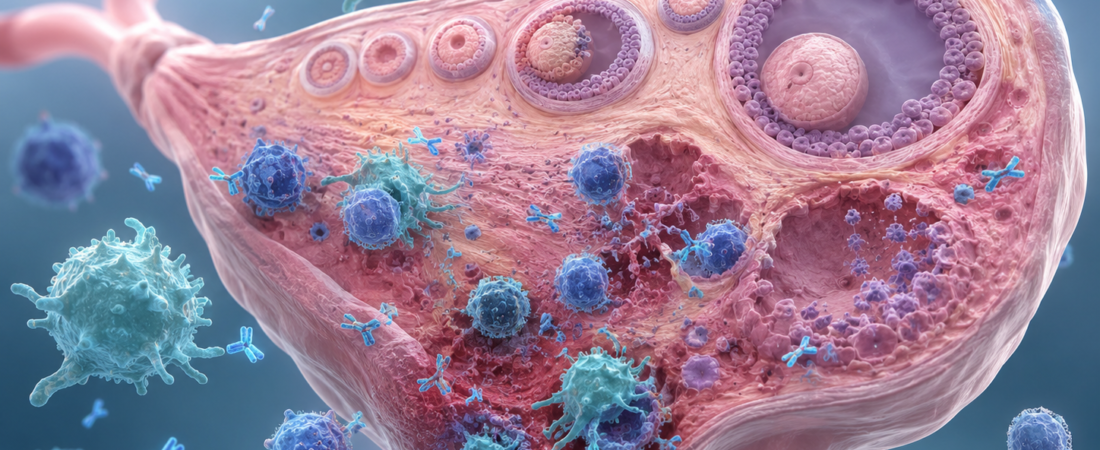
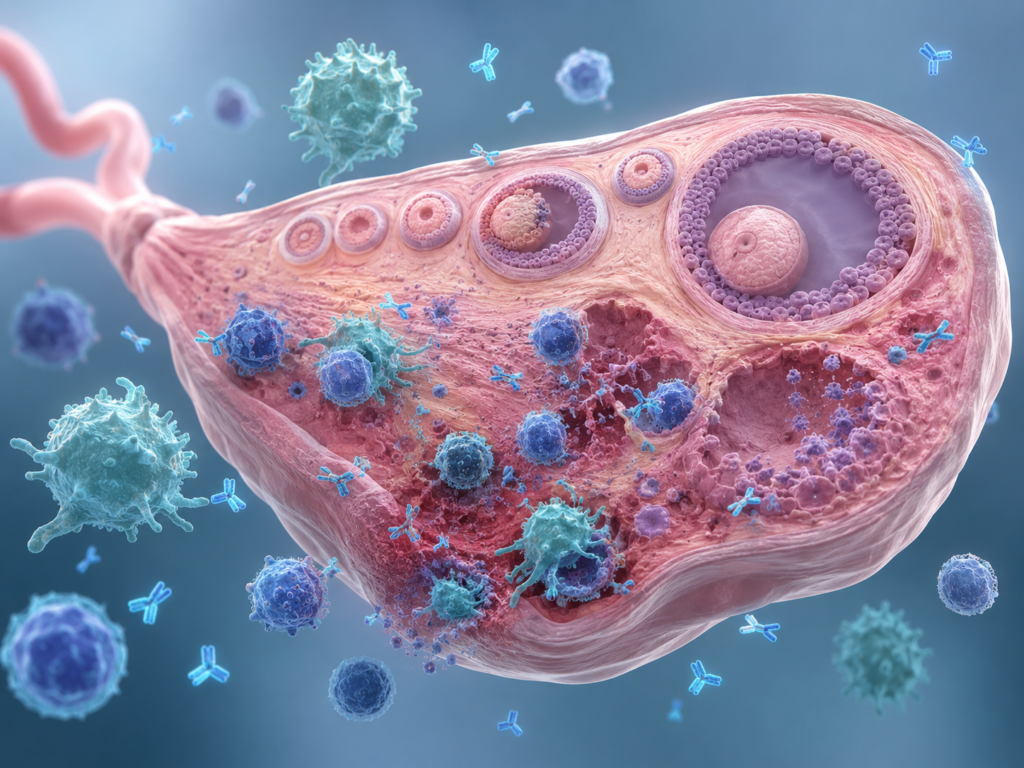
- Autoimmune oophoritis: Infiltration of immune cells, including T cells, around developing follicles can compromise ovarian function
- Unexplained POI workup: Adrenal-related “21-hydroxylase antibody” testing strongly recommended; anti-ovarian antibodies deemed unsuitable for clinical diagnosis
- Claims of reviving ovaries with steroids or immunotherapy: Reliable clinical evidence in human trials remains lacking
A woman in her twenties or thirties suddenly finds her ovaries losing their function. Her menstrual cycles become irregular, her Follicle-Stimulating Hormone (FSH) levels climb, yet diagnostic testing reveals no obvious cause.
This is Primary Ovarian Insufficiency (POI)—the loss of normal ovarian function before the age of 40.
When genetic testing comes back normal and there is no history of chemotherapy, radiation, or pelvic surgery, clinicians must consider another potential culprit: autoimmunity.
This occurs when the immune system, designed to protect the body, mistakenly identifies its own healthy tissues as foreign invaders. When this pathological process targets the ovary, its classic clinical presentation is known as autoimmune oophoritis.
Immune Cells Swarming Around the Follicles
A state-of-the-art review published in Frontiers in Immunology (2026) summarized how immune cells—such as T cells and macrophages—alongside inflammatory signaling cascades contribute to ovarian failure in POI.
When the local immune response becomes excessive, it can accelerate granulosa cell apoptosis, premature follicular atresia, and tissue fibrosis. In autoimmune oophoritis specifically, histological examinations have long observed dense lymphocytic infiltrates surrounding the steroid-producing cells of growing follicles.
What is particularly intriguing from tissue studies is that primordial and early-stage resting follicles are often relatively spared, while growing follicles bear the brunt of the immune attack.
In the past, this sparked clinical optimism: “If we can suppress the aberrant immune response, might those surviving dormant follicles resume normal activity?” Indeed, anecdotal case reports documented women who temporarily resumed menstruation following corticosteroid therapy.
From here, however, extreme clinical caution is warranted.
“Positive Anti-Ovarian Antibodies” Does Not Equal Autoimmune Oophoritis
Testing the blood for “anti-ovarian antibodies (AOA)” sounds intuitive, but real-world clinical practice tells a different story.
Current international POI guidelines strongly advise against using anti-ovarian antibody tests to diagnose autoimmune POI. The assays lack technical standardization and suffer from high false-positive rates, meaning the mere detection of antibodies cannot confirm that the ovaries are under genuine immune attack.
A meta-analysis published in the Journal of Ovarian Research (2026) evaluated 13 studies encompassing 1,593 individuals, finding that antinuclear antibody (ANA) positivity was significantly more frequent in women with POI than in controls, with an association of approximately 2.57-fold.
Yet, this too represents a statistical correlation, not direct causation. A positive ANA test does not prove the presence of autoimmune oophoritis, nor does it demonstrate that antinuclear antibodies are directly destroying ovarian follicles. The authors emphasized the need for further research regarding testing methodologies, antibody titers, and specific staining patterns.
What Truly Matters Is the “Adrenal Gland”
Current clinical guidelines prioritize a different diagnostic target altogether.
Joint international POI guidelines established by the European Society of Human Reproduction and Embryology (ESHRE), the American Society for Reproductive Medicine (ASRM), and partner societies recommend that women with unexplained POI undergo testing for 21-hydroxylase autoantibodies (21OH-Ab).
This antibody serves as a primary marker for autoimmune adrenal disease (such as Addison’s disease). If positive, the patient requires a prompt referral to an endocrinologist for a comprehensive evaluation of adrenal function, as undiagnosed adrenal insufficiency can be life-threatening.
Thyroid function cannot be overlooked either. Guidelines recommend checking Thyroid-Stimulating Hormone (TSH) at the time of a POI diagnosis. However, because thyroid peroxidase (TPO) antibodies are common even among healthy women in the general population, universal screening of thyroid antibodies solely for the purpose of hunting down “autoimmune POI” is not recommended.
In other words, the presence of autoimmune thyroid disease does not automatically justify concluding that “immune cells attacked the ovaries to trigger POI.”
Can Steroids or IVIG Revive the Ovary?
For women facing infertility, the ultimate question is always about treatment.
If autoimmunity is the driving problem, couldn’t dampening the immune response with corticosteroids or intravenous immunoglobulin (IVIG) restore ovarian function?
Theoretically, it sounds plausible. Clinically, however, evidence remains insufficient.
A systematic review evaluating treatments for autoimmune oophoritis identified 17 human studies, yet not a single completed randomized controlled trial (RCT), prospective cohort, or case-control study existed among them. The vast majority of available literature consisted merely of isolated case reports.
The 2026 review likewise concluded that while glucocorticoids reportedly helped restore menses in a handful of published cases, they carry severe systemic risks—including bone mineral loss, osteonecrosis, and opportunistic infections. Without adequately powered clinical trials, immunotherapy cannot be recommended as a routine treatment for POI.
Current international guidelines state unequivocally that no medical treatment has been proven to reliably reactivate ovarian function or increase natural conception rates in women with POI.
Ultimately, while it is inadequate to write off unexplained primary ovarian insufficiency in a young woman simply as “premature ovarian aging,” it is equally hazardous to leap to a diagnosis of “autoimmune oophoritis” based on non-specific antibody panels and initiate unproven immune therapies.
Autoimmunity is undeniably an important piece of the POI puzzle. Today, however, the clinical imperative is not rushing into empirical immunotherapy, but methodically identifying which patients’ ovarian decline is genuinely rooted in immune dysfunction.
Medical Sources & Literature References
- Journal: Frontiers in Immunology (2026; Vol. 17, Article 1765073). | DOI: 10.3389/fimmu.2026.1765073 | PMID: 41972141
- Journal: Journal of Ovarian Research (2026; Vol. 19, Article 34). | DOI: 10.1186/s13048-025-01945-3 | PMID: 41457262
- Guideline: ESHRE / ASRM / IMS International Consensus Guideline on Primary Ovarian Insufficiency, Human Reproduction Open (2024; Issue 4, Article hoae065). | DOI: 10.1093/hropen/hoae065
※ This article was synthesized based on research on inflammation and immunity in POI published in Frontiers in Immunology (2026), the antinuclear antibody meta-analysis in the Journal of Ovarian Research, and international POI consensus guidelines from ESHRE and ASRM. It does not replace individualized clinical diagnosis or medical care, and specific treatment decisions should always be made in consultation with a qualified reproductive endocrinologist.
※ The images associated with this article were generated using generative AI (ChatGPT, OpenAI) as illustrative visual references and do not depict real individuals.