Autoimmune premature ovarian insufficiency (POI) is one possible explanation for ovarian dysfunction before age 40, but a positive antibody test does not establish the diagnosis. International guidance recommends specific adrenal-antibody and thyroid-function testing in the appropriate POI workup. Evidence that steroids or other immune treatments reliably restore ovarian activity or natural conception remains insufficient.
A woman in her twenties or thirties may develop irregular menstrual cycles and raised follicle-stimulating hormone (FSH) levels, yet receive no clear explanation after initial investigations. POI—also called primary ovarian insufficiency—describes impaired ovarian function before age 40. The symptoms and hormone results need clinical assessment; they do not identify the underlying cause by themselves.
Autoimmunity is one possibility to consider when POI remains unexplained, including after investigation for genetic causes and review of chemotherapy, radiation or ovarian surgery. A normal genetic test does not, by itself, establish an autoimmune cause. Our related article examines genetic contributors to premature ovarian insufficiency.
Autoimmunity occurs when the immune system reacts against the body’s own tissues. When immune-mediated inflammation affects the ovary, it may be described as autoimmune oophoritis.
How can immune activity affect ovarian follicles?
A 2026 review in Frontiers in Immunology discusses T cells, macrophages and inflammatory signaling in POI. It brings together human observations and experimental models; it is not evidence that the same mechanism explains every patient’s condition.
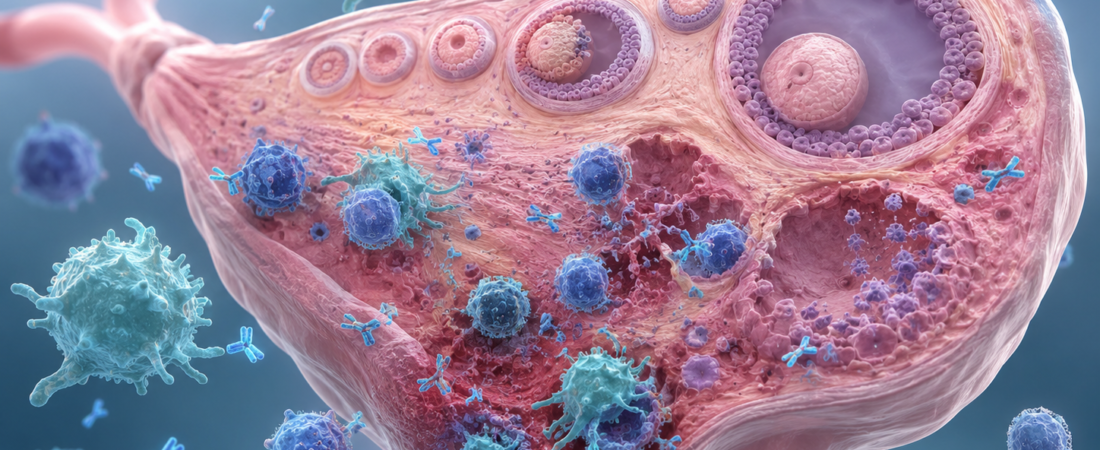
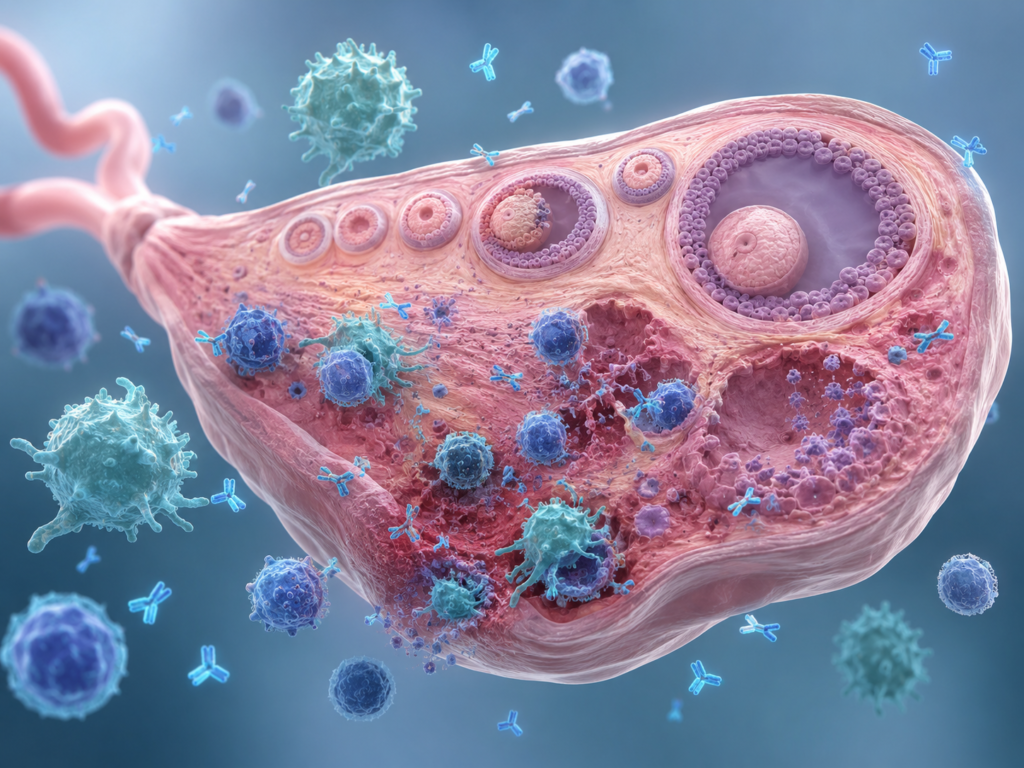
Excessive inflammatory activity may contribute to the death of granulosa cells, which support developing eggs, to follicular atresia, or degeneration, and to tissue fibrosis. In descriptions of autoimmune oophoritis, lymphocytes cluster around the steroid-producing cells of developing follicles.
Primordial and early follicles may be relatively spared while growing follicles are affected. This observation prompted a treatment hypothesis: if abnormal immune activity could be controlled, might surviving follicles resume activity?
Some case reports have described a return of menstruation after corticosteroid treatment. Such reports do not establish a reliable treatment effect. Ovarian activity can sometimes occur in non-surgical POI, making uncontrolled observations particularly difficult to interpret.
Why anti-ovarian antibodies and ANA do not prove autoimmune POI
A blood test for anti-ovarian antibodies may sound like a direct way to identify immune injury. However, the international POI guideline recommends against using anti-ovarian autoantibody screening to diagnose autoimmune POI. Test limitations and lack of reliable clinical discrimination mean that an antibody result should not be equated with proof that immune cells are damaging the ovaries.
Antinuclear antibodies, or ANA, are a separate category. A meta-analysis in Journal of Ovarian Research included 13 case-control studies with 1,593 participants. It found an association between ANA positivity and POI, with a pooled odds ratio of 2.57 (95% confidence interval 1.62–4.08).
The figure compares odds; it is not a claim that an individual woman’s probability of POI is exactly 2.57 times greater. Nor does the association prove that ANA caused ovarian damage or diagnose autoimmune oophoritis in someone with a positive test.
The investigators called for further work on testing methods, antibody titers and staining patterns. The studies were observational, and differences in tests and patient groups limit interpretation. The article was first published online on December 29, 2025, and appears in the journal’s 2026 volume.
Which adrenal and thyroid tests does the guideline recommend?
The joint international POI guideline from ESHRE, ASRM and partner organizations recommends 21-hydroxylase autoantibody testing (21OH-Ab) when the cause of POI is unknown.
These antibodies are relevant to autoimmune adrenal disease, including Addison’s disease. A positive result warrants referral to an endocrinologist for adrenal-function assessment. It is not, on its own, proof of ovarian immune injury. Identifying associated adrenal disease matters because adrenal insufficiency can be serious.
The guideline also recommends measuring thyroid-stimulating hormone (TSH) at POI diagnosis. It does not recommend routinely screening thyroid peroxidase (TPO) antibodies simply to investigate an autoimmune cause of POI, because positive TPO antibodies are common in the general population.
Having autoimmune thyroid disease therefore does not automatically establish that an immune attack caused a person’s ovarian insufficiency.
Can steroids or IVIG restore ovarian function?
For patients concerned about fertility, the practical question is whether suppressing an immune response could restore ovarian function. Corticosteroids and intravenous immunoglobulin (IVIG) have been considered for this purpose, but a plausible mechanism is not enough to establish an effective treatment.
A systematic review of autoimmune oophoritis therapies searched the literature through April 2022 and identified 17 human studies. Within that evidence base, it found no completed human randomized controlled trials, cohort studies or case-control studies. The human evidence consisted of case reports and case series.
The review described selected cases in which menstruation or hormonal function returned after treatment, sometimes alongside treatment of an associated autoimmune illness. These observations cannot show how reliably a treatment works or which patients benefit. Dating the review’s search is important: its finding describes the literature it examined, rather than proving that no later trial could exist.
The 2026 inflammation review also notes reports of improvement with glucocorticoids while emphasizing the lack of robust clinical evidence for broad use in POI. Corticosteroids have potential harms, including loss of bone density, osteonecrosis and increased susceptibility to infection. These risks depend in part on dose and duration; official prednisone prescribing information documents them. They should not be treated as harmless ways to try to restart ovarian function.
Current international guidance states that no intervention has been reliably shown to increase ovarian activity and natural conception rates in POI. This does not mean there is no useful care: managing estrogen deficiency and long-term health is a separate, established part of POI treatment. It also does not mean that ovarian activity can never recur.
Investigate possible causes without promising an immune cure
Unexplained POI in a young woman should not simply be dismissed as unusually early ovarian aging. Equally, nonspecific antibody results should not be used to label her condition autoimmune or to promise that immune treatment will restore fertility.
Autoimmunity is one part of the POI picture. The priority is a careful evaluation for relevant causes and associated conditions, with a clear distinction between an observed immune marker, a supported diagnosis and a treatment proven to improve outcomes.
For a broader explanation of diagnosis and ovarian-function changes, see how premature ovarian insufficiency is assessed before age 40.
Research references
- Chen Y and colleagues. Mechanisms of inflammation in premature ovarian insufficiency and advances in therapeutic studies. Frontiers in Immunology. 2026;17:1765073. DOI: 10.3389/fimmu.2026.1765073. PMID: 41972141. A review of human observations and experimental models.
- Pi T and colleagues. The association between serum antinuclear antibodies and premature ovarian insufficiency: a meta-analysis. Journal of Ovarian Research. 2026;19:34. First published online December 29, 2025. DOI: 10.1186/s13048-025-01945-3. PMID: 41457262.
- Panay N and colleagues, ESHRE, ASRM, CREWHIRL and IMS Guideline Group on POI. Evidence-based guideline: premature ovarian insufficiency. Human Reproduction Open. 2024;2024(4):hoae065. DOI: 10.1093/hropen/hoae065.
- Levit E, Singh B, Nylander E and Segars JH. A Systematic Review of Autoimmune Oophoritis Therapies. Reproductive Sciences. 2024;31:1–16. Published online July 27, 2023; literature searched through April 2022. DOI: 10.1007/s43032-023-01299-5. PMID: 37500976.
- Prednisone tablets: official prescribing information. DailyMed, U.S. National Library of Medicine. Used to verify the corticosteroid adverse effects discussed above.
This article explains research on inflammation and autoimmunity in POI, an ANA meta-analysis, a treatment review and international clinical guidance. It does not replace individual diagnosis or medical care. Specific treatment decisions should be made with a qualified reproductive endocrinologist and other relevant specialists.
The images associated with this article were generated using generative AI (ChatGPT, OpenAI) as illustrative visual references and do not depict real individuals.
Copyright © 2026 Fertility Information TokTok Fertility News | THE FERTILITY NOTES. All rights reserved. Unauthorized republication, reproduction, redistribution, scraping, AI training, and data use of any content, including articles, photographs, and images, are strictly prohibited. Violations may result in legal liability.