
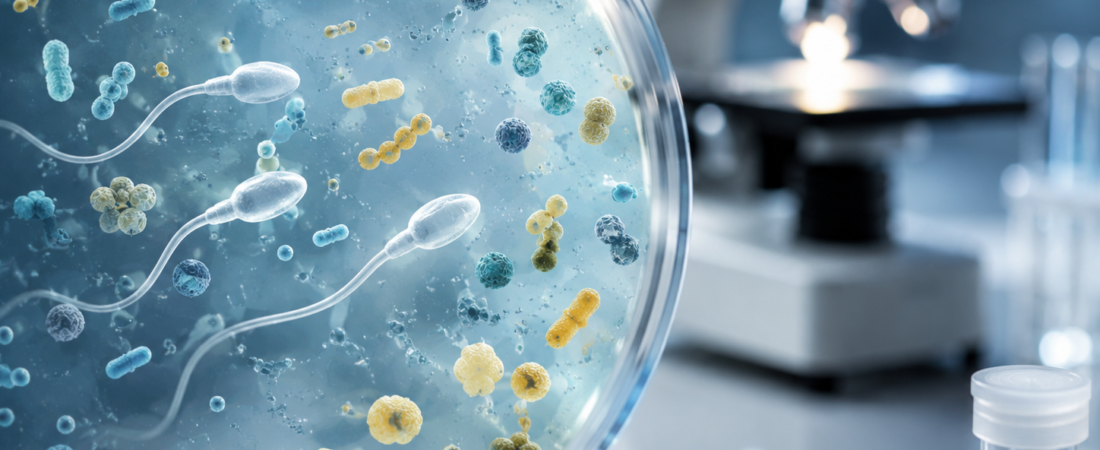
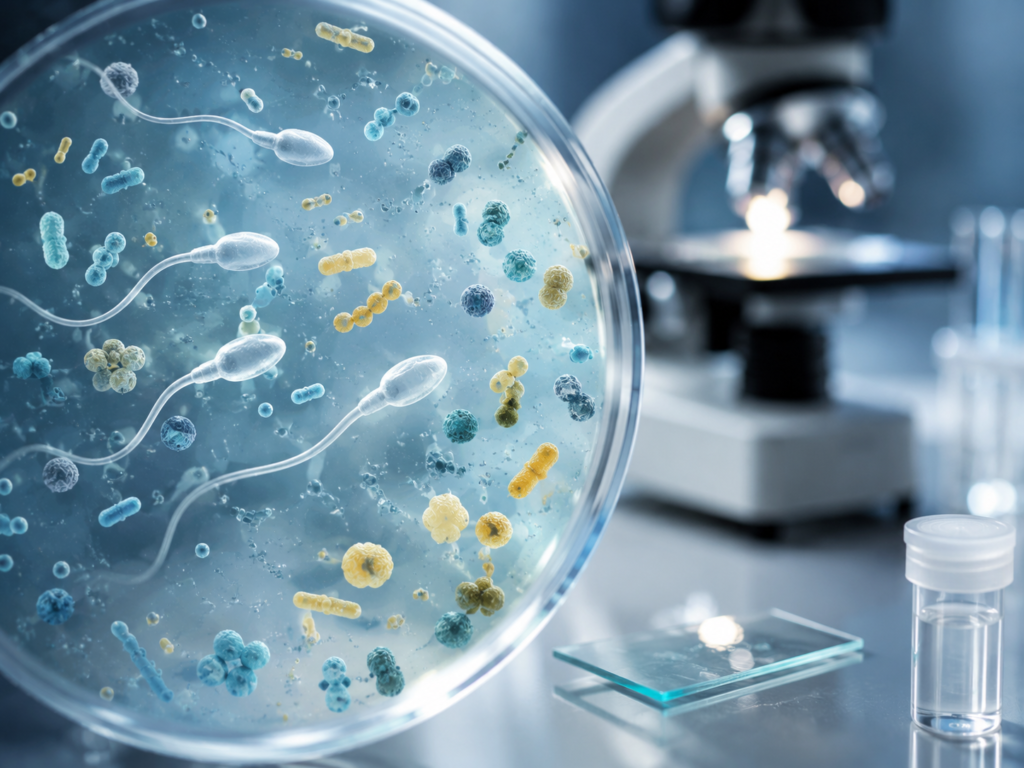
“Sperm Do Not Live Alone… The ‘Seminal Microbiome’ Emerges as a New Variable in Male Infertility”
- Higher Lactobacillus Correlates with Higher Sperm Concentration: Correlation between the seminal bacterial balance (Lactobacillus ratio) and progressive sperm motility reaches r = 0.95
- Multi-Omics Integration: Combined 16S rRNA sequencing and untargeted metabolomics reveal distinct microbial-metabolic networks in men with idiopathic oligoasthenozoospermia
- Triple-Blind RCT of 110 Men: Probiotic/synbiotic supplementation for 3 months significantly improved sperm concentration, motility, and normal morphology; direct impacts on clinical pregnancy and live birth rates remain unconfirmed
Some men present with low sperm counts or poor motility despite exhaustive diagnostic evaluations that yield no identifiable cause. Endocrine profiles are normal, varicoceles are absent, and there are no structural chromosomal abnormalities or active clinical infections. This condition is categorized as idiopathic male infertility.
Recently, reproductive researchers have begun shifting their focus from examining spermatozoa in isolation under the microscope to evaluating the fluid matrix in which they are suspended: the seminal plasma.
Seminal fluid is not merely a transport vehicle containing proteins, fructose, and lipids. It also harbors low-biomass microbial signals. A growing body of scientific evidence suggests that the specific composition and relative abundance of these seminal microorganisms may directly influence sperm concentration and motility.
In 2026, research progressed further with the publication of randomized controlled trials evaluating whether direct probiotic supplementation can alter semen parameters, establishing the seminal microbiome as an active variable in male reproductive biology.
Sperm Do Not Float in Isolation
A study published in the March 2026 issue of the international journal Andrology evaluated the relationship between seminal microorganisms and sperm parameters across 100 men.
Rather than a broad metagenomic survey of the entire microbiome, this prospective cross-sectional study quantified concentrations of Lactobacillus species alongside anaerobic and facultative anaerobic bacteria, correlating them with sperm concentration, progressive motility, and seminal leukocyte counts.
The initial correlations were distinct:
- Sperm Concentration: Higher concentrations of seminal Lactobacillus were positively correlated with higher sperm concentrations (r = 0.42, P < 0.001).
- Progressive Motility: Higher loads of anaerobic and facultative anaerobic bacteria were negatively correlated with progressive sperm motility (r = -0.77).
Ecological Balance vs. Absolute Bacterial Counts
The researchers then evaluated the proportion of Lactobacillus relative to total bacterial load (the Lactobacillus ratio):
- Progressive Motility Correlation: The correlation between the Lactobacillus ratio and progressive sperm motility reached r = 0.95 (where 1.0 indicates a near-perfect positive linear relationship).
- Seminal Leukocytes: A higher Lactobacillus ratio was inversely correlated with seminal leukocyte concentrations (r = -0.96).
- Immature Germ Cells: The ratio was also strongly and negatively correlated with the presence of immature germ cells (spermatids) in the ejaculate (r = -0.89).
These associations remained statistically significant after adjusting for multiple clinical confounders.
This suggests that the primary biological factor is not simply the isolated presence of a single “beneficial” bacterium, but the overall taxonomic equilibrium of the seminal microenvironment, which appears tightly coupled with the physical conditions required for optimal sperm motility.
However, these findings do not prove that bacteria directly drive the flagellar propulsion of sperm:
- In an inflamed seminal environment, sperm motility may drop while certain anaerobic bacteria proliferate simultaneously.
- Alternatively, shifts in microbial communities could trigger oxidative stress and inflammatory cascades that secondarily impair sperm function.
- Both phenomena could also be co-regulated by an unmeasured third factor.
Strong statistical correlation cannot be equated with biological causation on its own.
Microbial Shifts Correlate with Altered Seminal Metabolomics
A study published in Frontiers in Cellular and Infection Microbiology (January 2026) explored this interaction further by combining 16S rRNA gene sequencing with untargeted metabolomic profiling.
The researchers compared seminal plasma from 40 men diagnosed with idiopathic oligozoospermia or asthenozoospermia against 30 fertile normozoospermic controls, assessing both bacterial taxa and small-molecule metabolic pathways:
- Microbial Disparities: Men with low sperm counts exhibited a higher relative abundance of opportunistic anaerobic taxa, notably Prevotella species.
- Metabolomic Alterations: Hundreds of individual metabolites differed significantly between subfertile and fertile cohorts.
- Network Interdependence: Multi-omics integration revealed coordinated networks linking specific bacterial alterations to shifts in lipid metabolites, amino acids, and organic acids.
These findings suggest that seminal bacteria are not passive contaminants, but part of a dynamic biochemical ecosystem linked to local inflammation, oxidative-reductive balance, and energy metabolism.
Because ejaculated semen is a composite biological fluid—originating from the testes and epididymides and combining with secretions from the prostate gland and seminal vesicles—evaluating the broader fluid microenvironment provides a more comprehensive perspective than analyzing sperm cells alone.
Clinical Trial Evidence: Probiotic Supplementation in Idiopathic OAT
To test whether modulating the microbiome could translate into clinical improvements, researchers in Iran conducted a triple-blind, randomized controlled trial in 110 men with idiopathic oligoasthenoteratozoospermia (iOAT).
Patients, treating clinicians, and laboratory evaluators were all blinded. Participants were randomized into three arms for a 3-month intervention:
- Synbiotic/Probiotic Group: Formulated with Lactobacillus casei, L. rhamnosus, L. acidophilus, L. bulgaricus, Bifidobacterium longum, B. breve, and Streptococcus thermophilus, combined with prebiotic fructooligosaccharides (FOS).
- Antioxidant Group
- Placebo Group
Semen Parameter Results at 3 Months
| Clinical Parameter | Baseline (Probiotic Group) | 3 Months (Probiotic Group) | 3 Months (Placebo Group) | Key Statistical Outcomes |
| Sperm Concentration | ~5.13 million/mL | 10.42 million/mL | 4.91 million/mL | Statistically significant increase vs. placebo (P < 0.05) |
| Total Motility | 23.5% | 46.7% | 22.8% | Significant improvement vs. placebo and antioxidant arms |
| Normal Morphology | 1.6% | 4.31% | 1.7% | Significant improvement vs. placebo and antioxidant arms |
The synbiotic cohort demonstrated statistically significant gains in sperm concentration, motility, and normal morphology compared to placebo, with motility and morphology parameters exceeding those observed in the antioxidant arm.
Clinical Caveats and Guideline Perspectives
While these clinical trial findings are notable, several limitations must be considered:
- Sample Size & Surrogate Endpoints: A trial of 110 patients is relatively small. The primary endpoints were surrogate semen parameters rather than clinical pregnancy or cumulative live birth rates.
- Assisted Reproduction Outcomes: Whether improvements in baseline semen parameters translate into higher success rates during Intrauterine Insemination (IUI) or In Vitro Fertilization / Intracytoplasmic Sperm Injection (IVF-ICSI) requires dedicated interventional studies.
- EAU Guideline Position (2026): The European Association of Urology (EAU) Guidelines on Sexual and Reproductive Health acknowledge clinical trials reporting positive effects of probiotics on sperm concentration, motility, morphology, and DNA integrity. However, the panel concludes that larger, multicenter phase-III randomized trials are necessary before establishing probiotics as a routine clinical recommendation.
Species-Level Nuance: Not All Lactobacillus Strains Are Equivalent
The common assumption that all Lactobacillus species are uniformly beneficial is biologically oversimplified:
- A study published in Scientific Reports (2024) observed that Lactobacillus iners was enriched in men presenting with abnormal sperm motility.
- Within the same genus, specific species and strains can exert distinct physiological effects depending on their metabolic outputs (e.g., D-lactic vs. L-lactic acid production, local pH alteration, and cytokine modulation).
Future research must move beyond broad genus-level descriptions to characterize species- and strain-level dynamics, their metabolic profiles, and their specific impacts on oxidative stress.
Methodological Challenges in Seminal Microbiome Research
A significant technical hurdle in this field is that semen is a low-biomass specimen:
- Samples contain relatively low quantities of bacterial DNA compared to high-biomass environments like the gut.
- As a result, cross-contamination from the urethral meatus, surrounding penile skin flora, or trace bacterial DNA present in laboratory reagents can confound sequencing results.
- Detecting microbial DNA fragments via next-generation sequencing does not necessarily prove the presence of viable, colonizing bacterial communities. Rigorous negative controls and standardized decontamination protocols are essential.
Conclusion
Routine male fertility assessments have historically focused almost entirely on isolated sperm metrics: How many are there? How do they move? What percentage have normal morphology?
Current research is expanding this perspective to include the microbial and metabolic ecosystem of the seminal plasma that supports those cells.
While seminal microbiome profiling and probiotic therapy are not yet standard first-line clinical tools, investigating the seminal microenvironment may provide new mechanistic insight into cases of previously unexplained idiopathic male subfertility.
Medical Sources & Study References
- Journal: Andrology (Official Journal of the American Andrology Society and the European Academy of Andrology), March 2026 Issue. | DOI: 10.1111/andr.70140
- Journal: Frontiers in Cellular and Infection Microbiology (Published January 2026). | DOI: 10.3389/fcimb.2025.1741184
- Clinical Trial: Iranian Journal of Medical Sciences (Triple-blind randomized controlled trial in 110 iOAT men, 2025/2026). | DOI: 10.30476/ijms.2025.105150.3888
※ This article was synthesized based on clinical studies published in Andrology, Frontiers in Cellular and Infection Microbiology, and the Iranian Journal of Medical Sciences alongside male infertility guidelines from the EAU. It does not replace individualized clinical diagnosis or medical care, and specific treatment decisions should always be made in consultation with a qualified urologist, andrologist, or reproductive specialist.
※ The images associated with this article were generated using generative AI (ChatGPT, OpenAI) as illustrative visual references and do not depict real individuals.