

- Even with Regular Menstrual Cycles, the Ovulation Day Shifts Monthly
- Most Cycle Variability Originates in the ‘Follicular Phase’… The Luteal Phase Also Spans a Range of 11 to 17 Days
- “Ovulation Timing Must Be Evaluated Through Follicular Growth and Hormonal Dynamics, Not Fixed Calendar Dates”
If a woman has a 28-day menstrual cycle, does she ovulate exactly on Day 14 after the start of her period?
This is a calculation virtually every woman attempting to conceive has performed at least once. However, the female body does not operate like a rigid calendar. Even women with relatively regular cycles can ovulate on Days 12–13 in one cycle and Days 15–16 in the next. At times, that variance can widen even further.
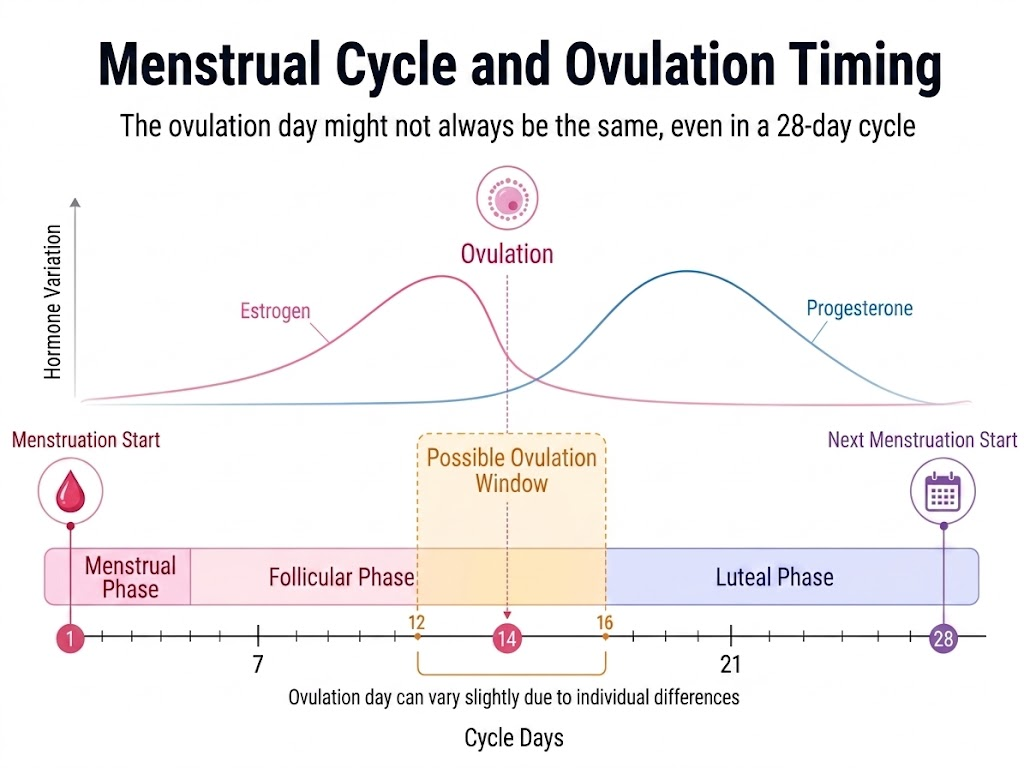
The familiar formula of “28-Day Cycle = Day 14 Ovulation” is merely a textbook pedagogical model designed to illustrate the menstrual cycle, not a universal physiological law applicable to every woman.
“28-Day Cycle = Day 14 Ovulation” Is Only an Average
A 2019 study published in the international journal npj Digital Medicine illustrated this clearly. Researchers analyzed 612,613 ovulatory cycles across 124,648 women.
Among the 81,605 cycles that lasted exactly 28 days:
- Mean Follicular Phase Length: 15.4 days
- Mean Luteal Phase Length: 12.6 days
Even across cycles of identical 28-day duration, ovulation did not uniformly occur on Day 14. The authors emphasized that real-world ovulation timing displays substantially greater biological diversity than the traditional “Day 14” dogma suggests.
The Follicular Phase: The Engine of Ovulatory Variability
The menstrual cycle is broadly divided into two phases: the pre-ovulatory follicular phase and the post-ovulatory luteal phase. The follicular phase spans from the first day of menses to ovulation, while the luteal phase extends from ovulation until the onset of the subsequent menses.
Between the two, the follicular phase accounts for the vast majority of cycle variability.
When menstruation begins, the Hypothalamic-Pituitary-Ovarian (HPO) axis initiates coordinated signaling. Under the influence of follicle-stimulating hormone (FSH) secreted by the pituitary gland, a cohort of antral follicles grows, from which a single dominant follicle is selected. As this follicle matures, estradiol secretion surges; once it crosses a critical threshold, it triggers the luteinizing hormone (LH) surge, culminating in ovulation.
However, the timing of dominant follicle selection and its subsequent rate of follicular growth differ from month to month:
- In one cycle, rapid follicular maturation can pull ovulation forward.
- In another cycle, sluggish follicular development can delay ovulation by several days.
In an observational study tracking 1,060 menstrual cycles among 141 healthy women, considerable cycle-to-cycle variation was observed even among regularly menstruating individuals. The researchers concluded that fluctuations in follicular phase duration were the single greatest contributor to total cycle length variability. Notably, 42.5% of women exhibited a difference of more than 7 days between their shortest and longest cycles during the observation period.
Factors such as psychological stress, acute weight fluctuations, strenuous exercise, advancing age, and endocrine conditions directly influence the HPO axis to alter ovulation timing. In conditions like Polycystic Ovary Syndrome (PCOS), thyroid disorders, or hyperprolactinemia, ovulation may become markedly delayed or anovulatory.
However, ovulating two days late in a given month does not immediately indicate pathology; the American Society for Reproductive Medicine (ASRM) affirms that a moderate degree of cycle-to-cycle variation is a normal physiological phenomenon.
Why the Luteal Phase Is More Consistent (Yet Still Variable)
Following ovulation, the collapsed follicle remodels into the corpus luteum, which secretes progesterone to decidualize and maintain the endometrium for blastocyst implantation. If pregnancy does not occur, luteolysis ensues, progesterone and estrogen levels fall, and the endometrial lining sheds, triggering the next menses.
Because the corpus luteum has a finite biological lifespan, the luteal phase is relatively more consistent than the follicular phase. However, the operative word is “relatively.” The luteal phase is not locked at exactly 14 days for every woman or across every cycle.
According to the updated Committee Opinion on Luteal Phase Deficiency by the American Society for Reproductive Medicine (ASRM):
- Typical Luteal Phase: 12 to 14 days
- Normal Physiological Range: 11 to 17 days
- Short luteal phases can occasionally occur even in healthy, regularly menstruating, fertile women.
Consequently, the common assumption that “ovulation always occurs 14 days prior to the next period” is not an absolute rule. While useful for rough retrospective estimations, it lacks the precision required to pinpoint the exact fertile window or timing for assisted reproduction.
Tracking Ovulation: Hormones and Ultrasound Over Calendars
In fertility management and assisted reproductive technology (ART), clinical timing relies on biological markers rather than calendar formulas:
- Urinary LH Kits: Capture the pre-ovulatory LH surge. According to the ASRM, an LH surge detected in urine indicates a high probability of ovulation occurring within the subsequent 24 to 48 hours. However, LH tests remain indirect proxies and are susceptible to false positives or false negatives.
- Serum Progesterone (P4): Confirming serum progesterone above threshold levels verifies that ovulation has occurred. However, because progesterone is secreted in a pulsatile manner with levels fluctuating widely within hours, a single blood draw cannot evaluate overall luteal adequacy.
- Transvaginal Ultrasound (TVS): In clinical protocols like Natural-Cycle Frozen Embryo Transfers (NC-FET), serial ultrasound scans track dominant follicle diameter, collapse, and endometrial trilaminar development alongside serum LH, estradiol, and progesterone. This biological monitoring ensures precise synchronization between embryonic developmental stage and the window of endometrial receptivity.
Regular Menstruation Does Not Mean Rigid Ovulation Timing
For a woman with consistent 28-day cycles, ovulation may fall on Day 13 in one cycle and Day 15 in the next. Cycle length itself fluctuates subtly, with the pre-ovulatory follicular phase driving the majority of shifts.
Ovulation is not a date dictated by a calendar; it is a dynamic biological event triggered when follicular maturation and neuroendocrine signaling align.
While population averages provide useful statistical baselines, individual female physiology does not adhere to a predetermined calendar schedule.
※ This article was synthesized based on clinical practice guidelines from the American Society for Reproductive Medicine (ASRM) and peer-reviewed studies on menstrual cycle dynamics published in international medical journals. It does not replace individual medical diagnosis or clinical care, and specific medical decisions should be made in consultation with a qualified specialist physician.
※ The images associated with this article were generated using generative AI (ChatGPT, OpenAI) as visual references and do not depict real individuals.