
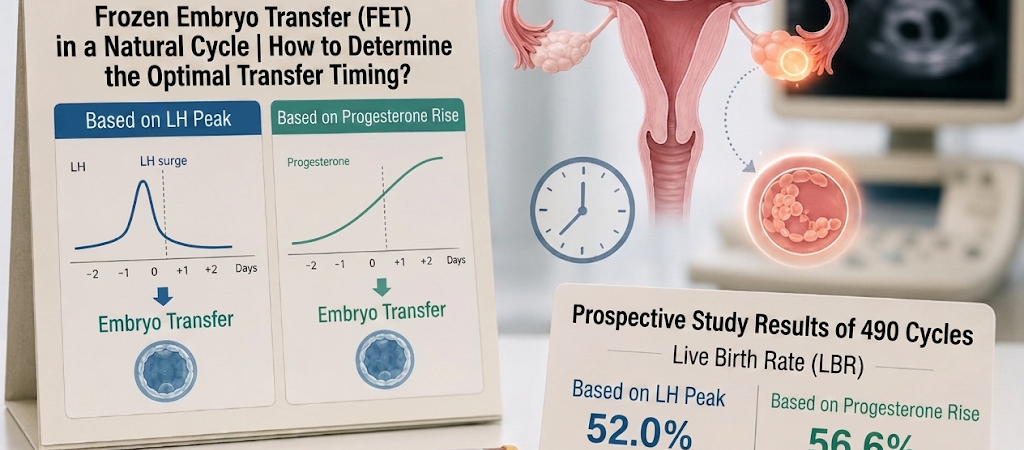
Does missing the LH surge mean a natural-cycle frozen embryo transfer must be abandoned? A prospective study compared transfer timing based on progesterone rise with timing based on LH. Similar observed live birth outcomes raise a practical monitoring question, without establishing a rule for every clinic or cycle.
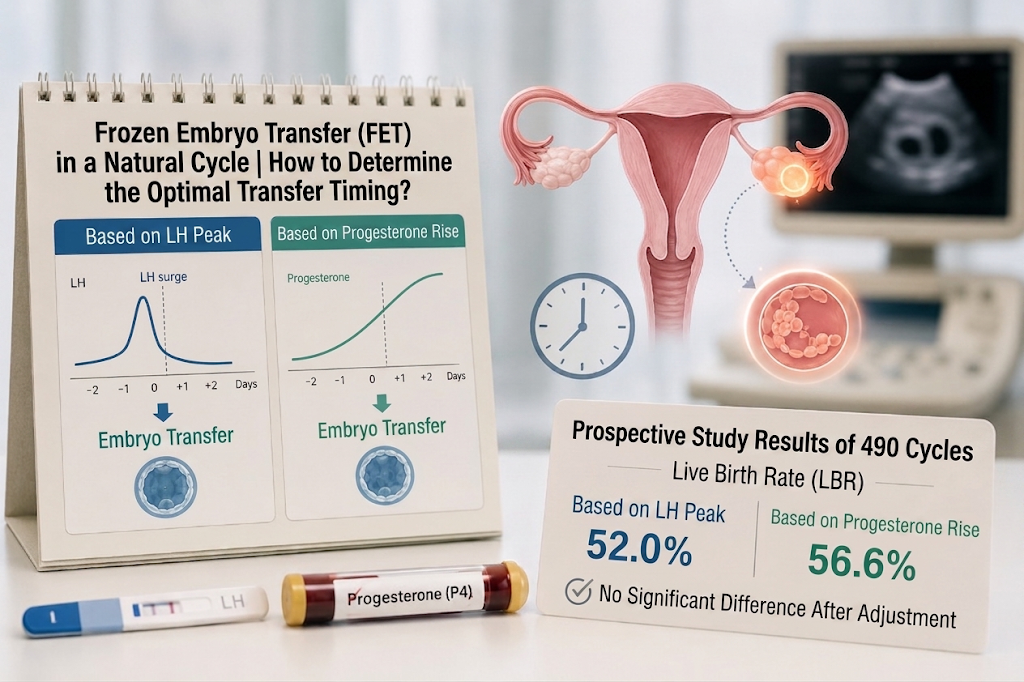
“Does Missing the LH Surge Ruin the Transfer?”… Unexpected Research Findings in Natural-Cycle Frozen Embryo Transfers 490-Cycle Prospective Study: Live Birth Rates 56.6% via P4 vs. 52.0% via LH, No Statistically Significant Difference After Adjustment
For women preparing for a Natural-Cycle Frozen Embryo Transfer (FET)—where frozen embryos are transferred using their own natural ovulation cycle—one of the most stressful moments is pinpointing the exact day of ovulation.
In particular, many patients endure repeated hospital visits over several days for blood draws and ultrasound scans to avoid missing the sharp rise in luteinizing hormone (LH) that occurs immediately before ovulation, commonly known as the ‘LH surge.’
When ovulation occurs, the LH surge triggers the formation of the corpus luteum on the spot, which secretes the hormone progesterone. As progesterone levels rise, the uterine lining thickens, creating an optimal environment for a fertilized egg to implant. Because the uterus cannot accept an embryo without progesterone secretion, confirming ovulation serves as a critical checkpoing in natural-cycle FETs.
However, recent clinical findings suggest that successful pregnancies can be achieved even if these strict rules are bypassed.
In natural-cycle FETs, determining the embryo transfer date based on rising blood progesterone (P4) levels—even if the LH surge is not precisely captured—can yield comparable childbirth outcomes.
According to a study published online on July 15 in the international journal Human Reproduction, an analysis of 490 cycles of true natural-cycle FET revealed no statistically significant difference in live birth rates between groups whose transfer timing was determined by progesterone elevation versus those determined by conventional LH elevation.
Study Design and Findings
Researchers prospectively tracked patients who underwent natural-cycle FET at a university hospital fertility center in Turkey between 2022 and 2025. The subjects were limited to ‘true natural cycles,’ utilizing the patient’s own natural ovulation without artificial ovulation-triggering injections or exogenous hormones.
Among a total of 490 cycles, transfer dates were determined based on progesterone elevation in 286 cycles and based on LH elevation in 204 cycles.
The results were intriguing.
- In the 286 cycles timed by progesterone, 162 live births occurred, resulting in a live birth rate of 56.6%.
- In the 204 cycles timed by the LH surge, 106 led to live births, resulting in a 52.0% rate.
In simple terms, the progesterone-timed group was 4.6 percentage points higher in raw numbers, but this difference was not statistically significant.
Even after adjusting for various clinical variables, no significant difference in the probability of live birth emerged between the progesterone-based group and the LH-based group. The adjusted relative risk was 1.09 with a 95% confidence interval of 0.93 to 1.30. Clinical pregnancy rates, hCG positivity rates, and miscarriage rates were likewise comparable between the two methods.
Based on these findings, the research team suggested that utilizing progesterone to time embryo transfer could serve as a practical alternative to traditional methods relying on LH surge monitoring.
Why Did We Rely on the LH Peak?
In natural-cycle FET, the priority is not merely confirming whether ovulation occurred. The developmental stage of the embryo and the window of uterine receptivity (endometrial readiness to accept implantation) must be matched as precisely as possible.
Historically, the sharp spike in LH right before ovulation has been widely utilized as a “starting signal” to calculate transfer dates. The complication is that the LH surge does not manifest identically in every woman.
While some women experience a rapid, short-lived rise and fall of LH, others maintain elevated levels for a relatively prolonged period or exhibit a dual-peaked surge.
Furthermore, criteria defining what constitutes an “LH surge” vary across studies. Published literature has utilized disparate thresholds, including 10, 15, 17, and 20 IU/L.
Depending on the timing of testing, short-lived LH peaks can easily be missed. Consequently, patients preparing for natural-cycle transfers often face the burden of visiting the hospital multiple times for ultrasounds and blood tests as ovulation approaches.
The Advantage of Progesterone Monitoring
What this study highlighted is progesterone.
While LH acts closer to a signal triggering ovulation, progesterone is a hormone demonstrating that the luteal phase has commenced post-ovulation and that the endometrium is shifting toward preparing for implantation.
Because progesterone begins rising around ovulation and increases relatively steadily during the early luteal phase, it offers a reliable marker for confirming the transition into the luteal phase, outperforming fleeting fluctuations in LH.
In this study, cycles where LH first reached ≥ 15 IU/L with progesterone < 1.0 ng/mL were classified into the LH-based group, whereas instances where progesterone rose to ≥ 1.0 ng/mL regardless of LH levels utilized progesterone to determine the timing of ovulation.
An interesting facet was that cycles where ultrasound scans showed ovulation had already occurred and dominant follicles were no longer visible were not automatically canceled. The researchers estimated the luteal phase dates using progesterone levels meeting specific criteria and proceeded with embryo transfer accordingly.
In short, the data indicates that the formula “Missed LH Peak = No Way to Determine Natural-Cycle Transfer Timing” may not always hold true.
Reducing the Burden of Hospital Visits
If validated further, progesterone-based methods hold positive implications for patients.
While natural-cycle FETs offer the advantage of utilizing fewer medications, they have long carried the inconvenience of requiring repetitive ultrasound and hormone monitoring to pinpoint the exact ovulation window.
The research team explained that progesterone monitoring could reduce reliance on LH testing and frequent ultrasound scans, mitigating difficulties in scheduling transfers caused by missed LH surges. This approach could prove particularly valuable for women whose LH rise amplitude or duration is atypical.
Cautions and Limitations
Certain caveats must be observed. These research findings should not be interpreted to mean that “the progesterone method is superior to the LH method” or that “LH testing is no longer necessary.”
Looking solely at the numbers—56.6% versus 52.0%—the childbirth rate in the progesterone group appears higher, but the difference was not statistically significant.
Moreover, the study itself was not designed as a randomized clinical trial to prove the non-inferiority of the two methods. Therefore, these results cannot definitively establish the non-inferiority of the progesterone-based standard.
Additionally, it was a prospective cohort study conducted at a single fertility center, and patients were not randomly assigned to the two groups.
Because progesterone values can vary depending on testing equipment and assay methods, whether the numerical thresholds used in this study can be applied directly to other hospitals requires further validation. The research team similarly emphasized that confirmation through large-scale, multi-center studies is necessary.
Conclusion
Nevertheless, the message delivered by this study is clear.
The core of natural-cycle FET is not necessarily “capturing a single numerical LH value,” but rather accurately tracking the progression of ovulation and the luteal phase to synchronize the timelines of the embryo and the endometrium.
If the precise timing of ovulation is ambiguous or a peak is missed between tests, patients need not automatically assume their transfer opportunity is lost. This study highlights the possibility that utilizing shifts in progesterone to evaluate luteal phase progression can serve as a viable alternative pathway.
※ This article was synthesized based on the study “Progesterone-based ovulation timing versus LH surge monitoring in true natural cycle frozen embryo transfer: impact on live birth rates in a prospective cohort study,” published in the international journal Human Reproduction on July 15, 2026. It does not replace a specific individual’s diagnosis or treatment, and actual medical judgment must be made through consultation with a specialist.
※ Images: Created using generative AI (ChatGPT, OpenAI); depicts fictional individuals, not real people.
Related reading
A 28-Day Cycle Means Ovulating on Day 14?"… The Female Body Does Not Run on a Calendar