
Successful Generation of Human Spermatocytes in Artificial Mouse Testes… Full Sperm Production Remains the Challenge
Research aimed at reproducing the ‘spermatogenesis process’—a long-standing hurdle in male infertility treatment—inside a laboratory has reached a significant turning point. Scientists have succeeded in taking human blood cells, reverting them into stem cells, and growing them up to the stage just before they develop into mature sperm.
While these are not yet complete, fertilizable sperm, the reproductive medicine community views this as a meaningful advancement because research that had previously been stalled in test tubes has moved one step closer to reproducing a living biological environment.
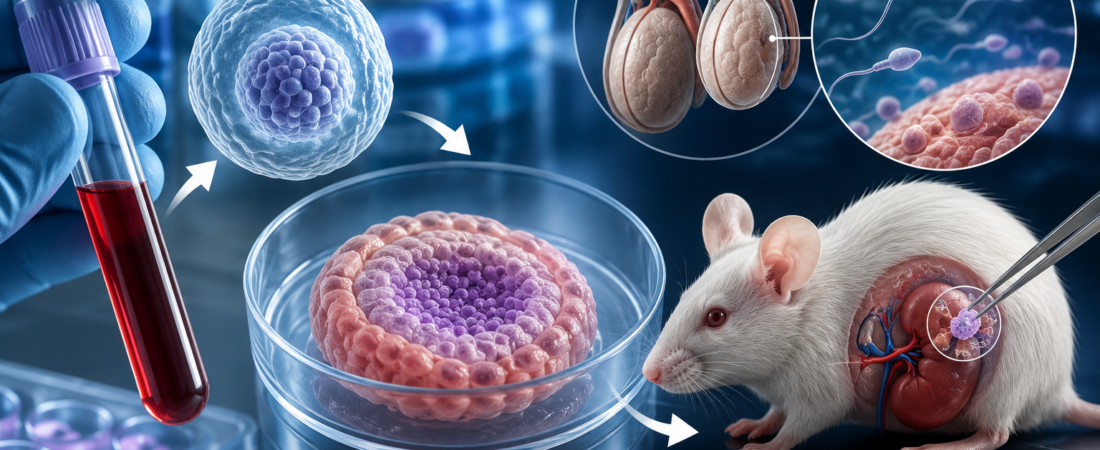
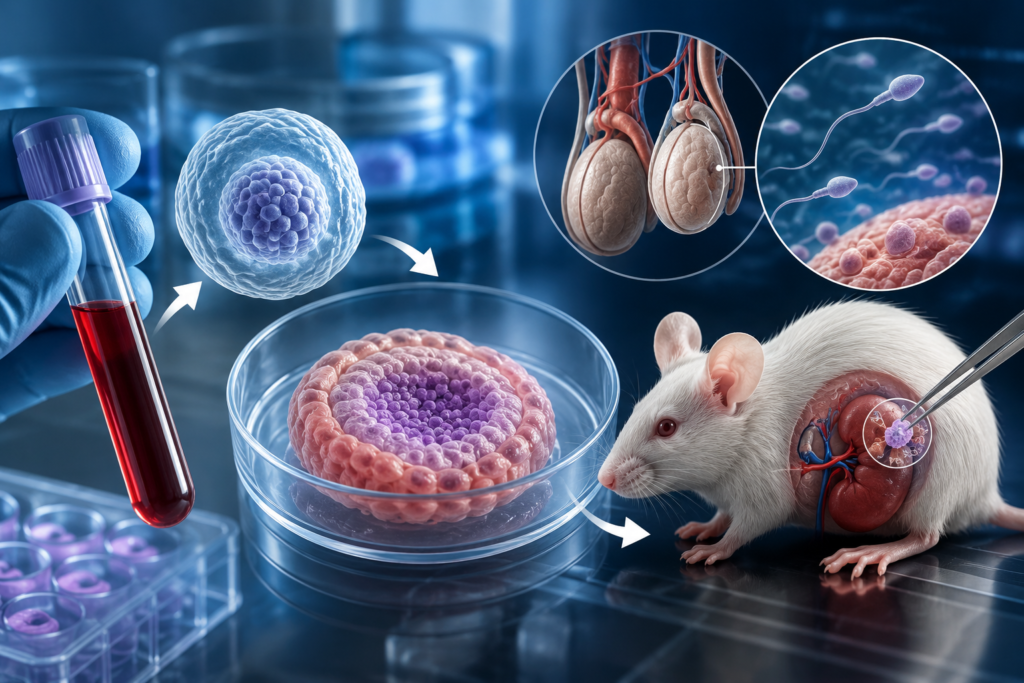
A research team led by Professor Kotaro Sasaki at the University of Pennsylvania School of Medicine published their findings in the international journal Cell Stem Cell. They successfully created human cells from blood, converted them into induced pluripotent stem cells (iPS cells), differentiated them into the germ cell lineage, and then transplanted them—along with testicular supporting cells—into the kidneys of mice in the form of artificial testicular tissue.
The core of this research is not simply inducing stem cells toward sperm development.
The research team created an environment where cells interact with each other, much like in actual testicles, to more naturally reproduce the early stages of sperm growth. Over time, the transplanted tissue formed structures similar to the seminiferous tubules of the testicles, and after about six months, the human cells had grown to the spermatocyte stage.
Spermatocytes are the stage immediately preceding the final development into mature sperm with tails, after undergoing meiosis to halve the number of chromosomes. In other words, they succeeded in “preparing for sperm creation,” even if they have not yet obtained complete sperm with fertilizing capacity.
Nevertheless, the significance of this research is substantial. Until now, human sperm had been difficult to grow beyond early differentiation stages in laboratory culture environments. By providing a microenvironment similar to actual testicular tissue, the research team successfully simulated the process of spermatogenesis more realistically, which is considered to have crossed a major technical barrier in male germ cell research.
Not Yet Sperm, But the Greatest Advancement in Human Germ Cell Research
This research opens new possibilities for studying male infertility of unknown origin.
Currently, male infertility accounts for nearly half of all infertility cases, yet many cases remain unexplained because no specific abnormalities are found during testing. Clinical practice classifies these as ‘unexplained male infertility,’ which is known to account for about 40% of all male infertility. If we can create germ cells with the same genetic information in a lab using only a patient’s blood cells, we can directly identify at which stage the sperm stops growing. This could allow for more precise analysis of infertility causes that previously relied on assumptions and may serve as foundational technology for developing personalized treatments.
However, there are still significant barriers to overcome before this translates into actual treatment.
In this study, the spermatocytes did not ultimately develop into mature sperm. The research team believes this is because the human cells, growing in a heterogeneous (xenogeneic) environment like a mouse kidney, did not receive sufficient hormones and cell-to-cell signals. Sperm formation is a complex process that requires the sophisticated interplay of hormones secreted by the brain and endocrine system, not just the cells inside the testicles.
Another challenge is the ethical issue. Research using human stem cells to create sperm and eggs is strictly regulated in most countries. For this reason, the research team announced plans to use macaques (monkeys) instead of humans in the future to verify the possibility of producing mature sperm.
The technology for artificially creating germ cells is advancing rapidly worldwide. A research team at Kyoto University in Japan has already succeeded in producing sperm and eggs from stem cells made from mouse skin cells, obtaining normal offspring, and confirming that those offspring also have reproductive capabilities. Recently, as U.S. biotech companies have begun competing to develop stem cell-based egg production and in vitro sperm production technologies, the field of germ cell manufacturing is expanding from the lab to the industrialization stage.
Experts evaluate this achievement as having put together a crucial piece of the puzzle necessary to understand the entire process of human sperm creation, even if it cannot change infertility treatment immediately. If they succeed in producing mature sperm in the future, it could bring major changes to overall reproductive medicine, not just for male infertility treatment, but also for recovering fertility in patients who lost reproductive capacity due to cancer treatment, and for research into rare genetic diseases.
The era where blood cells become sperm has not yet arrived. However, research attempting to reproduce human germ cells in the laboratory is now moving beyond mere possibility and taking steps toward reality. This is expected to be a new starting point that could change the paradigm of male infertility treatment.
※ This article was written based on materials including the paper published by researchers at the University of Pennsylvania in the international journal Cell Stem Cell. It does not replace a specific individual’s diagnosis or treatment, and actual medical judgment must be made through consultation with a specialist.
※ Image: Created using generative AI (ChatGPT, OpenAI); depicts fictional individuals, not real people.