
An Era of Delayed Childbirth, Obesity, and Environmental Changes; Experts Call for National Management of Male Reproductive Health
Back in the 1970s and 80s, it was common to see fathers who smoked two packs of cigarettes a day and drank alcohol after work raising three or four children. By today’s standards, such lifestyles would lead to urgent medical recommendations for smoking cessation and moderation of alcohol, yet large families were not rare at the time.
Conversely, today’s young men who quit smoking, cut down on alcohol, and even exercise regularly are the ones visiting fertility clinics. If their lifestyles have improved, why is it harder to have children?
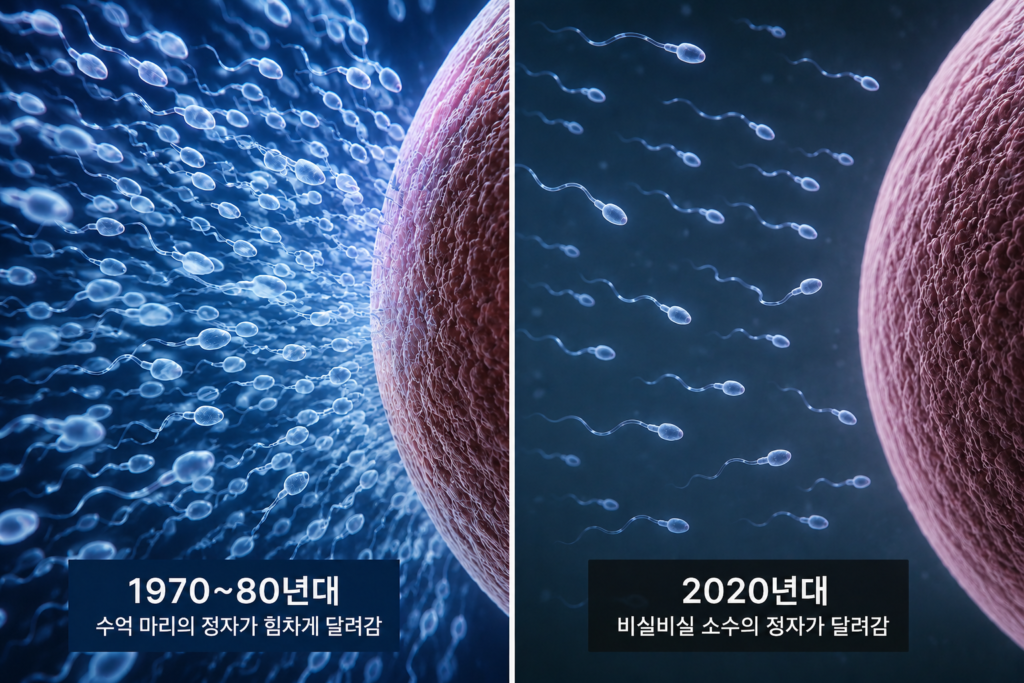
Reproductive medicine experts do not find the answer simply in tobacco or alcohol. It is because the male reproductive environment itself has changed completely in just one generation. Recent international research quantifies this transformation: male testosterone levels have dropped by nearly half over the last 50 years, flashing a global warning light for male reproductive health.
At the 2026 Annual Meeting of the European Society of Human Reproduction and Embryology (ESHRE) held in London, a research team led by Professor Hagai Levine of the Hebrew University of Jerusalem presented a meta-analysis of six longitudinal studies involving 118,593 men across five countries from 1972 to 2019.
The findings were shocking. The average male testosterone level has decreased by 54% over the past 50 years. The rate of decline has accelerated since 2000, showing a steady downward trend of about 1% per year. The research team interpreted this not as a temporary statistical fluctuation, but as a persistent, long-term biological change.
While testosterone is commonly known as a “male hormone,” its role is much broader. It is a core hormone that dictates overall male health, including sperm production, libido, muscle mass maintenance, bone density, energy metabolism, and mood regulation. As these levels drop, the likelihood of an impact on sperm count, motility, and reproductive function increases significantly.
Why Were Previous Generations More Fertile?
Experts emphasize that this should not be interpreted as “an era when smoking and drinking were fine.” Smoking and excessive drinking were still harmful to reproductive health back then. However, the environment surrounding childbirth was completely different.
In the past, most people married in their early to mid-20s and attempted their first pregnancy when their reproductive capacity was at its peak. There were also more opportunities to attempt natural conception multiple times. Today, the age of first marriage and first childbirth has risen significantly, and the number of pregnancy attempts has decreased. The current structure makes even the same level of decline in reproductive capacity have a much greater impact on pregnancy success rates than it did in the past.
Modern lifestyle environment changes are also pressuring male reproductive health.
The research team identified the rise in obesity and diabetes as the most significant causes. Excess body fat causes some testosterone to be converted into estrogen, a female hormone, and diabetes can impair the hormone-regulating functions of the hypothalamus and pituitary gland, leading to reduced male hormone secretion.
There are also concerns about endocrine-disrupting chemicals, microplastics, chronic stress, sleep deprivation, and lack of exercise. However, the research team clarified that the causal link between these environmental factors and testosterone decline is a field that requires further study.
Professor Levine stated, “We are living in an environment exposed to chemicals and unhealthy lifestyles. Male reproductive health is already a serious public health issue, but social interest remains insufficient.” He emphasized that a preventive approach to reduce environmental exposure is necessary even before the scientific evidence is fully accumulated.
Professor Channa Jayasena of Imperial College London, who did not participate in this study, evaluated it by saying, “It is very persuasive that results in the same direction have been confirmed in studies repeated over decades. We must accept this as a sign that male reproductive health is deteriorating over time.”
The Danger of ‘Testosterone Supplements’
Experts also expressed concern that more people are seeking testosterone supplements as news of declining male hormones spreads.
When testosterone is administered externally, the brain perceives that there is enough hormone in the body and reduces the signal to the testicles to produce sperm. As a result, sperm production may decrease or stop temporarily.
Professor Alan Pacey of the University of Manchester warned, “Testosterone supplements are advertised like drugs that boost virility, but for men who want to conceive, they can actually suppress sperm production. Male infertility must be diagnosed and treated after consultation with a reproductive medicine specialist.”
A generation ago, infertility was considered a woman’s problem. However, the reality shown by reproductive medicine today is different. The decline in male hormones and the deterioration of sperm health are not individual problems, but indicators of overall societal health in an era of population decline. The era that allowed the high fertility of our fathers’ generation is over. There is a growing call to view male reproductive health as a public health task that the nation must manage together.
※ This article was synthesized from research presented at the ESHRE 2026 Annual Meeting, commentary from international reproductive medicine experts, and the latest studies on male reproductive health. It does not replace a specific individual’s diagnosis or treatment, and actual medical judgment must be made through consultation with a specialist.
※ Image: Created using generative AI (ChatGPT, OpenAI); depicts fictional individuals, not real people.