
“Will Eating Pineapple or Loach Soup After Transfer Help Implantation?”… What Science Reveals About ‘Implantation Foods’
- Clinical effects of specific foods like pineapple, pomegranate, soy milk, eel, and loach soup remain scientifically unproven
- 2026 systematic review of 39 ART studies: Healthy dietary patterns show positive associations, but definitive proof regarding live birth rates remains uncertain
- Mediterranean and Pro-Fertility diets improved pregnancy and embryo metrics in selected trials… Overall dietary patterns matter far more than any single “superfood”
“What should I eat after my embryo transfer to help it stick?”
This is one of the most frequent questions asked by women undergoing fertility treatment.
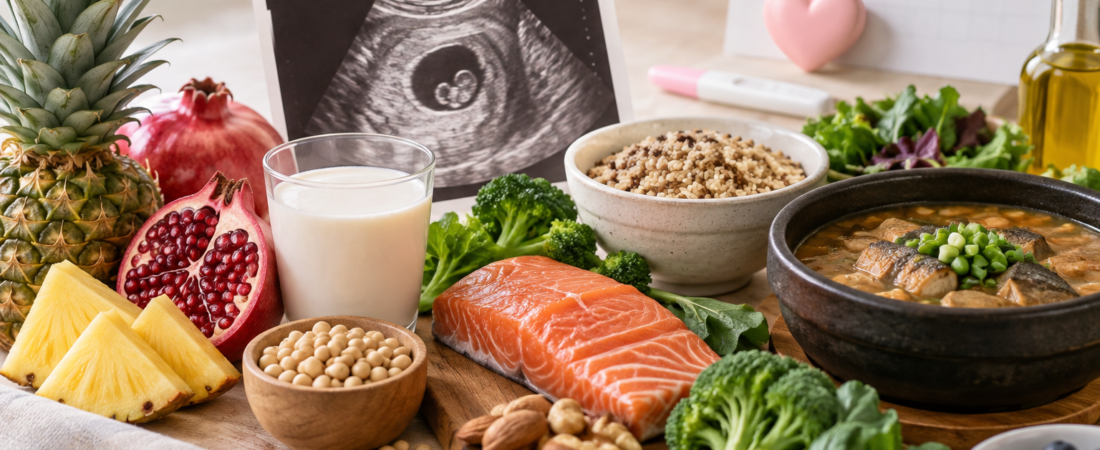
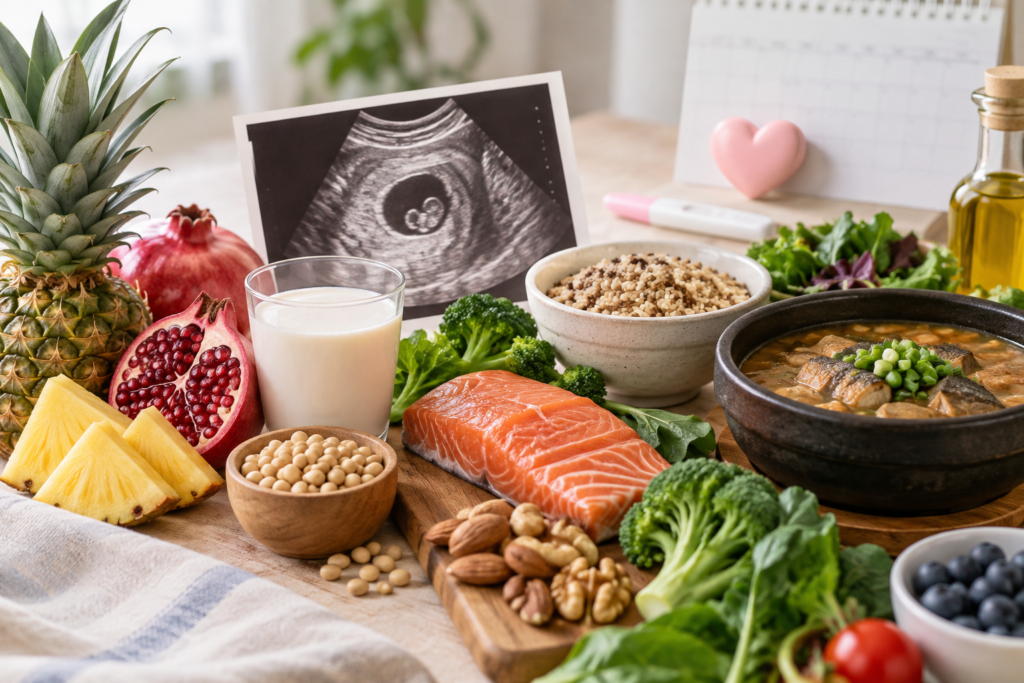
The list of foods rumored to “aid implantation” is extensive—ranging from pineapple and pomegranate to soy milk, eel, and hot bowls of loach soup (chueotang). Some patients make a point of eating pineapple core on the day of transfer, while others seek out rich, restorative soups. But does actual clinical research demonstrate that any of these specific foods genuinely boost embryo implantation?
To date, there is insufficient clinical evidence to prove that eating any single food item will increase implantation rates. Rather than asking “what single thing should I add to my plate,” recent scientific literature increasingly points toward a different question: what kind of dietary pattern do you maintain over the long term?
Can Pineapple or Loach Soup Make an Embryo Stick?… The Evidence Is Lacking
The most widespread myth centers on pineapple. The claim that pineapple aids implantation gained traction because its core contains bromelain, an enzyme known to exhibit mild anti-inflammatory properties. However, demonstrating a biochemical action in a laboratory dish is worlds apart from proving that eating a fruit increases clinical implantation rates in IVF patients.
To date, there are no large-scale, well-designed clinical trials showing that women who eat pineapple achieve meaningfully higher implantation or live birth rates than those who do not. The same holds true for pomegranate, eel, loach soup, and soy milk: there is no verifiable clinical proof that consuming any of these specific foods directly enhances implantation.
39 Clinical Trials Evaluated ‘Dietary Patterns,’ Not ‘Isolated Foods’
A comprehensive systematic review published in July 2026 in the international journal Reproductive BioMedicine Online evaluated 39 clinical studies investigating the relationship between diet and assisted reproductive technology (ART) outcomes.
The researchers observed that dietary patterns rich in healthy, nutrient-dense whole foods—such as vegetables, fruits, whole grains, and fish—were generally associated with favorable ART outcomes. Conversely, Western-style diets characterized by high intakes of ultra-processed foods, refined sugars, and saturated fats trended toward poorer reproductive parameters.
However, the authors concluded that definitive evidence confirming that any specific diet or isolated micronutrient conclusively elevates overall IVF success or cumulative live birth rates remains limited.
The Most Thoroughly Studied Regimen: The Mediterranean Diet
Among fertility diets, the Mediterranean diet has received the greatest share of scientific attention. This dietary pattern emphasizes high consumption of vegetables, fruits, whole grains, legumes, nuts, seeds, fish, and olive oil, while sharply reducing red meat and processed foods.
A systematic review and meta-analysis published in 2023 reported that when trials with a high risk of bias were excluded, patients undergoing assisted reproduction who closely adhered to a Mediterranean diet had an approximately 1.9-fold higher likelihood of achieving pregnancy or a live birth compared to non-adherent controls.
Yet, because the total number of included studies was relatively small and the majority were observational cohorts, patients should not jump to the conclusion that “eating a Mediterranean diet automatically doubles your implantation chances.”
2026 Randomized Trial: Improvements in Fertilization and Embryo Quality
In 2026, researchers published an interventional study exploring proactive dietary modification. In a randomized controlled trial of 180 infertile women undergoing IVF, one group was assigned to follow a structured “Pro-Fertility Diet” supplemented with Omega-3 fatty acids, Vitamin D, folic acid, and Vitamin B12 for 60 days prior to stimulation. The control group received standard general dietary advice alongside routine folic acid supplementation.
The results demonstrated tangible differences: the intervention group achieved a fertilization rate of 81% compared to 66% in the control group, and an embryo formation rate of 79% versus 62%. Furthermore, the proportion of top-quality (Grade A) embryos was significantly higher in the intervention arm, at 45.2% versus 21.7%.
Crucially, however, this trial did not examine the isolated effect of a single food. It applied a comprehensive dietary protocol bundled with targeted nutritional supplements. Moreover, the primary endpoints evaluated were fertilization efficiency and embryo morphological grading, rather than final implantation or live birth rates.
Everyday Dietary Habits Outweigh Post-Transfer “Miracle Meals”
Synthesizing the available evidence leads to a clear conclusion: it is impossible to designate any single food as an “implantation food.” Eating pineapple will not guarantee that an embryo implants, and skipping it will not cause a transfer to fail. Anecdotal claims attributing pregnancy success to a bowl of loach soup or eel cannot separate the food itself from the underlying biological probability of pregnancy.
The consistent message emerging from reproductive nutritional science is to focus on a balanced, nutrient-dense lifestyle: eating abundant vegetables, fruits, whole grains, legumes, nuts, and healthy fish, while minimizing processed foods, excess added sugars, and trans/saturated fats.
Rather than binge-eating a specific fruit or heavy dish starting 24 hours before a transfer, maintaining stable nutritional and metabolic health in the months leading up to the cycle is what truly aligns with current scientific evidence.
In reproductive medicine, food does not function like a pharmaceutical drug that triggers implantation within hours of ingestion. Instead of hunting for “foods that force an embryo to stick,” current research indicates that the real goal is cultivating a sustained, healthy physiological environment where the uterus and embryo are best equipped to support new life.
※ This article was written based on the systematic review investigating the relationship between assisted reproductive technology and diet published in the international journal Reproductive BioMedicine Online (July 2026). It does not replace individualized clinical diagnosis or medical care, and specific dietary and treatment decisions should always be made in consultation with a qualified reproductive specialist or clinical nutritionist.
※ Image: AI generated (ChatGPT, OpenAI) / For illustrative reference only.