
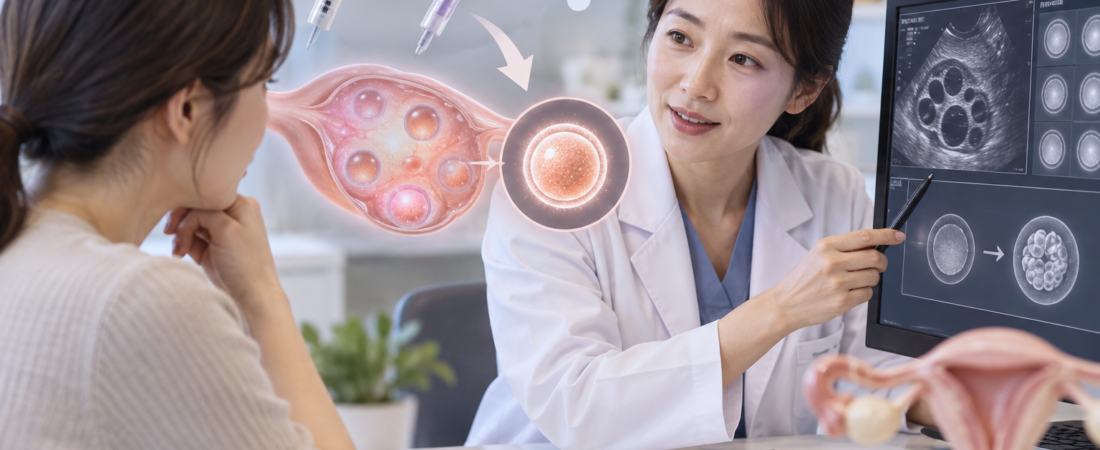
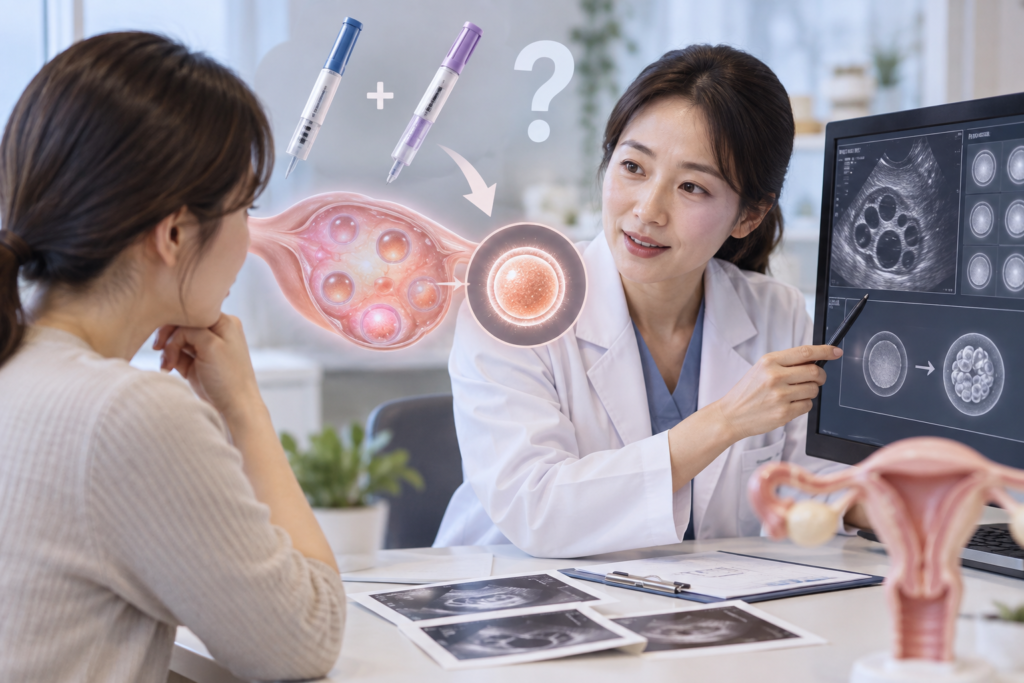
- CHA Medical Center researchers analyze real-world clinical data from 1,028 IVF patients
- Comparing rFSH monotherapy versus rFSH + HP-hMG co-treatment
- Combined group retrieved fewer eggs, but maturation and clinical pregnancy rates were comparable
- OHSS in frozen transfer cohort dropped from 13.2% to 6.9%
When starting In Vitro Fertilization (IVF), the very first milestone patients encounter is ovarian stimulation injections.
Yet even within the same fertility center, prescriptions vary considerably from person to person. Some patients receive a single type of follicle-stimulating hormone, while others are prescribed two different injections in combination. Does combining multiple types of gonadotropins genuinely yield more eggs?
Real-world clinical data from over 1,000 fertility patients analyzed by South Korean researchers at CHA Medical Center revealed an outcome that ran slightly counter to intuitive expectations.
Patients who received two types of gonadotropins in combination did not retrieve more eggs. In fact, their average retrieved egg count was lower. However, when evaluating the maturation rate of those eggs and the resulting clinical pregnancy rates, there was virtually no difference compared to monotherapy.
The research team from CHA Fertility Center Seoul Station and Bundang CHA Hospital at CHA University School of Medicine analyzed clinical records from 1,028 women undergoing IVF, comparing outcomes between those who received recombinant follicle-stimulating hormone (rFSH) alone and those prescribed rFSH combined with highly purified human menopausal gonadotropin (HP-hMG). The findings were published in the international journal Scientific Reports in May 2026.
Egg Counts Were Actually Higher in the Monotherapy Group
All study participants underwent ovarian stimulation using a Gonadotropin-Releasing Hormone (GnRH) antagonist protocol. Among them, 329 patients underwent fresh embryo transfers, while 699 received frozen embryo transfers (FET).
Looking at raw numbers first, the simple formula that “mixing injections yields more eggs” did not hold true.
In the fresh embryo transfer cohort, the average number of retrieved oocytes was 11.0 in the rFSH monotherapy group compared to 9.5 in the rFSH + HP-hMG combination group. In the frozen embryo transfer cohort, the difference was 20.6 eggs versus 16.3 eggs, with the monotherapy group retrieving more oocytes in both settings.
However, this does not mean the combination therapy was biologically inferior. The baseline clinical characteristics of the two patient groups were fundamentally different from the start.
Patients in the combination group had a higher average age and lower baseline markers of ovarian reserve, including Anti-Müllerian Hormone (AMH) and Antral Follicle Count (AFC). In clinical practice, combination regimens were selectively prescribed to patients who were anticipated to have a poorer ovarian response.
Indeed, the proportion of patients prescribed combination therapy climbed sharply with age: it was 55.1% in women aged 20 to 30, rising to 60.3% in those aged 31 to 35, and reaching 83.0% in women aged 36 to 39. Among patients with an AMH level of 1.90 ng/mL or lower, 90% were prescribed combination therapy.
Maturation Rate—More Important than Egg Count—Remained Comparable
What happened after retrieval is where the true clinical picture emerged.
The proportion of mature Metaphase II (MII) oocytes—the only eggs capable of undergoing fertilization—showed no difference between the two treatment approaches. In fresh transfers, maturation rates were 74.1% for rFSH monotherapy and 75.4% for combination therapy; in frozen transfers, they were 68.9% and 69.3%, respectively.
Clinical pregnancy rates were similarly equivalent:
- Fresh Embryo Transfers: 43.6% in the rFSH monotherapy group vs. 44.6% in the combination group.
- Frozen Embryo Transfers: 56.8% in the rFSH monotherapy group vs. 58.4% in the combination group.
Despite the combination cohort including patients who were older and had lower AMH levels and baseline follicle counts, their final clinical pregnancy outcomes showed no statistically significant disparity compared to the younger, higher-reserve monotherapy group.
When the researchers statistically adjusted for differences in age, AMH, and AFC, the findings held firm: following adjustment, the numerical gap in retrieved egg counts disappeared entirely, and clinical pregnancy rates remained comparable between the two arms.
OHSS in Frozen Transfers: 13.2% vs. 6.9%
Another notable observation centered on Ovarian Hyperstimulation Syndrome (OHSS).
Within the frozen embryo transfer cohort, the incidence of OHSS was 13.2% in the rFSH monotherapy group compared to 6.9% in the rFSH + HP-hMG combination group. Rates of severe OHSS were also lower in the combination group, at 0.5% versus 2.4%.
However, this finding should not be interpreted as definitive proof that “adding HP-hMG cuts your OHSS risk in half.”
This was a retrospective observational study analyzing past medical records rather than a prospective randomized trial. Once the researchers controlled for baseline patient characteristics—most notably age, AMH, and AFC, which are the primary determinants of OHSS risk—the statistical significance of the OHSS disparity between the groups faded.
Focus on ‘Whom to Prescribe For’ Rather Than ‘Which Injection Is Better’
The central takeaway of this research is that combining different types of stimulation injections does not automatically guarantee a higher oocyte yield.
rFSH delivers targeted FSH receptor stimulation to directly drive follicular proliferation. In contrast, HP-hMG provides both FSH and luteinizing hormone (LH) bioactivity (primarily mediated by human chorionic gonadotropin, hCG), delivering a dual hormonal stimulus during follicular maturation.
In real-world clinical care, reproductive endocrinologists determine medication selection and dosing by evaluating a patient’s age, baseline ovarian reserve, and past response to stimulation. Evaluating gonadotropin regimens simply as “is one drug better or two” overlooks that clinical context.
Maximizing raw egg numbers is not the sole objective of an IVF cycle. What matters far more is how many retrieved oocytes are mature, how successfully they fertilize and develop into viable blastocysts, and whether they ultimately lead to a healthy pregnancy and delivery.
In this study, patients who received combined gonadotropins retrieved slightly fewer eggs, but their proportion of mature eggs and their clinical pregnancy success matched those receiving monotherapy. Ultimately, the question is not whether you are using multiple medications, but whether the chosen stimulation strategy aligns with your individual age and ovarian biology.
Because this study analyzed existing clinical records retrospectively, it was not an interventional trial randomizing patients from the outset, nor did it track cumulative live birth rates across multiple subsequent cycles.
Consequently, it is premature to conclude that “taking two medications together is superior” or that “taking only one is safer.” Prescribing ovarian stimulation injections remains an individualized medical decision—one that must be tailored to each patient by weighing chronological age, AMH, antral follicle count, and how her ovaries responded to past cycles.
※ This article was written based on the study “Comparing clinical outcomes of rFSH versus rFSH+HP-hMG in women undergoing in vitro fertilization-embryo transfer in real-world practice: a retrospective study” by researchers from CHA Fertility Center Seoul Station and Bundang CHA Hospital, CHA University School of Medicine, published in Scientific Reports on May 19, 2026. The study included a total of 1,028 patients (DOI: 10.1038/s41598-026-51867-3). It does not replace individualized clinical diagnosis or medical care, and specific pharmacological decisions should always be made in consultation with a qualified specialist.
※ The images associated with this article were generated using generative AI (ChatGPT, OpenAI) as illustrative visual references and do not depict real individuals.
※ Copyright © 2026 THE FERTILITY NOTES. All rights reserved. Unauthorized reproduction, duplication, distribution, scraping, AI training, or data utilization of all content, including articles, photos, and images, is strictly prohibited and may result in legal liability.