
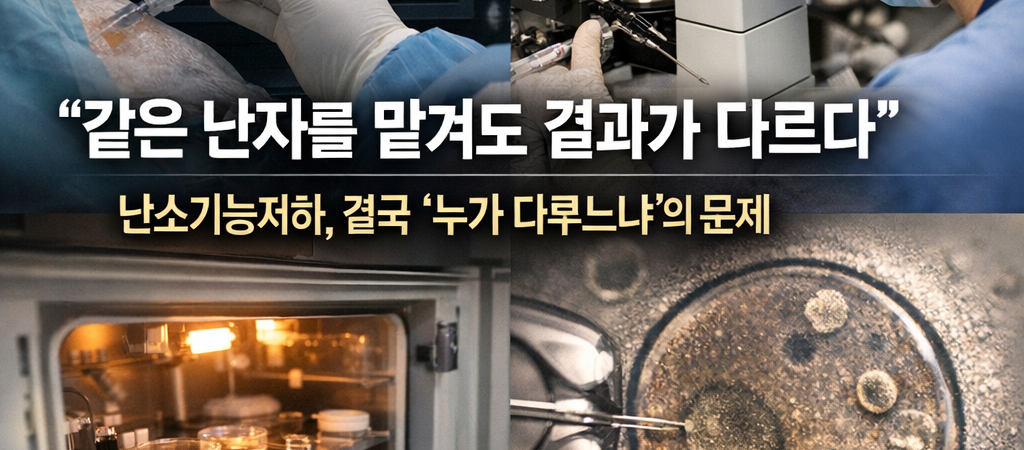
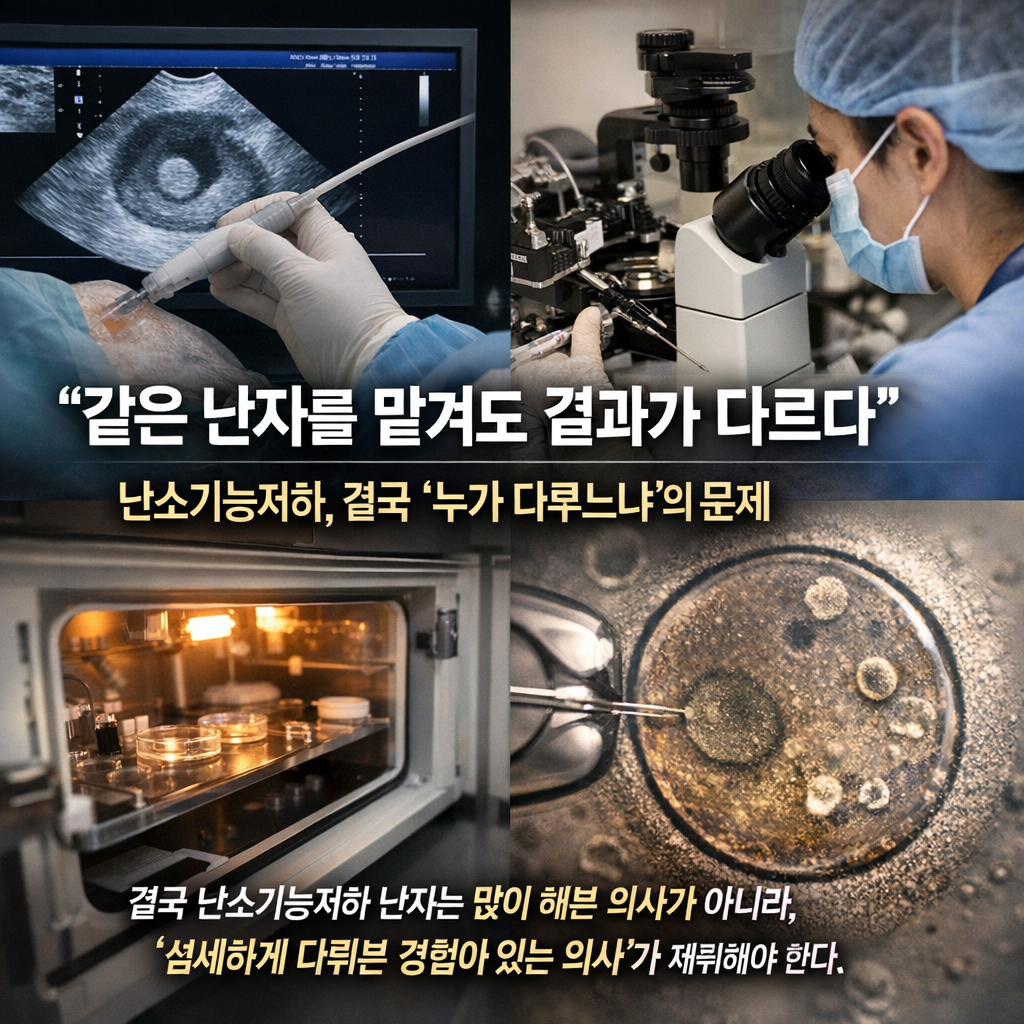
In the field of In Vitro Fertilization (IVF), the same question is asked with high frequency: Are oocytes harvested from an ovary with diminished ovarian reserve (DOR) genuinely weaker? And if so, where exactly does this biological deficit manifest?
The conclusion is straightforward: These eggs are not simply “fewer in number”; they are inherently “far more fastidious.” And managing this biological fragility is a variable decided not by automated technology, but by human hands.
The Crucial Cushion: Young vs. Aged Oocytes
Oocytes harvested from young, healthy ovaries possess a certain degree of physiological “cushion.” They can comfortably absorb the mechanical stress of retrieval, subtle temperature fluctuations in the laboratory, and microscopic manipulation margins.
Conversely, oocytes from an ovary with diminished reserve possess virtually no such cushion. Because their baseline cellular metabolism and cytoplasmic structures are already unstable, they can experience an absolute cellular collapse in response to even the most microscopic external stressor.
This critical divergence initiates at the exact moment of oocyte retrieval. In DOR patients, the follicular walls are frequently thin, and the structural binding integrity of the cumulus-oocyte complex (COC) is markedly compromised. Consequently, applying standard vacuum aspiration pressures can mechanically damage the egg or cause the clinician to miss it entirely.
At this juncture, what saves the cycle is not advanced equipment, but the tactile intuition of the surgeon’s hand—accurately judging how low to reduce the aspiration pressure, how to subtly re-angle the aspiration needle, and precisely when to halt the vacuum. These real-time micro-judgments cannot be memorized from a textbook manual; they are forged through thousands of hours of repetitive clinical experience.
Therefore, when harvesting oocytes from an ovary with diminished ovarian reserve, having a physician who has performed “many” procedures is important, but it is far more critical that the eggs are harvested by a specialist who has mastered the art of “highly delicate” manipulation.
And the retrieval is merely the prologue.
The Battleground of the Embryology Laboratory
The true diagnostic divergence unfolds within the walls of the embryology laboratory. Oocytes from depleted ovaries are extraordinarily hyper-sensitive to the slightest shift in their culturing environment:
- Temperature: A mere 0.5-degree variance can halt development.
- Time: A few seconds of extended exposure during a culture media change can induce stress.
- pH Levels: Microscopic drifts completely alter fertilization kinetics.
Young eggs can comfortably weather these fluctuations, but older eggs will react negatively. Fertilization kinetics, cellular cleavage speeds, and overall embryo morphology are entirely decided by these fractions of a second. For this reason, the role of the embryologist extends far beyond that of a clinical technician.
Particularly when manipulating senescent (aged) oocytes, longitudinal experience directly translates into the final outcome. Even within a standardized Intracytoplasmic Sperm Injection (ICSI) protocol, the precise angle of needle insertion, the velocity of sperm injection, and the tactile force applied to pierce the oocyte membrane vary significantly under different hands. Inject too quickly, and the oocyte undergoes immediate lysis (cellular rupture); inject too slowly, and the cell fails to recover.
This delicate equilibrium defies mathematical definition. Ultimately, it can only be safely navigated by an embryologist who does not just look at cells, but intimately understands the exact tipping point where a fragile egg begins to break.
Paradigm Shift: Choosing the Right Practitioner
Clinically, this human variable directly dictates live birth rates. This explains why, even across identical patient demographics, different fertility centers exhibit massive statistical variances in retrieval loss rates, fertilization success, and blastocyst development rates.
This gap cannot be logically explained by intrinsic egg quality alone. The reason different outcomes are achieved from the exact same pool of oocytes is simply that the clinical approach to handling those oocytes is fundamentally different.
This is the precise intersection where the true nature of fertility treatment reveals itself. Undergoing an IVF cycle as a patient with diminished ovarian reserve is less about the “choice of medication protocol” and far more about the “choice of the individual practitioner.” The corporate protocols may look identical on paper, yet the clinical outcomes emerge entirely poles apart.
Ultimately, the fundamental question must be reframed. The goal is no longer about how high of an egg count can be extracted, but rather: Who is handling that single, precious egg, and how are they doing it? Is the care truly meticulous?
Managing a diminished ovarian reserve is not a game of sheer numbers; it is a discipline of absolute precision. And that precision is fulfilled only through the compiled depth of human experience.
Editor’s Note: This content is an analytical commentary prepared by a specialized medical journalist through the collection and evaluation of domestic and international reproductive medicine research, clinical policies, and statistical data. All medical diagnoses and treatment plans must exclusively be established through direct consultation with a qualified fertility specialist.
Image Source: AI-generated (ChatGPT, OpenAI) / Provided solely as a supplemental visual aid for conceptual understanding.