
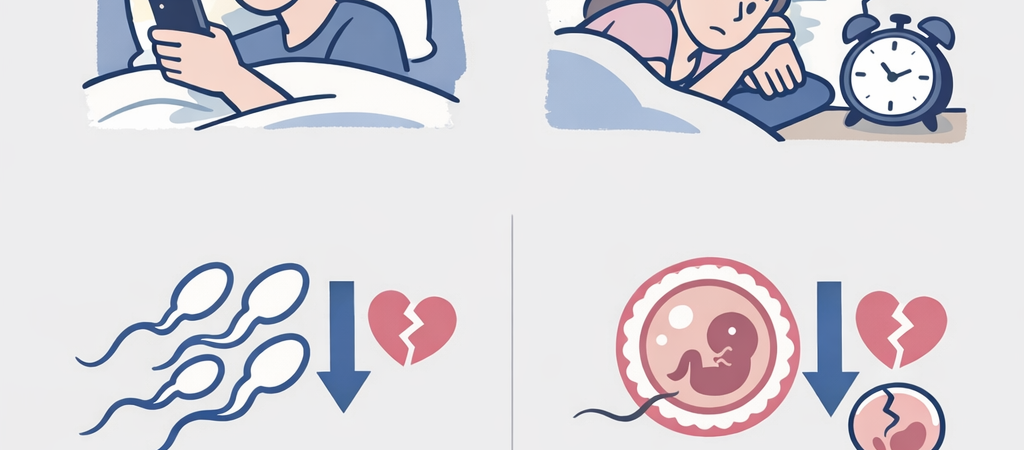
When conception proves difficult, we instinctively search for answers in the external environment: our age, our ovarian reserves, our sperm parameters, or the clinical protocols we follow. Yet, cutting-edge reproductive research is pointing in a completely different direction. The issue may not be in the daylight hours, but in the nighttime: it depends entirely on how we sleep.
Sleep is no longer categorized merely as “downtime.” It is the silent, powerful conductor of the reproductive system. When this conductor falters, the body instinctively prioritizes immediate survival over reproduction. This simple biological reality is now being confirmed by robust clinical data.
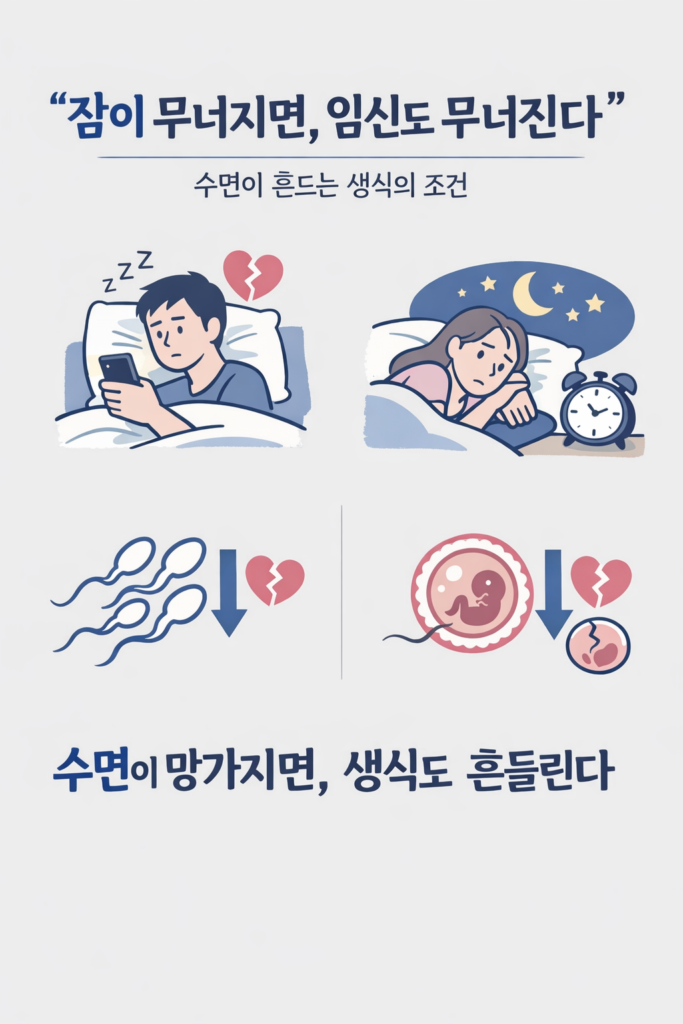
For men, the link between sleep and reproduction is stark. Poor sleep quality and duration are directly associated with reduced sperm concentration, impaired motility, and lower total sperm count. But the implications run deeper: men with poor sleep patterns exhibit lower actual pregnancy success rates. This is not a matter of “numbers” alone; it is a degradation of “function.” Sperm are increasingly interpreted not as products of diet or nutrition, but as the outcomes of internal biological rhythms. Sperm are not just “made”; they are produced according to a specific temporal schedule.
For women, the consequences of disrupted sleep are even more insidious. A compromised sleep pattern first destabilizes the ovulation cycle. While everything may appear normal on the surface, the internal timing is subtly misaligned. This manifests slowly: it takes longer to conceive, and the probability of pregnancy drops significantly. In cases where sleep disorders are present, the risk of infertility can nearly double. This is not just a “lifestyle issue”; it is a sign that the reproductive system’s equilibrium has been lost.
The core of the problem is not hormones in isolation; it is rhythm. Reproductive biology does not operate on “quantity”; it operates on “timing.” Hormones like GnRH, LH, and FSH must be secreted with exact precision to be meaningful. When sleep is fractured, this “timetable” collapses. Ovulation shifts, oocyte maturation becomes erratic, and spermatogenesis is compromised. The problem is not a deficit, but a fundamental lack of synchronization.
Laboratory findings confirm this trend: women with poor sleep quality yield fewer eggs, produce embryos of lower quality, and show reduced implantation rates. Conception is not the starting point—it is a result of a long, synchronized process that occurs long before fertilization.
Perhaps most dangerously, sleep is an invisible variable. We can track our diets and remain conscious of our exercise, but sleep is often sacrificed to stress, artificial light, blue-light exposure, late-night meals, and irregular schedules. Everything blends together, slowly eroding reproductive function unnoticed. Most individuals only realize the damage when faced with the result: “Why am I not getting pregnant?” By then, it is often too late.
The current paradigm of reproductive medicine is shifting its inquiry. We are no longer asking just “What did you eat?” but “How did you sleep?” We are asking not “How hard did you try?” but “What rhythm did you live by?”
The conclusion is simple, yet profound: When sleep suffers, sperm quality declines. When sleep is disrupted, egg quality falters. When sleep collapses, the probability of pregnancy follows. This is no longer just a cautionary tale; it is an established clinical flow.
Reproduction is not designed during the day. It is engineered at night. And your night—right now—is deciding the next generation.
Sources: Caetano G et al., “Sleep and female reproductive health: systematic review,” Sleep Medicine Reviews (2021); research published in Human Reproduction and Fertility and Sterility.
Disclaimer: This content is provided for informational purposes, based on reporting on infertility and various public data. Medical judgments and treatment decisions must always be made in consultation with professional medical personnel. Image: AI-generated (ChatGPT, OpenAI) / Visual reference for illustrative purposes only.