
Endometriosis remains a “disease discovered too late.” While it is a common condition affecting 10–15% of women of reproductive age, it takes an average of five to ten years to reach a definitive diagnosis.
This gap is not merely a matter of healthcare accessibility. More fundamentally, it stems from the fact that this disease manifests as “pain disguised as normalcy.” Most women endure menstrual cramps, but the problem lies in the lack of awareness that such pain may be a signal of a deeper pathology. Pelvic pain, cramps, and chronic fatigue are so common that they are rarely questioned. The disease buys time through this very complacency. During this interval, endometrial tissue spreads outside the uterus, silently growing, fueling inflammation, and causing adhesions. By the time it is finally discovered, many patients are already in a state where achieving pregnancy has become increasingly difficult.
This leads us to a pivotal question: Why is endometriosis increasing, and why is it being detected later than ever?
In Korea, the number of patients has surged by approximately 50% over the past five years. This increase is too sharp to be attributed solely to improved diagnostic rates. While traditional explanations—retrograde menstruation, immune dysfunction, and genetic factors—are valid, the clinical reality is changing faster than these theories can explain.
The variable we must now scrutinize is the “environment,” specifically fine dust.
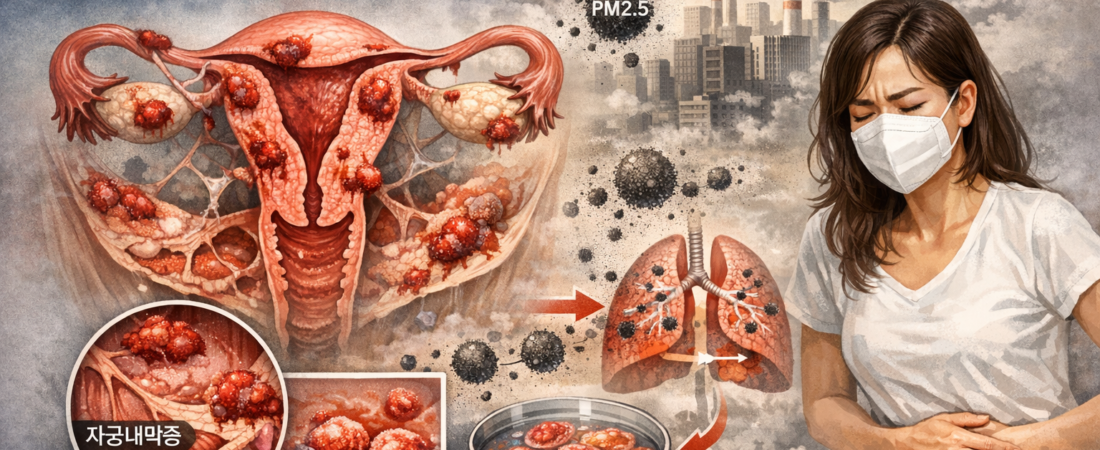
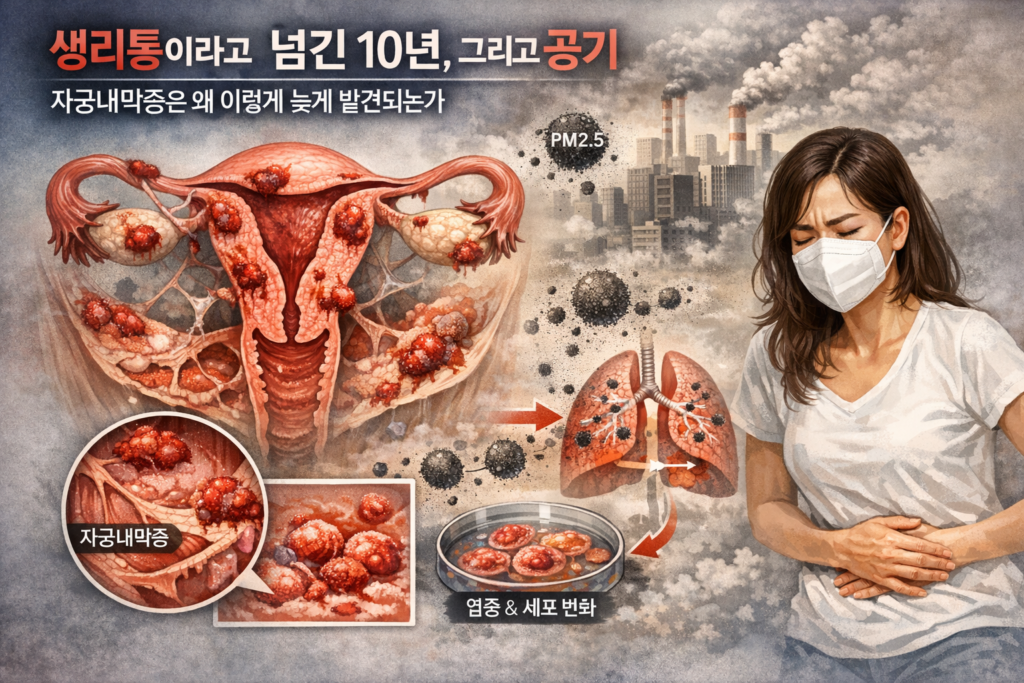
Fine dust is no longer just a respiratory issue. Fine particulate matter (PM2.5) enters the bloodstream, affecting the entire body. The uterus is no exception. Recent research confirms this directly: cells repeatedly exposed to fine particulate matter initially suffer damage, but over time, they undergo a pathological transformation, becoming more aggressive, proliferative, and resistant to cell death. It creates an environment where “pathological cells” are favored and selected.
Animal studies mirror this trend. Subjects exposed to fine particulate matter exhibit larger endometriosis lesions, increased inflammation, and decreased cell apoptosis. Combined with changes in estrogen receptors, this suggests that the environment is not just a passive irritant, but an active catalyst that fuels the disease.
When we apply these findings to the field of fertility, the implications become clearer. Repeated implantation failure without an identifiable cause, unexplained chronic inflammation, and recurrent lesions after surgery—factors once attributed to “luck” or “constitutional disposition”—are now being redefined. Invisible environmental factors are filling the gaps in our understanding.
This leads to a sobering question: How free are we from this risk?
The answer is cold: nearly everyone is exposed. Through the daily commute, indoor air quality, poorly ventilated spaces, and seasonal surges in high-concentration fine dust, endometriosis is evolving from a condition affecting specific individuals into an increasingly common disease within the modern urban landscape.
However, the key here is not fear, but “interpretation.”
Addressing this disease is not just about medical treatment; it requires a strategy to reduce exposure. Minimizing outdoor activities on days with high fine dust levels, wearing protective masks when necessary, immediate cleansing upon returning home, and maintaining indoor air quality through brief, frequent ventilation—these may seem trivial, but they are essential actions to protect the uterine environment.
The core message of this article is simple: The uterus is more vulnerable to the external environment than we previously thought.
We have long explained pregnancy solely through the lens of age and hormones. Now, we must change our questions. We must ask, “What kind of air am I living in?”
As long as we ignore this question, endometriosis will continue to be discovered late, and the tragedy of unexplained, recurrent infertility will persist.
Disclaimer: This content is provided by a fertility specialist journalist based on the collection and analysis of domestic and international reproductive medicine research, policy materials, and statistical data. Medical judgments and treatment decisions must always be made in consultation with professional medical personnel. Image: AI-generated (ChatGPT, OpenAI) / Visual reference for illustrative purposes only.