
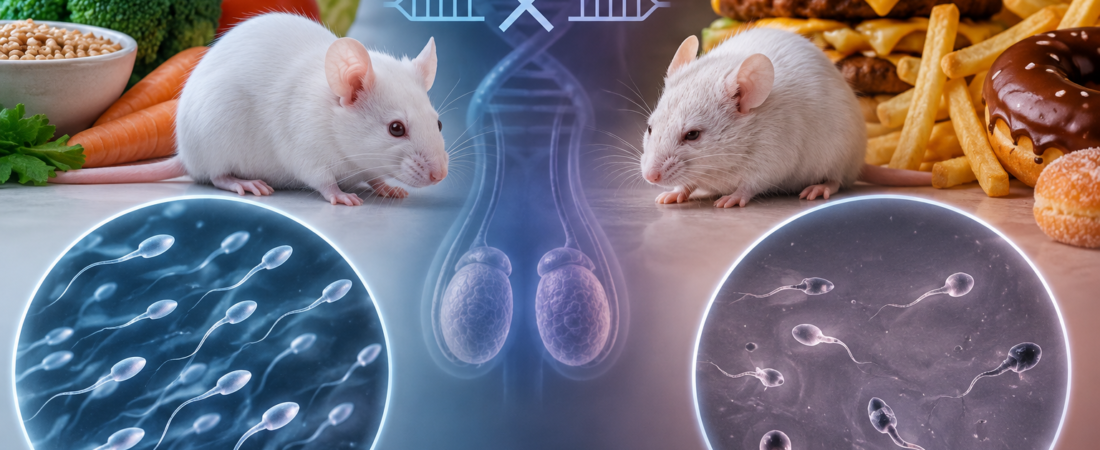
A high-fat, high-sugar diet intensified reproductive impairment in mice lacking M1ap.
The experiment raises questions about gene–environment interactions, not proof that changing diet treats inherited infertility in men.
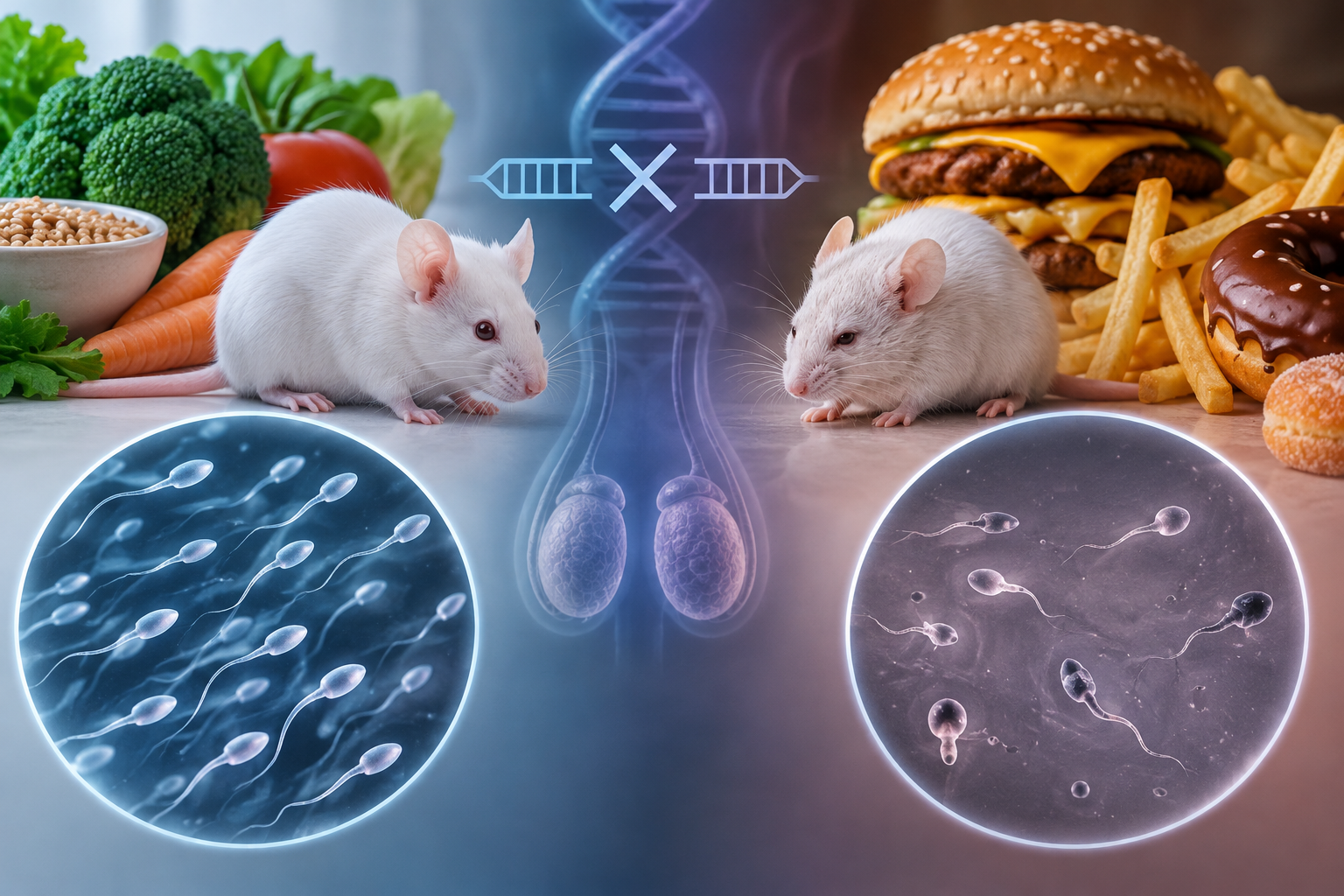
Can diet change the severity of genetically related male infertility? Researchers at the University of Melbourne found that a Western-style diet worsened reproductive impairment in male mice lacking M1ap, a gene involved in sperm production.
The findings suggest that diet and genetic vulnerability may act together, rather than simply having separate effects on sperm quality and reproductive capacity.
Published in the October 2026 issue of Human Reproduction, the study examined fertility after removal of M1ap gene function in mice.
The same genetic problem can have different consequences
M1AP is important in sperm production, particularly processes involved in normal chromosome segregation as sperm develop.
Disruption can impair sperm formation, producing very low counts or azoospermia, in which no sperm are detected.
However, men with abnormalities involving the same gene do not necessarily have equally severe infertility: some produce very few sperm, while others produce almost none.
The researchers investigated whether environmental influences such as diet could contribute to this variation.
They assigned normal mice and M1ap-knockout mice to a standard diet or a high-fat, high-sugar Western-style diet, then compared sperm count, motility, morphology, pregnancies in female partners and offspring numbers.
Offspring numbers fell sharply when both factors were present
The differences were pronounced.
Normal males on the standard diet produced an average of 8.25 offspring per litter.
M1ap-knockout males on the standard diet produced an average of 2.5, approximately 70% fewer than the normal-standard-diet group.
Normal males on the Western-style diet produced an average of 5.2 offspring.
The largest reduction occurred when gene disruption and the Western-style diet were combined.
M1ap-knockout males fed that diet produced an average of 0.37 offspring. Both the Korean source article and the original study report a reduction of approximately 98%; however, comparing the displayed averages of 0.37 and 8.25 gives approximately 95.5%. Those two statements are numerically inconsistent and should not be treated as interchangeable.
These are reproductive outcomes in mice. They cannot be applied directly to human pregnancy probabilities or birth rates.
Poorer sperm movement and more abnormal sperm
The researchers also investigated sperm production itself.
Mice with both gene disruption and the Western-style diet showed more abnormalities in testicular germ cells, including increased numbers of dying or improperly developing cells and disruption of sperm formation.
Sperm movement and shape were affected too.
Forward progressive movement was poorer, and abnormal sperm-head shapes were more common.
Living sperm are not necessarily capable of successful fertilization: they must also move toward an egg and have suitable structure and function.
The experiment found that the Western-style diet further impaired these functions in genetically vulnerable mice.
Interestingly, in genetically normal mice, the Western-style diet reduced offspring numbers without clear adverse changes in sperm count, motility or morphology.
The effects on sperm function were more evident in the knockout mice, which the researchers interpreted as an interaction between genetic background and diet.
Why might the same gene abnormality lead to different sperm counts?
A central point is that male infertility may not be explained by one factor alone.
Once a genetic abnormality is identified, it is easy to view it as the entire explanation. Reproductive capacity may also reflect the combined effects of environmental conditions.
The researchers suggested that an unfavorable diet could further reduce already impaired sperm production below the level needed for natural reproduction.
This could help explain variation in severity among men with the same genetic abnormality.
However, the study did not establish that diet changes infertility severity in all men with M1AP abnormalities.
It provides early evidence for that possibility from an animal model.
Could dietary change improve inherited male infertility?
The findings support investigating whether dietary improvement could help manage infertility with a genetic component.
Important limitations remain.
This was an animal experiment, not a human clinical trial. It also did not test how much already-impaired fertility recovered after a change in diet.
It cannot show that avoiding a Western-style diet treats inherited infertility or restores sperm counts.
If severe loss of M1AP function disrupts sperm production, dietary changes alone may not resolve the underlying problem.
Nevertheless, the research expands the scientific basis for considering diet and environment alongside genetic testing.
The authors called for human studies of genetic vulnerability and diet, including whether dietary improvement changes sperm quality or pregnancy outcomes.
Male infertility may not be determined by a gene alone. This experiment suggests that environmental conditions can make an underlying reproductive vulnerability more apparent.
Study source
Brendan J. Houston, Joseph Nguyen, Moira K. O'Bryan, Jessica E. M. Dunleavy and colleagues: “A Western-style diet exacerbates male infertility in M1ap knockout mice.” Human Reproduction, first published online August 31, 2026; volume 41, issue 10, pages 1633–1642, October 2026. DOI: 10.1093/humrep/deag130.
The illustration was created using generative AI (ChatGPT, OpenAI).
Related reading
Calcium, vitamin D and semen quality
Copyright © 2026 THE FERTILITY NOTES. All rights reserved.