

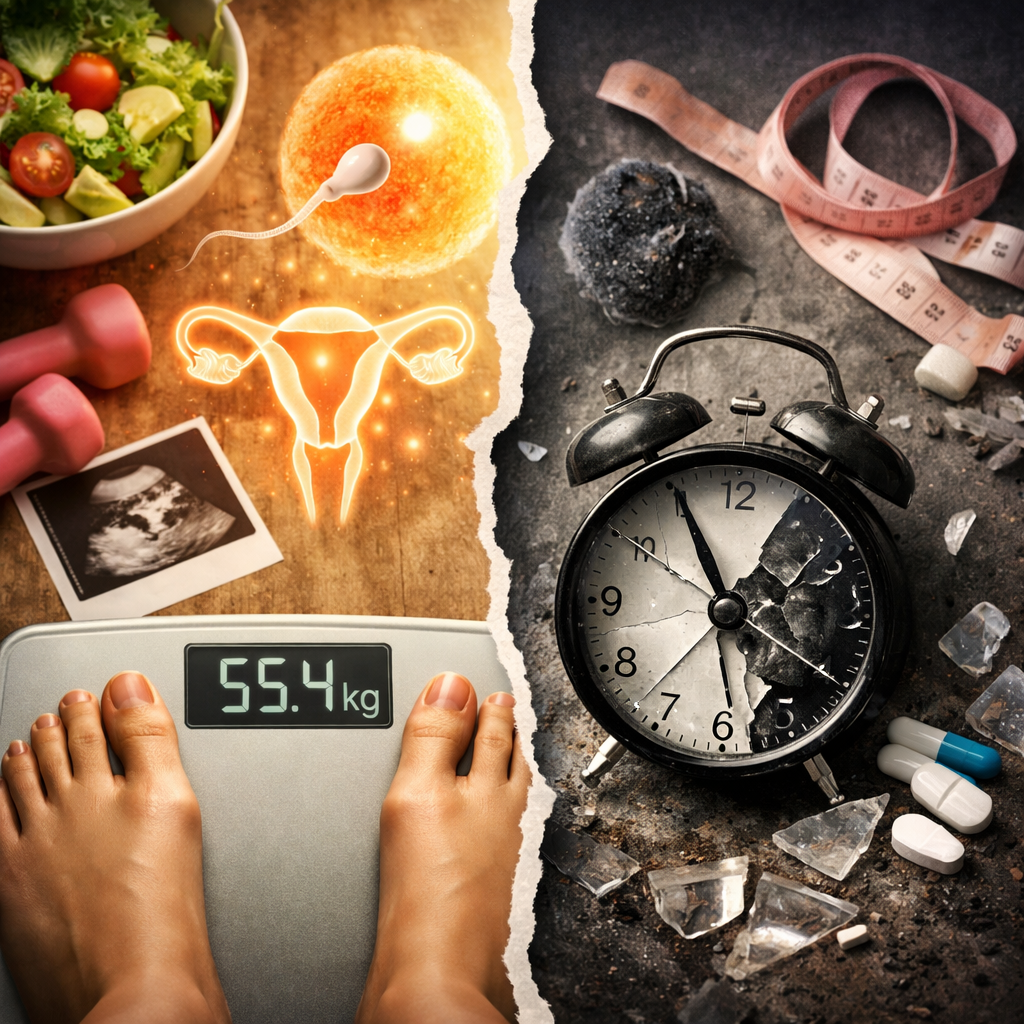
Does losing weight automatically translate into enhanced fertility?
To this question, reproductive endocrinologists answer with absolute conviction: “Yes, but that is only half the truth.” To be medically precise, weight loss can either aggressively revitalize your reproductive potential or completely destroy it.
The primary clinical challenge is that the vast majority of individuals fail to comprehend this critical divergence. There is a deep, widespread cultural belief that losing weight universally improves systemic health and naturally optimizes conception outcomes. This overly simplified formula, however, frequently functions as the exact starting point for reproductive failure.
Adipose tissue (지방 조직) is not merely a passive storage matrix for excess calories; it operates as an aggressive, endocrine-active organ. When body weight escalates, it triggers a chronic overproduction of estrogen in females and a severe drop in testosterone levels in males. When this hormonal skew is compounded by insulin resistance, the ovaries completely lose their directional cues—ovulatory rhythms fracture, and menstrual cycles break down.
The male profile undergoes an identical degradation. Sperm quality collapses far more severely than simple raw counts indicate; an escalation in DNA fragmentation and localized oxidative stress directly compromises ultimate fertilization competency. Obesity is never a superficial aesthetic concern; it is a profound malfunction of the global reproductive architecture.
Pivoting toward weight reduction initiates a measurable metabolic shift. Clinically, a modest reduction of just 5 to 10% of baseline body weight consistently yields restored ovulatory pathways and a systematic realignment of core reproductive hormones. This therapeutic turnaround is extraordinarily pronounced within patients navigating Polycystic Ovary Syndrome (PCOS). Concurrently, male cohorts exhibit visible improvements in sperm concentration and progressive motility parameters. Evaluating data up to this specific boundary line leads to a deceptively simple clinical directive: “Lose weight.”
However, it is precisely at this juncture that the biological narrative completely inverts.
The exact millisecond weight loss crosses a critical physiological threshold, it begins to exert a profoundly destructive influence. When body fat percentages drop below a specific baseline, the human brain systematically shuts down the reproductive axis. In females, this manifests as hypothalamic amenorrhea (무월경) and an immediate cessation of ovulation.
In males, it precipitates a precipitous, acute drop in systemic testosterone. Embracing an extreme low-calorie restriction diet, pairing it with excessive physical overtraining, and driving an unsustainably rapid rate of weight loss forces the body to entirely abandon reproductive processes. The underlying evolutionary logic is absolute: immediate visceral survival must always take precedence over reproduction.
Ultimately, the defining variable is never the raw number on a scale; it is the absolute direction of the metabolism.
Is the active weight reduction stabilizing your delicate endocrine loop, or is it fundamentally fracturing it? For individuals classified as overweight or obese, targeted reduction is undeniably therapeutic. However, an obsessive fixation on driving weight down further when a patient already resides within standard normal parameters transforms into a direct mechanism that erodes baseline fertility.
The metrics on a digital scale are unyielding, yet the human reproductive system does not modulate its pathways based on raw weight metrics alone. It operates on a binary cascade of systematic activation versus complete inhibition. Weight loss is never a universal treatment in its own right; it is a biological condition. Exercised accurately, it serves as a powerful instrument to restore reproductive longevity; deployed recklessly, it completely obliterates the baseline possibility of conceiving.
What, then, constitutes the definitive framework of “healthy, fertility-optimized weight loss?” Patients invariably demand a specific, flat numerical metric—asking precisely how many kilograms they must shed. Yet, human fertility reacts strictly to global functional capacity rather than isolated numbers on a scale.
For the female profile, the clinical benchmarks are relatively transparent. A Body Mass Index (BMI) spanning between 20 and 24 constructs the exact physiological corridor where ovulatory kinetics and endocrine feedback loops achieve maximum homeostatic stability. The exact moment BMI scales past 25, the incidence of anovulatory disorders steadily increases; once it crosses the threshold of 30, the clinical pregnancy success rate drops markedly.
Conversely, driving the metric down to 18.5 or lower triggers a systematic shutdown of the menstrual cycle and halts follicular maturation. The core clinical objective is never the pursuit of a standardized “normal weight,” but rather the realization of absolute internal equilibrium. Within the PCOS demographic, a targeted reduction of a mere 5 to 10% of current weight is mathematically sufficient to restore spontaneous ovulatory function.
The male profile demands a completely separate diagnostic evaluation. For men, the primary culprit is localized abdominal adiposity (복부 지방) rather than global body mass. Utilizing two identical weight profiles, the individual presenting with an elevated waist-to-hip ratio will manifest a severely compromised fertility index. An accumulation of visceral fat actively drives down systemic testosterone while scaling up sperm DNA fragmentation indices. The moment an individual’s waist circumference surpasses 90 cm, these negative pathogenetic signals become clinically undeniable.
In the end, the ultimate equation remains uncomplicated: prioritize cellular function over raw weight metrics. Evaluate whether spontaneous ovulation has returned for the female, and whether global semen parameters are recovering for the male. The exact second a patient strays from this functional benchmark to chase a flat numerical target, their entire reproductive strategy loses its direction.
The most hazardous physiological zone resides within the volatile transitional phase of rapid, aggressive weight reduction. During this high-velocity shift, the endocrine system enters a state of acute instability, and reproductive functions are universally the very first pathways to be systematically suppressed.
Therefore, the definitive clinical benchmark stands clear:
A BMI maintained between 20 and 24, completely devoid of visceral abdominal obesity.
A physiological system where spontaneous ovulation and pristine sperm kinetics are actively sustained.
This represents the absolute optimal corridor where human fertility functions at its peak capacity.
📚 Medical References
Female Weight, Ovulation, and Conception Dynamics
- American Society for Reproductive Medicine (ASRM)
- “Obesity and reproduction: a committee opinion.”
- ASRM Practice Committee Report.
- Significance: Establishes the definitive clinical correlation establishing that maternal obesity directly drives chronic ovulatory dysfunction, alters oocyte quality, and compromises baseline implantation success rates.
- Human Reproduction Update
- Longitudinal cohort analyses on PCOS interventions.
- Significance: Provides robust empirical data confirming that a systematic 5 to 10% reduction in baseline weight is clinically sufficient to restore regular ovulatory cycles and metabolic homeostasis in women with Polycystic Ovary Syndrome.
- World Health Organization (WHO)
- International baseline reference metrics for BMI and global health outcomes.
- Significance: The official international reference framework defining the precise epidemiological boundaries of low weight, normal weight, and progressive obesity phenotypes.
Male Weight, Visceral Adiposity, and Semen Parameters
- Fertility and Sterility
- Clinical evaluations of paternal metabolic syndromes.
- Significance: Documents a statistically significant, direct drop in total sperm concentration, morphological integrity, and progressive forward motility within paternal cohorts presenting with elevated BMIs.
- Human Reproduction
- Correlative analyses on paternal body mass and genomic integrity.
- Significance: Establishes the molecular link demonstrating that a linear escalation in male BMI directly scales up the sperm DNA Fragmentation Index (DFI) via localized systemic oxidative stress pathways.
Editor’s Note: This content is an analytical commentary prepared by a specialized fertility journalist through the collection and evaluation of domestic and international reproductive medicine research, clinical policies, and statistical data. All medical diagnoses and treatment decisions must exclusively be established through direct consultation with a qualified medical professional.
Image Source: AI-generated (ChatGPT, OpenAI) / Provided solely as a supplemental visual aid for conceptual understanding.