
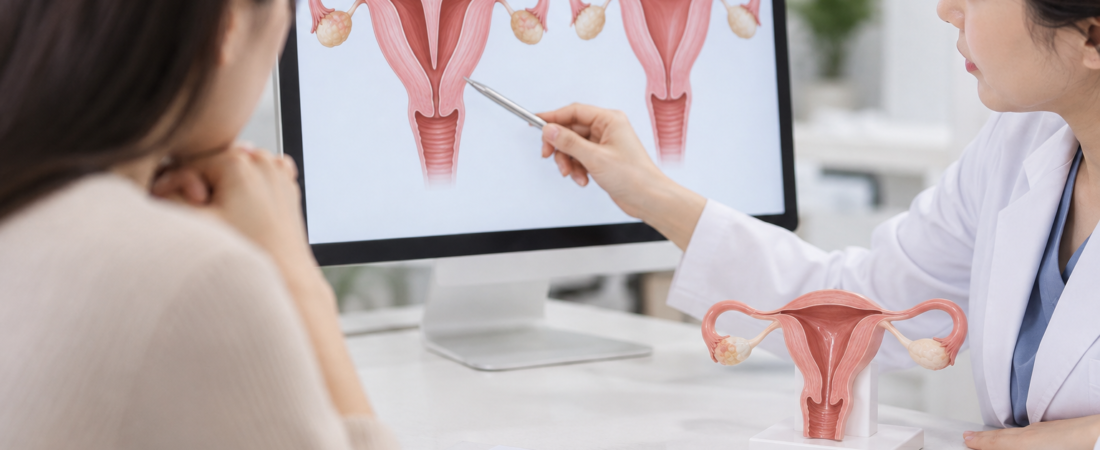
Does uterine septum surgery improve the chance of a live birth? A 2026 systematic review of five randomized trials found insufficient evidence of a clear reproductive benefit. Crucially, only one trial directly compared surgery with no surgery: live-birth rates were 31% and 35%, respectively.
Removing the partition inside a septate uterus has long been considered for women with infertility or those preparing for IVF. Whether the operation actually improves pregnancy and birth outcomes remains debated.
Would removing a uterine partition help implantation?
A uterine septum is a congenital anomaly that develops when an internal partition does not fully disappear during formation of the uterus. The outside may appear relatively normal, while a partition partly or substantially divides the cavity.
A septate uterus has been associated with miscarriage and preterm birth. When identified during fertility assessment, hysteroscopic resection may be considered to make the cavity more suitable for implantation and fetal growth.
But correcting anatomy and improving live-birth outcomes are separate questions requiring evidence.
31% versus 35%: what the direct comparison showed
The review focused on randomized controlled trials, in which participants are assigned randomly to compare interventions.
Five trials were included, but only one assessed the effect of surgery itself by comparing resection with expectant management. The other trials compared surgical techniques.
The direct trial randomized 80 women with a septate uterus and a history of infertility, pregnancy loss or preterm birth. The final analysis included 39 women in the surgical group and 40 in the nonsurgical group.
Live birth occurred in 31% after surgery and 35% with observation. Clinical pregnancy rates were 56% and 48%, respectively, without a statistically significant difference.
The relative risk for live birth was 0.88, with a wide confidence interval. This does not prove surgery reduces birth rates; it means the available randomized evidence did not establish an improvement, while uncertainty about benefit or harm remains.
Better surgical technique is not the same as better pregnancy outcomes
Trials comparing techniques reported advantages for some approaches, including shorter operating time, less postoperative pain and reduced fluid absorption.
These procedural improvements did not consistently translate into higher pregnancy or live-birth rates. A faster or safer procedure does not by itself show that undergoing the procedure improves the chance of birth.
The small direct comparison also limits conclusions about whether particular groups—defined by septum size or shape, or recurrent miscarriage history—may benefit more.
Must a septum be removed before embryo transfer?
Women preparing for IVF may wonder whether a septum found on ultrasound or hysteroscopy should be removed before transfer, especially after repeated implantation failure or miscarriage.
The review does not support recommending surgery to every woman with a septum. It also does not establish that surgery is never appropriate.
The American Society for Reproductive Medicine’s 2024 guideline explains that resection may be considered for women with infertility or undergoing fertility treatment, but evidence is insufficient for a uniform recommendation.
For women with recurrent miscarriage, surgery can be offered as an option through shared decision-making that considers pregnancy history, uterine anatomy and surgical risks.
The finding alone is not an automatic indication for surgery
Although a septum may be associated with adverse outcomes, evidence does not show that removing it improves pregnancy success for every woman.
Assessment before IVF should consider recurrent miscarriage, previous transfer outcomes, the extent and shape of the septum, and other infertility factors. Potential harms, including uterine perforation, bleeding and delays to treatment, also matter.
The review calls for more precise treatment selection, rather than simply rejecting surgery. The essential question is whether a proposed anatomical correction is likely to help achieve pregnancy and birth.
Study sources
M. Acosta Chiquillo, S. Arens Nieto, A.M. Calabria Valencia and colleagues: “Hysteroscopic Septum Resection in Septate Uterus: Systematic Review of Randomized Trials,” Clínica e Investigación en Ginecología y Obstetricia, volume 53, issue 4 (2026). DOI: 10.1016/j.gine.2026.101141. The source article also drew on ASRM’s 2024 “Evidence-based Diagnosis and Treatment for Uterine Septum: A Guideline.”
Related reading
For broader context before deciding on additional interventions, see our guide to recurrent implantation failure and the evidence for further investigations.
Illustration created with generative AI (ChatGPT, OpenAI); it does not depict an actual patient.
Copyright © 2026 The Fertility Notes. All rights reserved. Unauthorized reproduction, redistribution, scraping, AI training, or other data use of articles, photographs, images, and all other content is strictly prohibited and may result in legal liability.