
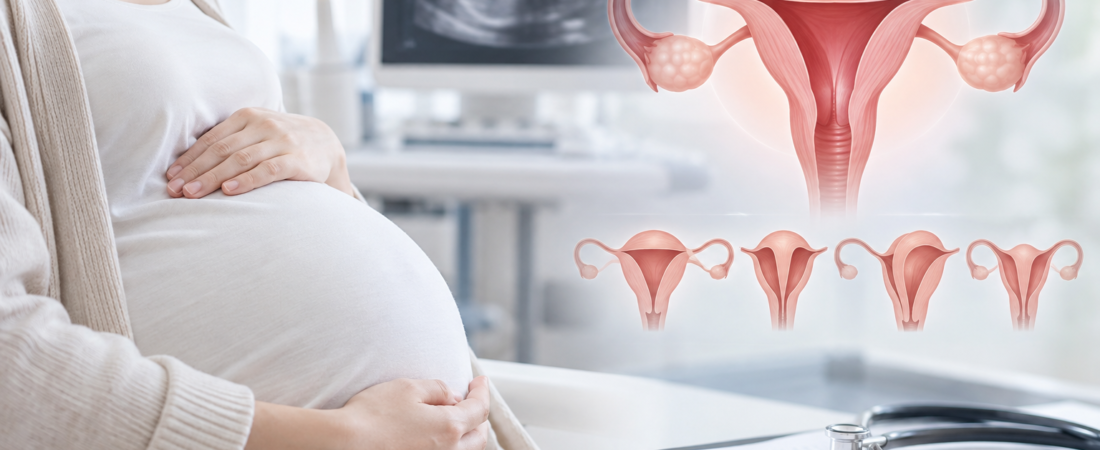
Congenital uterine anomalies were associated with higher odds of preterm birth, placental abruption and breech presentation in a Korean study of approximately 878,000 singleton deliveries. The adjusted odds ratios were 2.43, 3.01 and 6.42, respectively—not absolute-risk multipliers for every individual.
Congenital uterine anomalies are structural differences arising while the reproductive organs develop before birth. Examples include a septate uterus, with a partition inside the cavity; a bicornuate uterus, with two upper horns; and a unicornuate uterus, in which only one side develops.
Some women have no obvious symptoms and first learn of the anomaly during an infertility assessment, recurrent miscarriage investigation or pregnancy ultrasound.
6,038 women with uterine anomalies
The study, published in September 2026, analyzed approximately 878,000 singleton deliveries in South Korea from 2018 to 2023. Singleton deliveries involve one baby rather than twins or other multiple births.
Among them, 6,038 women had a recorded uterine anomaly. Researchers compared their pregnancy and delivery outcomes with those of women without an anomaly.
The adjusted odds ratio for preterm birth was 2.43. An adjusted odds ratio compares the odds of an outcome after statistically accounting for other relevant factors. It should not be read as saying that the absolute rate of preterm birth was 2.43 times higher.
Preterm birth means delivery before 37 weeks. Earlier birth can increase neonatal risks involving breathing, temperature regulation and neurodevelopment, making it an important focus of prenatal care.
Placental abruption and breech presentation
The adjusted odds ratio for placental abruption was 3.01. This occurs when the placenta partially or completely separates from the uterine wall before birth. Severe cases can cause maternal bleeding and compromise fetal oxygen supply, requiring prompt assessment and treatment.
Breech presentation had the highest adjusted odds ratio of the three reported outcomes, at 6.42. In breech presentation, the baby’s buttocks or feet lie toward the lower uterus rather than the head.
A differently shaped uterine cavity could influence how a fetus changes position as it grows. However, this association does not establish the mechanism by which a uterine anomaly might contribute to breech presentation.
An anomaly does not mean complications are inevitable
It is important to distinguish an association with adverse outcomes from a prediction that every woman with a uterine anomaly will experience complications.
The type and shape of the anomaly, degree of cavity distortion, previous miscarriage or preterm birth, cervical condition and other medical factors may all affect the individual course of pregnancy.
This analysis involved singleton pregnancies that reached delivery. It did not directly measure the probability of natural conception, IVF success or early miscarriage across all women with uterine anomalies.
Why assessment before IVF and individualized prenatal care matter
IVF discussions often focus on fertilization, embryo development and transfer. The structure of the uterus in which the pregnancy will develop also matters.
When an anomaly is suspected, three-dimensional ultrasound or MRI may help define its shape. Finding an anomaly does not automatically make surgery necessary: its type, pregnancy history, symptoms and expected treatment benefit need to be considered together.
During pregnancy, individualized follow-up may include attention to signs of preterm birth, fetal growth and position, and placental findings, informed by the anomaly and previous obstetric history.
The study suggests that congenital uterine anomalies can be associated with differences in pregnancy maintenance and delivery outcomes, supporting careful prenatal assessment rather than assuming that anatomy alone determines the outcome.
Study source
Ahyoung Choi, Min-A Kim, Geum Joon Cho and Han Sung Hwang, affiliated with Gangnam Severance Hospital at Yonsei University College of Medicine, Korea University Guro Hospital and Konkuk University School of Medicine: “Congenital Uterine Anomalies and Pregnancy Outcomes: A Population-Based Retrospective Cohort Study,” Journal of Clinical Medicine, September 2026. The study used Korean National Health Insurance Service data. DOI: 10.3390/jcm15176788. PMID: 42739791.
Related reading
For a separate question about the period before pregnancy is established, see our guide to repeated implantation failure after euploid embryo transfer.
Illustration created with generative AI (ChatGPT, OpenAI); it does not depict an actual patient.
Copyright © 2026 The Fertility Notes. All rights reserved. Unauthorized reproduction, redistribution, scraping, AI training, or other data use of articles, photographs, images, and all other content is strictly prohibited and may result in legal liability.