
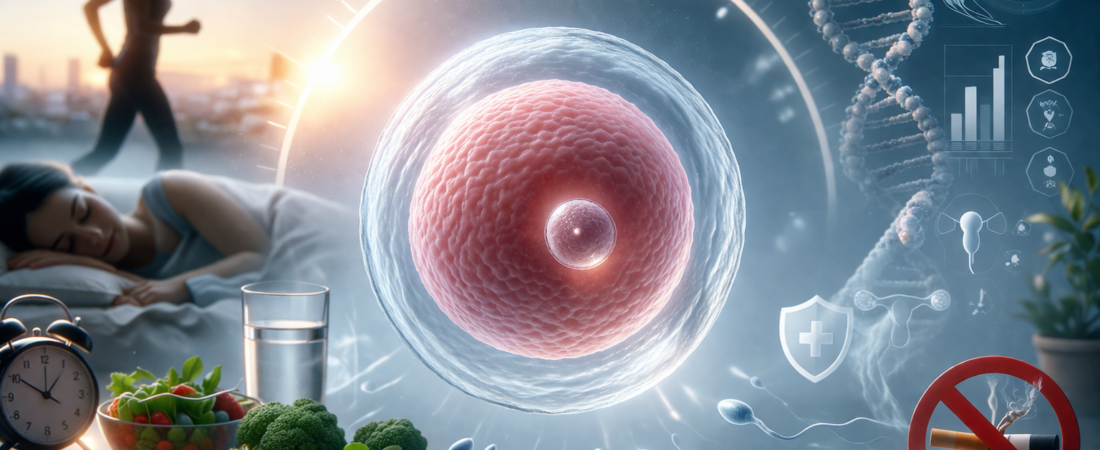
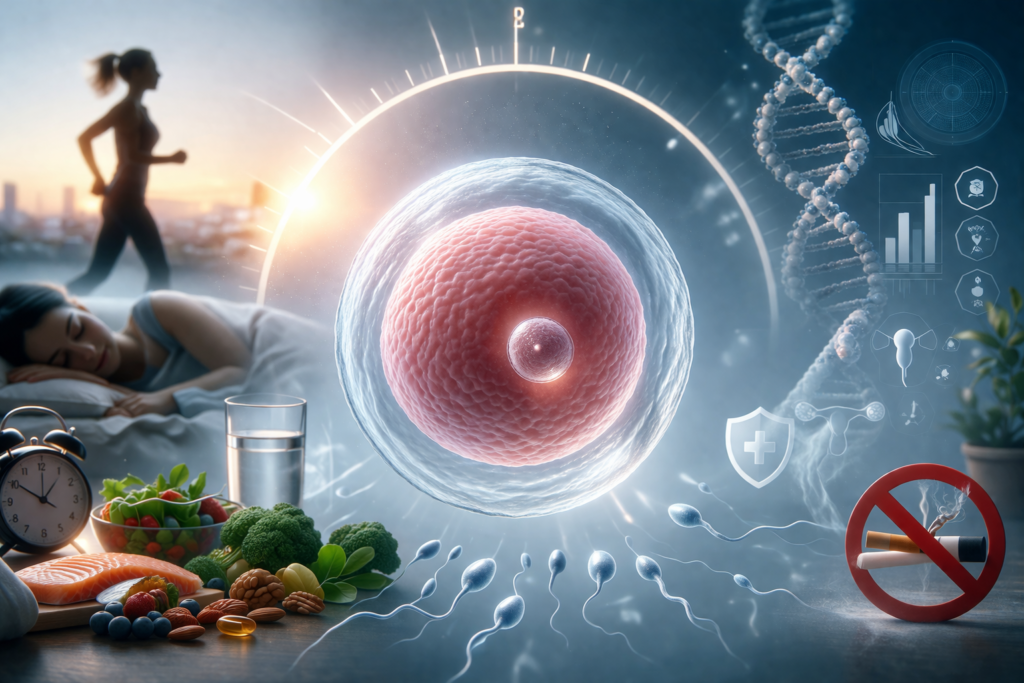
Can the biological quality of an oocyte genuinely be managed and improved?
To address this from the absolute core: the current consensus within contemporary reproductive medicine establishes that while you cannot completely reverse oocyte aging, you can undeniably slow down the velocity of its structural degradation.
The primary clinical challenge is that the consumer market and online lifestyle content refuse to state this reality honestly. While commercial platforms endlessly repeat the phrase “improving egg quality,” real-world reproductive science defines this process strictly as “preventative management to minimize cellular decay.” It is precisely at this intersection that diagnostic data becomes heavily exaggerated, and patients fall into severe misconceptions.
Legacy lifestyle advice remains overwhelmingly superficial: get more sleep, eat a cleaner diet, integrate regular exercise. While these generic directives are not inherently incorrect, they fail to provide a calculated framework for clinical decision-making. They consistently omit precisely why these factors matter, to what degree they alter physiological outcomes, and which variable must be prioritized first. Information overflows, yet the path to execution remains completely obscured. This requires a systematic, evidence-based re-evaluation.
The global biological framework relies upon a definitive triad: mitochondrial efficiency, localized oxidative stress management, and the baseline endocrine micro-environment.
The human oocyte is an extraordinarily high-energy-consuming cell. The cellular engines responsible for manufacturing this vital energy are the mitochondria; the exact millisecond this specific system fractures, the incidence of meiotic spindle abnormalities and subsequent chromosomal segregation errors scales drastically. This represents the precise pathogenetic mechanism driving the abrupt escalation of aneuploidy (chromosome abnormalities) in advanced maternal age.
Longitudinal data documents that the embryo chromosomal abnormality rate surpasses the 60% threshold once a patient transitions past the age of 40. Paternal and maternal age is never a simple chronological number on a chart; it dictates the absolute velocity at which the intracellular bioenergetic systems collapse.
At what precise coordinates, then, do targeted lifestyle modifications intervene?
- Circadian Alignment (수면 리듬): Melatonin is widely oversimplified as a basic sleep-inducing hormone. In molecular reality, melatonin functions as a highly potent, localized antioxidant within the follicular fluid, aggressively shielding the developing oocyte from oxidative stress. When sleep architecture fractures, the baseline follicular micro-environment breaks down concurrently. Crucially, generic advice to simply secure “seven hours of sleep” misses the biological target. The definitive variable is the circadian rhythm itself—specifically, establishing a consistent sleep onset prior to midnight paired with a rigid, unaltered waking timeline.
- Glycemic Control (혈당 및 대사 관리): Insulin resistance directly destabilizes the ovarian micro-environment. This serves as the primary pathogenetic pathway driving chronic anovulation (ovulatory disorders) in patients navigating Polycystic Ovary Syndrome (PCOS). However, managing glycemic variance cannot be reduced to simply minimizing processed sugar intake; the true variables are systemic meal sequencing, calculated fasting intervals, and the complete elimination of nocturnal eating. Utilizing identical caloric volumes, the downstream endocrine feedback loops vary profoundly based on the structural methodology of consumption.
- Oxidative Stress Buffer (산화스트레스 억제): The oocyte demands the highest degree of systemic cellular protection within the human body, yet its complex architecture renders it exceptionally vulnerable to environmental insults. This is the precise entry point for targeted antioxidant regimens—explaining why Coenzyme Q10, Vitamin D, and Omega-3 fatty acids are continuously integrated into clinical protocols. Select literature reports visible improvements in overall antral follicle counts and subsequent embryo morphology within cohorts utilizing CoQ10. The critical caveat remains that the efficacy operates at the level of “mitigating the rate of decline,” rather than achieving an absolute cellular reversal. This baseline reality ensures ongoing academic debate regarding its classification as a standardized, universal first-line therapy.
The clinical parameters for physical exercise and body mass are exceptionally clear. The peak corridor for optimized reproductive outcomes correlates with a Body Mass Index (BMI) maintained strictly between 18.5 and 23. Engaging in excessive, hyper-intense overtraining paradoxically triggers a hypothalamic suppression of spontaneous ovulation. This stands as another widely misunderstood variable: exercise engineered for athletic conditioning operates under completely different physiological parameters than exercise structured for reproductive longevity. The goal is never raw physical output; it is absolute homeostatic equilibrium.
Concurrently, the immediate impact of localized xenobiotic exposure is surfacing as the fastest-growing arena of contemporary research. Endocrine-disrupting chemicals (EDCs), specifically Bisphenol A (BPA) and ubiquitous phthalates, are now being consistently isolated directly within human follicular fluid. Select experimental models have documented the presence of microscopic plastic fragments within the immediate follicular matrix.
Nevertheless, formulating an absolute causal decree linking this exposure to primary oocyte degradation remains premature due to a lack of long-term human cohort data. While the toxicological threat is profoundly suspected, the linear causal architecture is not entirely sealed. This specific frontier will likely experience the most radical regulatory and clinical updates over the coming years.
The clinical verdict on tobacco consumption, however, permits zero debate. The epidemiological data is absolute and unyielding: chronic smoking accelerates the premature depletion of the primordial follicle pool, increases double-stranded DNA damage within the oocyte, and slashes live birth rates across active IVF cycles. Within this domain, the therapeutic target is never a gradual reduction; it demands immediate, total cessation.
Psychological distress remains the most complex variable to quantify, rendering it highly susceptible to exploitation within commercial spaces. While the cultural claim that high stress completely blocks conception is ubiquitous, the underlying biological mechanism is non-linear. The pathway wherein sustained cortisol elevation suppresses the primary Hypothalamic-Pituitary-Gonadal (HPG) axis is fully verified, yet the real-world clinical manifestations exhibit immense individual variation. Consequently, systemic stress must be diagnostically classified as an amplifying variable that exacerbates pre-existing underlying pathologies, rather than an isolated primary cause of infertility.
To summarize the clinical reality: oocyte quality cannot be manufactured; it can only be systematically preserved. There is zero medical technology capable of reversing the structural integrity of a follicle that has already undergone advanced cellular decay. However, you possess the direct capacity to optimize the biochemical environment of the oocyte cohorts scheduled for future recruitment. If a patient fails to comprehend this vital distinction, clinical treatments transform into volatile emotional expectations, and daily management inevitably collapses into deep psychological exhaustion.
The future trajectory of advanced reproductive care is clear: interventions will increasingly center around optimizing mitochondrial kinetics, targeted intracellular antioxidant delivery, and aggressive environmental exposure management.
Yet, regardless of what sophisticated reproductive technologies emerge, they will lack the power to supersede the baseline biological requirements of synchronized sleep architecture, calibrated glycemic intervals, and stable metabolic health. The intrinsic quality of a human oocyte is never a problem that can be resolved by isolated laboratory technology; it remains the definitive, aggregate manifestation of global somatic homeostasis.
📚 Medical References
- American Society for Reproductive Medicine (ASRM) & European Society of Human Reproduction and Embryology (ESHRE)
- Significance: Official consensus guidelines mapping out the precise impact of chronological aging and lifestyle variables on female gamete viability.
- Fertility and Sterility & Human Reproduction
- Significance: Core peer-reviewed data tracking the linear correlation between mitochondrial ATP depletion, elevated oxidative stress, and the sharp rise in meiotic aneuploidy rates past the maternal age threshold.
- Journal of Assisted Reproductive Genetics
- Significance: Clinical trials evaluating the cellular mechanics of CoQ10 and targeted adjuvants in slowing down the degradation of the follicular micro-environment.
- Nature Reviews Endocrinology
- Significance: Advanced endocrine literature outlining the precise pathways where insulin resistance and environmental toxicants disrupt regular follicle selection and oocyte maturation.