

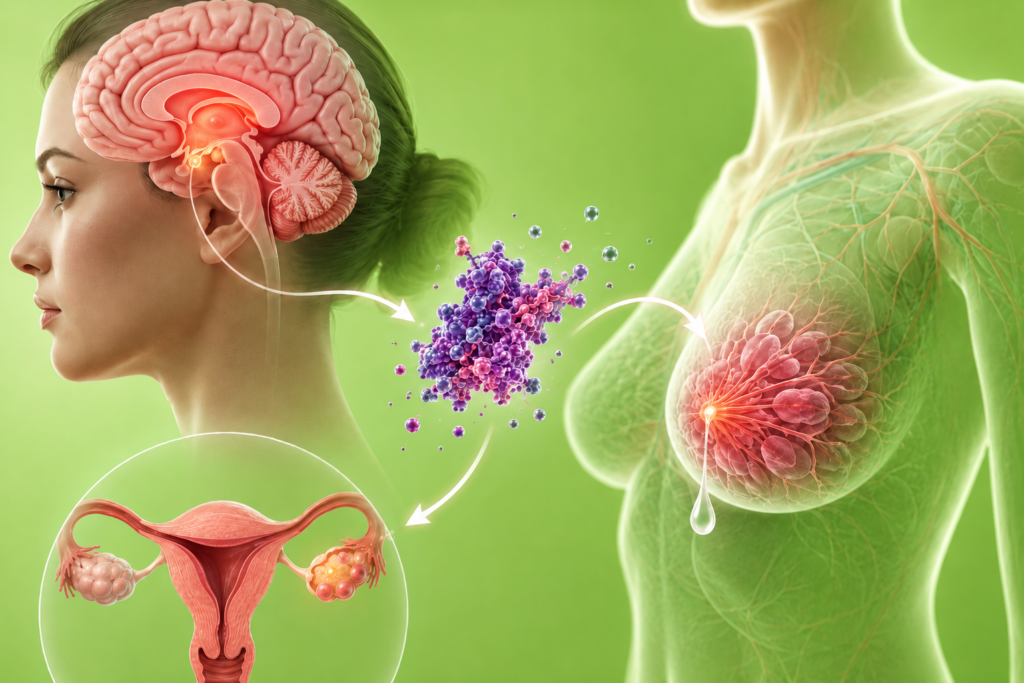
It is a startling experience for a woman who has never been pregnant or given birth to notice breast milk secretion (galactorrhea). While many immediately fear breast cancer or dismiss it as trivial, in the context of reproductive medicine, this symptom is a common and vital clinical signal. Often, this issue is less about the breasts themselves and more about a complex neurological and endocrine feedback loop gone awry.
The Biology of Prolactin The hormone prolactin is responsible for inducing milk production after childbirth. However, when prolactin levels rise without the trigger of pregnancy or lactation—a condition known as hyperprolactinemia—it can wreak havoc on a woman’s reproductive cycle.
When prolactin levels are abnormally high, the brain is essentially “tricked” into believing the body is in a postpartum, breastfeeding state. Biologically, this is an evolutionary survival mechanism: if a woman is nursing, suppressing a subsequent pregnancy is beneficial for the survival of the current infant. However, when this happens in the absence of a baby, the hypothalamus suppresses the secretion of GnRH (gonadotropin-releasing hormone). This subsequently reduces FSH and LH, effectively stalling follicle growth and halting ovulation.
Identifying the Root Cause Hyperprolactinemia is rarely the primary disease; it is almost always a symptom of an underlying issue:
- Prolactinoma: A benign tumor (adenoma) in the pituitary gland that secretes excess prolactin. While the term “tumor” is frightening, these are almost exclusively non-cancerous.
- Chronic Stress & Lifestyle: Intense stress, sleep deprivation, and poor lifestyle habits can disrupt hormonal regulation and trigger prolactin spikes.
- Thyroid Dysfunction: Hypothyroidism causes the brain to increase TRH production to compensate, which concurrently drives up prolactin levels.
- Medications: Certain antidepressants, antipsychotics, and gastrointestinal motility agents can elevate prolactin as a side effect.
The Impact on IVF and Fertility For those planning In Vitro Fertilization (IVF), checking prolactin levels is a mandatory step. IVF relies on the delicate synchronization of the reproductive hormonal system. If prolactin is high, the ovaries may not respond to stimulation as predicted; the follicular growth pattern can become erratic, and ovulation function may remain unstable. Consequently, most fertility centers will normalize prolactin levels before proceeding with IVF.
Diagnostic and Therapeutic Approaches The diagnostic process is straightforward: ruling out pregnancy first, followed by thyroid function tests, medication reviews, and, if levels are significantly elevated, an MRI of the pituitary gland.
Treatment typically involves dopamine agonists, such as cabergoline or bromocriptine. These medications effectively suppress prolactin secretion. Cabergoline, in particular, is widely used due to its high efficacy and relatively low side-effect profile, often normalizing cycles within weeks or months.
However, a nuanced clinical approach is required: while these medications are essential for normalizing the cycle, they can sometimes decrease blood flow to the uterine lining. Therefore, experienced fertility specialists carefully weigh the timing of this medication—particularly when transitioning from stimulation to embryo transfer—to ensure the best clinical outcome.
Conclusion: A Systemic Signal Galactorrhea is not just a breast-related symptom; it is a profound biological warning sign from the brain. If you experience unexpected nipple discharge or irregular menstrual cycles, do not assume it will resolve on its own. It is a signal that your body’s reproductive rhythm is out of sync, and a timely evaluation can help restore that balance, paving the way toward your fertility goals.
Sources: ASRM guidelines on hyperprolactinemia; ESHRE clinical guidelines; Endocrine Society clinical practice guidelines; ACOG committee opinions on ovulatory dysfunction; Williams Gynecology; Berek & Novak’s Gynecology.
Disclaimer: This report is for informational purposes. If you are experiencing symptoms like galactorrhea or cycle irregularities, consult an OB/GYN or reproductive endocrinologist for a diagnostic evaluation. Do not attempt to self-medicate or ignore these symptoms.