
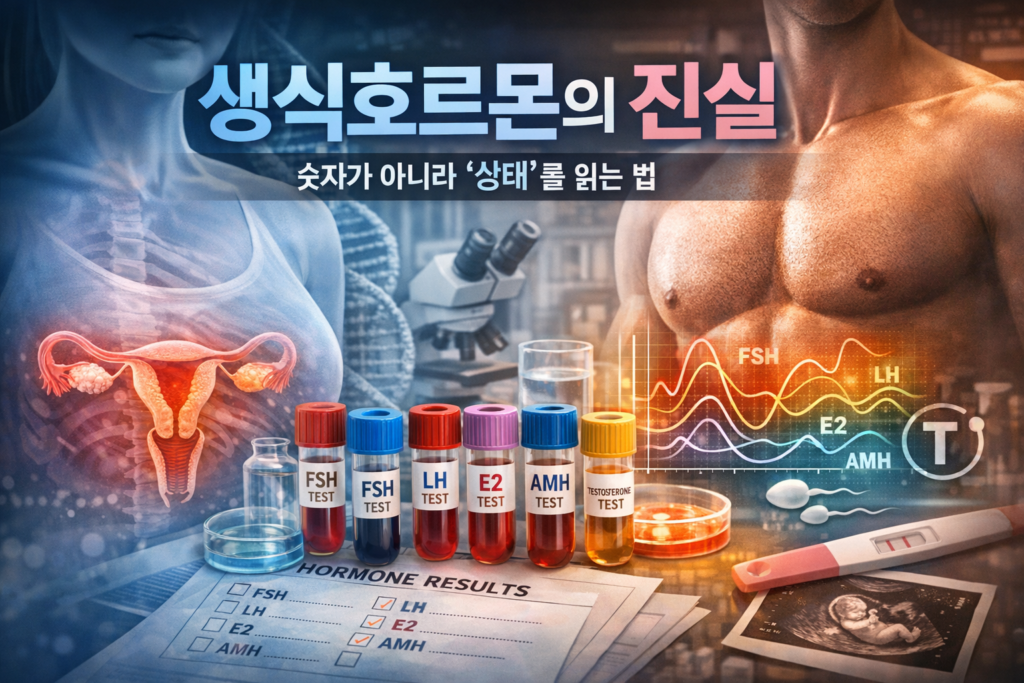
The reference ranges of reproductive hormones should never be viewed as fixed, absolute constants. Instead, they must be fundamentally understood as dynamic parameters that continuously shift based on sex, age, phase of the menstrual cycle, and the exact timing of the laboratory evaluation.
🚺 Female Endocrine Profiles: Navigating the Cycle
- Follicle-Stimulating Hormone (FSH)
- Baseline (Days 2–3 of cycle): General reference parameters fall precisely between 3 and 10 mIU/mL.
- Ovulatory Phase: Temporarily spikes to 5–20 mIU/mL.
- Post-Menopausal Baseline: Escalates markedly to 25 mIU/mL or higher.
- Clinical Implication: An elevated baseline FSH signals a structural decline in overall ovarian reserve (난소기능 저하), whereas abnormally suppressed levels require an immediate evaluation for hypothalamic or pituitary insufficiency.
- Luteinizing Hormone (LH)
- Follicular Phase: Ranges between 2 and 10 mIU/mL.
- Pre-ovulatory Surge: Rapidly escalates to a peak parameter of 10–80 mIU/mL to trigger oocyte release.
- Luteal Phase: Declines back to a baseline corridor of 1–10 mIU/mL.
- Clinical Implication: An LH-to-FSH ratio expanding past the threshold of 2 or higher serves as a prominent biochemical marker indicating the presence of Polycystic Ovary Syndrome (PCOS).
- Estradiol (E2)
- Follicular Phase: Ranges from 20 to 150 pg/mL.
- Ovulatory Phase: Peaks dynamically between 150 and 750 pg/mL, reflecting follicular maturation.
- Luteal Phase: Maintains a parameter of 30–450 pg/mL.
- Clinical Implication: Abnormally suppressed E2 signals deficient follicular recruitment, while excessive levels warn of underlying endocrine imbalance or an impending risk of ovarian hyperstimulation.
- Progesterone
- Follicular Phase: Maintained consistently at a near-zero parameter under 1 ng/mL.
- Post-Ovulatory Phase (Luteal): Rises into a corridor of 5–20 ng/mL.
- Clinical Implication: Verifying a mid-luteal progesterone value exceeding 10 ng/mL serves as definitive clinical confirmation that a healthy, spontaneous ovulation has occurred.
- Anti-Müllerian Hormone (AMH)
- Age 20s–30s Baseline: Generally spans a corridor of 2–5 ng/mL.
- Low Reserve Boundary: A value falling below 1 ng/mL indicates an overt depletion of ovarian reserve, while a metric plunging below 0.5 ng/mL signals critical, severely compromised ovarian capital.
- Clinical Implication: Unlike cyclic hormones, AMH remains stable and can be measured independent of the menstrual cycle phase, functioning as a reliable barcode reflecting the raw remaining quantitative pool of oocytes.
🚹 Paternal Endocrine Profiles: Spermatogenesis and Vitality
- Total Testosterone
- Standard Reference Corridor: Spans between 300 and 1000 ng/dL.
- Clinical Implication: Sub-baseline values directly correlate with diminished libido, erectile insufficiency, and a severe downward skew in global spermatogenesis (정자 생성 저하).
- Male Follicle-Stimulating Hormone (FSH)
- Standard Reference Corridor: Maintained between 1 and 8 mIU/mL.
- Clinical Implication: An elevated male FSH reflects primary testicular failure, indicating that the system is desperately over-signaling to overcome severe deficits in sperm production.
- Male Luteinizing Hormone (LH)
- Standard Reference Corridor: Ranges between 1 and 9 mIU/mL.
- Clinical Implication: Abnormally low levels point toward an upstream central pituitary dysfunction, whereas elevated values signal direct somatic Leydig cell failure within the testes.
🔄 Shared Biological Cross-Variables
- Prolactin
- Male Reference: Spans between 2 and 18 ng/mL.
- Female Reference: Ranges from 2 to 25 ng/mL.
- Clinical Implication: Hyperprolactinemia (유즙분비호르몬 상승) acts as an anti-gonadotropic driver, aggressively suppressing spontaneous ovulation in females and blunting overall sexual function and spermatogenesis in males.
🩺 Critical Rules of Clinical Interpretation
When decoding reproductive endocrinology charts, a highly seasoned fertility team prioritizes four structural rules over flat numerical metrics:
- Context Rules Over Absolute Numbers: An identical hormone value carries completely divergent biological meanings depending upon the patient’s chronological age, underlying medical history, and immediate clinical scenario.
- Timing is Absolute for Females: Baseline female evaluation metrics (FSH, LH, E2) must be captured strictly within the specific chronological window of Days 2 to 3 of active menstruation to secure diagnostic validity.
- AMH Dissects Volume, FSH Assesses Action: AMH reflects the precise quantitative volume of the remaining egg pool, whereas FSH measures the real-time responsiveness and biological effort of the ovaries to mature a follicle in this cycle.
- Banned Monotherapy Judgments: Formulating a clinical prognosis based on an isolated hormone marker is fundamentally hazardous. True endocrinological mapping requires the synchronized, multi-axial evaluation of the entire hormone panel.
Ultimately, reproductive hormone profiles should never be evaluated as flat numbers on a laboratory sheet; they represent an intricate, living narrative of your body’s immediate reproductive capacity.
📚 Medical References
- Broekmans FJ, Soules MR, Fauser BC.
- “Ovarian reserve testing and the clinical prediction of reproductive outcomes.”
- Human Reproduction Update.
- Significance: Establishes how cyclic markers interact to project long-term reproductive longevity.
- La Marca A, Sunkara SK.
- “Individualization of controlled ovarian stimulation in IVF using anti-Müllerian hormone (AMH) analysis.”
- Human Reproduction Update.
- Significance: Outlines the distinct diagnostic properties of AMH in dictating tailored stimulation strategies.
- Rosenfield RL, Ehrmann DA.
- “The pathogenesis of polycystic ovary syndrome (PCOS): the oocyte-granulosa cell axis.”
- Endocrine Reviews.
- Significance: Provides a comprehensive molecular review detailing the hyper-androgenic and LH/FSH ratio imbalances that disrupt regular follicular selection.
- Handelsman DJ.
- “Androgen physiology, pharmacology, and abuse.”
- The Lancet Diabetes & Endocrinology.
- Significance: The definitive endocrine standard mapping out the biological boundaries, circadian rhythms, and structural assessment metrics for paternal testosterone profiles.
- Bhasin S, et al.
- “Testosterone therapy in men with hypogonadism: an Endocrine Society clinical practice guideline.”
- Journal of Clinical Endocrinology & Metabolism.
- Significance: The official international clinical practice guidelines defining the formal diagnostic criteria for male androgenic deficiencies.